
REVIEW · KATHMANDU
Everest Base Camp Trek with Helicopter Return -11 Days
The smartest feature here is the helicopter return from Gorakshep to Kathmandu. You still earn the full approach to Everest Base Camp and Kala Patthar, but you skip the long walk back down the Khumbu Valley. That turns a usual two-week trek into an 11-day plan.
I like the careful acclimatization days in Namche Bazaar and Dingboche, plus the practical package of meals, tea-house lodging, permits, porter support, and emergency arrangements. The main caution is altitude: Kala Patthar reaches 5,545 meters, and the schedule is demanding even for fit hikers. Helicopter flights also depend on good weather.
Key points to know before you book
- Kala Patthar is the high point: At 5,545 meters, it gives you the major Everest views, but it is also the toughest morning of the trek.
- The return flight saves several walking days: You trek uphill to Base Camp, then fly from Gorakshep to Kathmandu by shared helicopter.
- Acclimatization is built in: You spend planned rest days in Namche Bazaar and Dingboche rather than racing upward.
- Meals and basic lodging are covered: Breakfast, lunch, dinner, and tea-house accommodation are included during the trek.
- Guide and porter support are part of the price: One porter is provided for every two clients, with an experienced guide assigned to your group.
- Weather can change the plan: Poor conditions may cancel the helicopter flight or affect the Lukla flight, so keep some flexibility.
What this 11-day Everest trek is really like
This is not a gentle sightseeing holiday with a mountain backdrop. You will walk for several hours on most trekking days, sleep at high altitude, and face cold, thinner air, basic lodges, and steep sections. The reward is a steady approach to Everest through Sherpa villages, Buddhist monasteries, suspension bridges, and some of the world’s biggest peaks.
The trip begins in Kathmandu with airport pickup and a private transfer to your hotel. Two nights in a three-star Kathmandu hotel are included, with breakfast. That gives you a soft landing before the harder part begins and a final night in the city after the helicopter flight.
The published price is $3,500 per person. That is a substantial amount, but it covers more than the walking itself. You are paying for the guide, porter system, domestic mountain flights, permits and fees, tea-house accommodation, three daily meals during the trek, a shared helicopter flight, airport transfers, and basic rescue arrangements. For a high-altitude trip with several moving parts, this can be fair value if you want one operator handling the details.
Still, ask about the exact flight routing before paying. The package describes travel from Kathmandu to Lukla, or from Ramechhap to Lukla, depending on operations. It also says the helicopter from Gorakshep is shared. If you are traveling alone or in an odd-numbered group, confirm any extra charge in advance.
More Everest Base Camp Treks in Kathmandu
- Everest Base Camp Trek – 14 Days
★ 5.0 · 1,499 reviews - Everest Base Camp Trek
★ 5.0 · 842 reviews - Everest Base Camp Trekking
★ 5.0 · 485 reviews
Day 1: Kathmandu arrival and a useful first night
Your first day is simple. You are met at Tribhuvan Airport and transferred by private vehicle to the hotel. The start point is the airport, and the activity ends back there on the final day.
This overnight is more useful than it may sound. You can meet the guide, check your equipment, organize your duffle bag, and prepare for the early start ahead. The company provides a duffle bag for the trek and returns it afterward. Company T-shirts are also included, though the practical value is much greater than the souvenir value.
Day 2: Lukla to Phakding, a short first walk
The morning begins early, with a listed start time of 6:00 a.m. You fly toward Lukla at 2,860 meters, then walk to Phakding at 2,610 meters. The trek takes about three to four hours.
This is a sensible opening day because it lets your body begin adjusting without forcing a long climb immediately. The trail introduces you to the rhythm of the route, with a guide setting the pace and porters handling much of the group’s heavier luggage.
The flight is also one of the trip’s practical uncertainties. Mountain weather can affect operations, and the cancellation terms specifically note that poor weather can force a change of date or a full refund. Even after the trek begins, allow some mental space for plans to shift.
Breakfast, lunch, and dinner are included during the trekking portion. Bottled water, tea, coffee, hot showers, battery charging, laundry, phone calls, and bar bills cost extra, so carry enough cash for these small but regular expenses.
Day 3: Phakding to Namche Bazaar
The walk from Phakding to Namche Bazaar takes about six to seven hours. Namche sits at 3,446 meters and is the main settlement of the Khumbu route, making it an important stopping point rather than just another overnight village.
The day is longer and more demanding than the first. You gain altitude and begin to feel the effects of the mountain environment. This is where the value of a good guide becomes clear. The company’s guides are expected to watch the group, keep the walking pace sensible, and respond if someone begins struggling.
The itinerary gives you an acclimatization day next, which is essential. A faster schedule might look attractive on paper, but it would make the high sections less forgiving.
More helicopter flights in Kathmandu
- Everest Base Camp Trek with Helicopter Return from Gorakshep to Lukla
★ 5.0 · 161 reviews - Everest Base Camp Trek with Helicopter Return to Lukla – 10 Days
★ 5.0 · 34 reviews - Helicopter Return Everest Base Camp Trek, KTM-LUKLA & Gorakshep-KTM by Heli
★ 5.0 · 9 reviews - Everest Base Camp Trek with Helicopter Return – 10 Days
★ 5.0 · 9 reviews
Day 4: Namche acclimatization, Khumjung, and Hotel Everest View
You do not simply sit in the lodge on the Namche rest day. The plan takes you toward Khumjung Village and Hotel Everest View at 3,880 meters.
This is a good use of an acclimatization day. You gain height during the daytime, then return to sleep lower than your highest point of the walk. The outing also gives you a closer look at local settlement patterns and the human side of the Khumbu, rather than making the entire trip about ticking off mountain names.
You should still treat this as a recovery day. The goal is not to win a race. Keep your pace comfortable, drink regularly, and tell the guide early if you have a headache, nausea, unusual fatigue, or breathing trouble.
The published material names Prakash Adhikari and Dikpal among guides who have led previous groups. Prakash is repeatedly singled out for safety, support, and practical mountain experience. Your assigned guide may differ, so confirm the name before departure.
Day 5: Namche to Tengboche and its famous monastery
The trail from Namche to Tengboche takes about five to six hours. Tengboche is at 3,860 meters and is best known for Tengboche Monastery, described as the largest monastery in the Everest region.
This is one of the most rewarding days for variety. You move from the commercial center of Namche toward a quieter religious setting, with rhododendron and juniper forest along the route. The monastery gives the day a cultural focus that a purely mountain-centered itinerary would miss.
Tengboche also marks a change in feel. The air is colder, the terrain more serious, and the next stages will take you well above 4,000 meters. Your tea-house room will be basic. That is normal for this route, and the included lodging should be understood as functional mountain accommodation, not hotel comfort.
Day 6: Tengboche to Dingboche
The walk to Dingboche takes another five to six hours and reaches 4,360 meters. The route includes a relatively steep section through forest before opening into higher, more exposed country.
Dingboche is an important overnight because it prepares you for the thin air ahead. The village is not merely a convenient dot on the map. It is where you pause before the trek begins its serious push toward Lobuche, Gorakshep, and Base Camp.
This is a point where fitness matters. The tour asks for moderate physical fitness, but that phrase should not be read as meaning easy. You need to manage several hours of walking, repeated climbs, and high-altitude nights. Training with long walks and hills is useful, though no preparation can fully replace gradual acclimatization.
Day 7: Dingboche acclimatization
The second acclimatization day is spent in Dingboche at 4,360 meters. This pause is one of the strongest features of the schedule.
By now, you will have spent several days walking uphill and sleeping higher than usual. A rest day gives your body time to adjust before the trail rises toward 4,910 meters at Lobuche. Some people find this day harder psychologically than a walking day because the target is still ahead, but it improves the trip’s pacing.
Use the day for a controlled outing, rest, food, and close communication with your guide. The itinerary does not specify a particular side hike, so do not assume a named peak or viewpoint is included.
Day 8: Dingboche to Lobuche
The trek from Dingboche to Lobuche takes five to six hours, ending at 4,910 meters. This is a serious altitude gain, and the walking can feel slower even if the distance looks modest.
Lobuche is a staging point for the main goal. The accommodation is again in a lodge or tea house, and meals are included. Personal extras are not: hot showers, charging, drinks beyond the included meals, and laundry are separate.
At this altitude, the sensible approach is steady rather than heroic. You are not helped by rushing. Keep your daypack light, protect yourself from the cold, and follow the guide’s advice about rest and pace.
Day 9: Everest Base Camp and Gorakshep
This is the big walking day. You travel from Lobuche to Everest Base Camp at 5,360 meters, then continue to Gorakshep at 5,160 meters. The full day takes about six to seven hours.
Reaching Base Camp is a major milestone, but it is important to understand what it means. You are walking to the base area used by Everest expeditions, not climbing Mount Everest and not reaching the summit. The route itself is the achievement, with the high altitude and rough terrain demanding real effort.
Gorakshep is the night before Kala Patthar. It is also the launch point for the helicopter return, though the schedule identifies Day 10 as the flight day. Accommodation and meals are included, but comfort is basic and conditions can be tiring at this height.
This is where a supportive guide matters most. Several published accounts praise the company’s attention to safety and the calm, encouraging help of guides such as Prakash. The descriptions of porter support are also especially warm, including praise for porter Madan. Keep in mind that staff assignments vary, but the one-porter-for-two-clients arrangement is part of the package.
Day 10: Kala Patthar, then the helicopter home
You rise early for the walk from Gorakshep to Kala Patthar, reaching 5,545 meters. The ascent takes about three to four hours, and this is the highest point of the itinerary.
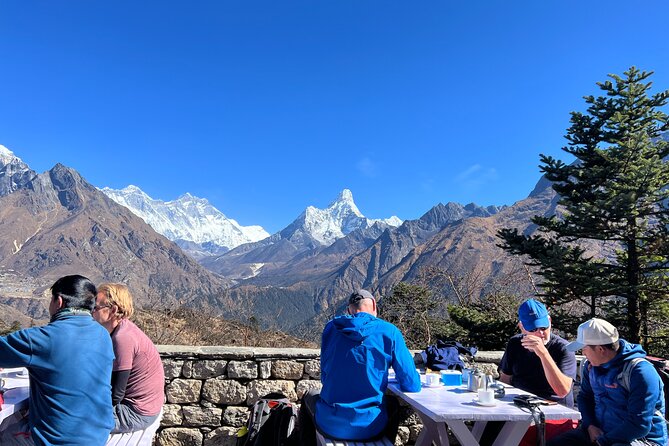
Kala Patthar is the key viewpoint of the route. From here, you get the broad Everest panorama that many people picture when they imagine the trek. The timing matters because mountain light is often best early, though the exact view depends on weather.
After Kala Patthar, you return toward Gorakshep and take a shared helicopter to Kathmandu. This is the itinerary’s clever shortcut. Instead of walking back through Lobuche, Dingboche, Tengboche, Namche, and Lukla, you trade several descent days for an aerial transfer.
The helicopter is a major convenience, but it is not guaranteed in every condition. Weather can stop or delay the flight, so ask the operator how a delay is handled and keep your schedule flexible. The package includes the helicopter from Gorakshep to Kathmandu, but the listing does not promise a private aircraft or a scenic flight reserved only for your group.
Breakfast and dinner are included on this day. Lunch is not listed, which makes sense if your flight timing changes, but confirm what happens during the transfer.
Back in Kathmandu, the final night includes a farewell dinner at an authentic Nepalese restaurant with cultural performance. It is a pleasant way to close a demanding trip, though your energy level after Kala Patthar and the flight may vary.
Day 11: Departure from Kathmandu
The final day is an airport departure with breakfast included. The activity ends back at the meeting point, Tribhuvan Airport.
Airport transfers are included at arrival, and the package says pickup and transfer services are provided. Confirm the final departure transfer with the company so you know the timing, especially if the helicopter schedule changes.
What the $3,500 price includes, and what it does not
The price makes the most sense for someone who wants a managed trek rather than a loose collection of bookings. Included items cover:
- Airport pickup and private hotel transfer
- Two nights in a three-star Kathmandu hotel with breakfast
- Tea-house or lodge accommodation during the trek
- Breakfast, lunch, and dinner during the trekking days
- TIMS permit and Khumbu Valley fees
- Domestic flight arrangements to Lukla
- Guide and porter support
- Duffle bag and company T-shirt
- Basic first-aid supplies
- Travel and rescue arrangements
- Shared helicopter flight from Gorakshep to Kathmandu
- Farewell dinner with cultural performance
You still need money for bottled water, coffee, tea, phone use, laundry, charging, hot showers, bar bills, extra porters, and tips. Travel and rescue insurance is not included, and it should be treated as essential for a high-altitude trek.
Tips for the guide and porter are also separate. Ask the operator for current guidance before you leave so you can budget fairly.
Who will enjoy this trek most
I would choose this trip if you want the classic Everest Base Camp route but do not want to spend several extra days retracing your steps. The helicopter return is particularly useful if your holiday window is tight or if long downhill days sound less appealing than the ascent.
It suits an active person with moderate fitness who accepts basic accommodation, early starts, and high-altitude discomfort. It is less suited to someone seeking luxury, a relaxed walking pace, or a fixed schedule that cannot tolerate weather delays.
The private-group format is another advantage. Only your group participates, which allows the guide to focus on your pace and needs. But private does not mean easy. The altitude remains the same, and a small group does not remove the need for insurance or preparation.
The published score is five out of five with a 100 percent recommendation rate from 12 reviews, although some displayed entries show no individual rating. The strongest praise centers on careful planning, safety, friendly service, and guides including Prakash Adhikari and Dikpal. That fits the package itself, which puts real weight on staff, permits, rescue arrangements, and porter support.
Should you book the Everest Base Camp helicopter return?
Book it if you want the full approach to Everest Base Camp and Kala Patthar, but prefer to save the long return walk. The itinerary has a sound acclimatization pattern, useful inclusions, and a private group setup. The company’s staff receive especially strong praise for organization, care, and encouragement.
Before booking, get clear answers about the Lukla flight route, helicopter weather delays, solo or odd-numbered group supplements, insurance requirements, and the exact guide assigned to you. If you accept the altitude, basic lodges, and weather risk, this is a practical way to experience Everest in 11 days without cutting out the most important walking stages.
FAQ
How long is the Everest Base Camp trek with helicopter return?
The experience lasts approximately 11 days, including arrival and departure days in Kathmandu.
Where does the trek begin?
The trip begins at Tribhuvan Airport in Kathmandu. You are transferred to your hotel before flying toward Lukla.
What time does the experience start?
The listed start time is 6:00 a.m.
What altitude does Kala Patthar reach?
Kala Patthar reaches 5,545 meters.
Is Everest Base Camp included?
Yes. The itinerary takes you from Lobuche to Everest Base Camp at 5,360 meters before continuing to Gorakshep.
Is the helicopter flight private?
No. The included flight from Gorakshep to Kathmandu is described as a shared helicopter.
Are meals included during the trek?
Yes. Breakfast, lunch, and dinner are included during the trekking days. Bottled water, coffee, and tea are not included.
Is accommodation included?
Yes. The package includes two nights in a three-star Kathmandu hotel with breakfast and lodge or tea-house accommodation during the trek.
Is a guide and porter included?
Yes. An experienced guide is included, along with one porter for every two clients.
What happens if bad weather cancels the experience?
If poor weather causes the experience to be canceled, you are offered a different date or a full refund. You can also cancel for a full refund if you do so at least 24 hours before the start time.
Latest treks added in Kathmandu
- Private Manaslu Circuit Trek at Himalayas★ 5.0 · 3 reviews
- Ghorepani Poonhill Trek★ 5.0 · 5 reviews
- Ghorepani Poon Hill Trek★ 5.0 · 16 reviews
- Upper Mustang Trekking★ 3.0 · 2 reviews
- Amazing 1 Day Trekking Experience in Kathmandu Nepal★ 5.0 · 24 reviews
- Upper Mustang Trekking★ 5.0 · 2 reviews
- Upper Mustang Trek★ 5.0 · 5 reviews
- Upper Mustang Trekking★ 5.0 · 4 reviews
Everest Base Camp Treks, compared.






Browse the lists this tour appears in