
REVIEW · KATHMANDU
Everest Gokyo Trek Multi Day Private Tour with Pickup
The big draw here is the route itself: you get Gokyo Valley and Everest Base Camp in one demanding Himalayan trek. Gokyo’s blue lakes, Ngozumpa Glacier, Cho La Pass, Everest Base Camp, and Kala Patthar give you several major rewards instead of one out-and-back trail.
I like the private format, which keeps the trek focused on your group, and I like the careful support built into the trip. Guide Phuri, assistant Porsu, and porters Diwa and Dilu are named as part of the guiding team, and the service includes planning meals ahead at tea houses. The main caution is that the published 14-day route ends at Pheriche, so you should confirm the return plan to Kathmandu before paying.
Key points to know
- Gokyo and Everest in one route: See Gokyo’s lakes, Ngozumpa Glacier, Everest Base Camp, and Kala Patthar.
- Cho La Pass is the hard day: The crossing reaches 5,320 meters and includes glacial moraine, steep trails, and an early start.
- Private guiding matters: Your group hikes together, with named guide Phuri, assistant Porsu, and porters Diwa and Dilu available for support.
- Kathmandu to Lukla takes extra time: You drive from Kathmandu to Manthali, sleep there, then fly by helicopter to Lukla.
- Tea-house trekking: Overnight stays are in lodges and tea houses, with menus that include vegetarian, vegan, and gluten-free choices at the same stated price.
- This is a serious high-altitude trip: You need moderate fitness, high-altitude medicine, aviation rescue coverage, and medical insurance.
Why the Gokyo route is worth the extra effort
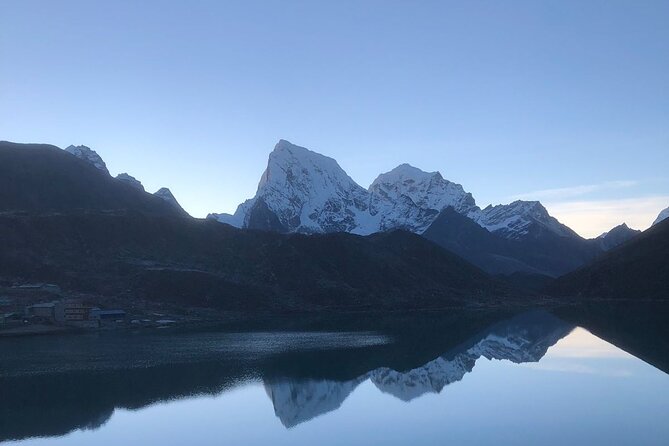
Many Everest-area treks focus on the standard route to Base Camp. This one adds the Gokyo Valley and Cho La Pass, so you see the Khumbu from a broader angle. The reward is variety: turquoise lakes, high passes, glacier views, Sherpa villages, and the famous Everest Base Camp approach.
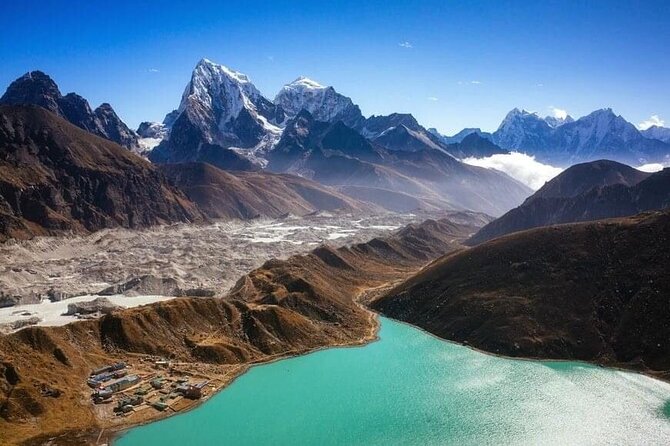
The high points are striking. From the Gokyo area, you can see peaks above 8,000 meters, including Everest, Lhotse, Makalu, and Cho Oyu. The route also includes Gokyo’s five lakes and the vast Ngozumpa Glacier, described as Nepal’s largest glacier.
That extra scenery comes with extra work. The itinerary includes several long hiking days, a peak ascent to Gokyo Ri at 5,414 meters, Cho La Pass at 5,320 meters, Everest Base Camp at 5,360 meters, and Kala Patthar at 5,545 meters. I would treat this as a serious trek, not a sightseeing holiday with a little walking added.
More Everest Base Camp Treks in Kathmandu
- Everest Base Camp Trek – 14 Days
★ 5.0 · 1,499 reviews - Everest Base Camp Trek
★ 5.0 · 842 reviews - Everest Base Camp Trekking
★ 5.0 · 485 reviews
Kathmandu begins with temples and preparation
Your first day includes pickup in Kathmandu and a visit to Pashupatinath Temple, one of the city’s most important Hindu sanctuaries. It is a useful first stop because it gives the trip a spiritual and cultural beginning before the high mountains take over.
The schedule also allows time to check trekking gear in Kathmandu, if you arrive early enough. Use that time well. A missing layer, poor footwear, or a weak sleeping bag is much harder to fix once you leave the city.
Day two includes Swayambhu, often called the Monkey Temple, followed by shopping and final preparation. In the afternoon, you drive about four to five hours by jeep or car to Manthali, also known as Ramechhap, and spend the night at a lodge.
This transfer is not glamorous, but it matters. Flights to Lukla now use Manthali in this itinerary, so you need to reach the smaller airport before the trek begins. The early start is listed as 6:15 a.m., and the schedule may require a very early morning departure from Kathmandu.
Lukla to Namche brings the first real climb
On day three, you fly from Manthali to Lukla by helicopter. The flight takes about 20 minutes. Lukla is the usual gateway for trekking in the Everest region, and from there you walk three to four hours to Phakding, at about 2,630 meters.
Phakding is a sensible first night because the walking day is relatively short. You begin beside the Dudh Koshi River and get your first taste of the trail without an immediate push to high altitude.
Day four is tougher. You walk from Phakding to Namche Bazaar, reaching about 3,450 meters after six to seven hours. The route follows the Dudh Koshi and gives you views of Thamserku and Kusum Kanguru, listed at about 6,500 meters.
Namche is more than a rest stop. It is a historic trading center and one of the most important villages in the Khumbu. You may find tea houses, shops, and a more active village setting here than on the smaller trail sections. The climb into Namche is a key test of your legs, so keep a steady pace and do not rush the final ascent.
Namche’s acclimatization day is not a day off
Day five is set aside for acclimatization, with a hike to the Everest View Hotel at roughly 3,800 meters. The walk takes about three to four hours and offers views of Everest, Lhotse, Ama Dablam, Thamserku, Khantega, and many other peaks.
This is one of the smartest parts of the schedule. You climb higher during the day, then sleep lower in Namche. That pattern helps your body adjust to altitude. I would not skip the hike just because you feel fine in the morning. Altitude problems can arrive later, and a steady acclimatization plan is worth more than saving a few hours.
The itinerary mentions Khumjung and its monastery, including the famous claim of a Yeti scalp, but the listed day centers on the Everest View Hotel. Ask your guide if there is time for a nearby cultural stop, but do not assume it is included.
More Trekking Tours in Kathmandu
- Annapurna Circuit Trek with Tilicho Lake
★ 5.0 · 368 reviews - Everest Base Camp Trekking – 13 Day
★ 5.0 · 365 reviews - Everest Base Camp Trek
★ 5.0 · 350 reviews - Everest Base Camp Trek -14 Days
★ 5.0 · 321 reviews
The trail turns toward Gokyo Valley
Day six takes you from Namche toward Phortse Tanga via Mong La Pass, reaching about 3,960 meters. The walk takes five to six hours. Mong La is a strong viewpoint and a natural place for a lunch stop, with broad views over the surrounding peaks and valleys.
The route then continues to Phortse Tanga, listed at about 3,600 meters. You may find the day easier on your lungs than a direct gain in elevation suggests, since the trail rises to the pass and then drops. Still, the up-and-down profile can be tiring.
The next two days require careful attention to the written schedule. Day seven describes a walk from Phortse Tanga to Dole, at about 4,032 meters, taking three to four hours. Day eight then describes a walk from Dole to Machhermo, at about 4,380 meters, taking six to seven hours.
The daily descriptions contain a few mixed place names, but the intended direction is clear: you move steadily north toward Gokyo. The trail passes through wooded areas where you might see musk deer, then opens into higher country with views toward Taboche Peak and Cholatse.
Machhermo is an important altitude stop. At around 4,380 meters, you are already well above the height where many people begin to feel the thin air. Keep meals simple, drink regularly, and tell your guide promptly if you develop a headache, unusual tiredness, dizziness, or breathing trouble.
Gokyo Lakes and Gokyo Ri deliver the visual reward
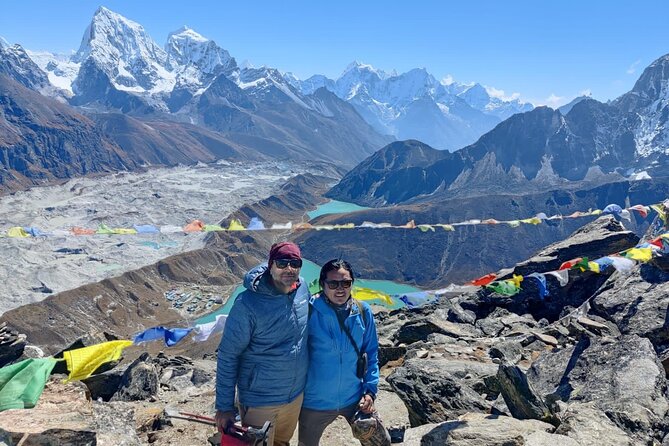
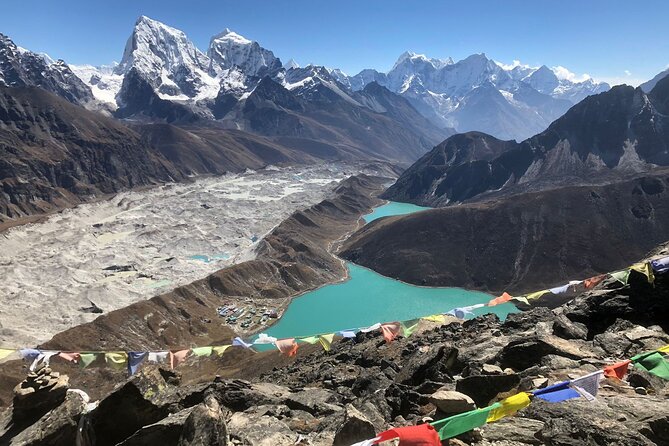
Day nine takes you from Machhermo to Gokyo, listed at about 4,750 meters. The walk takes six to seven hours and passes three of the beautiful Gokyo Lakes. The valley’s open water, snowy peaks, and glacier views make this one of the most memorable parts of the trek.
Gokyo is also the base for the climb to Gokyo Ri. On day ten, you rise early for the ascent to about 5,414 meters, return to the tea house for breakfast, and then walk on to Thagnak at about 4,695 meters.
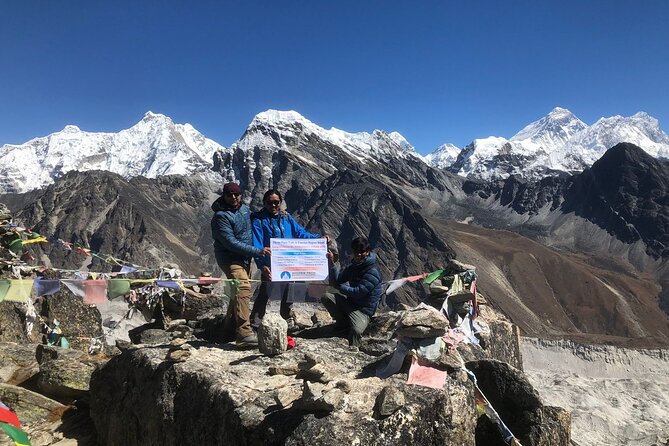
This is a demanding morning, but it is one of the best viewpoints on the route. The summit gives you a wide panorama of the Himalayan giants, including Everest, Lhotse, Makalu, and Cho Oyu. You also look across the Gokyo Valley and the Ngozumpa Glacier.
The walk from Gokyo to Thagnak takes four to five hours after the viewpoint climb. The trail crosses or follows the Ngozumpa Glacier, where footing can be uneven. The itinerary warns about rockfall and asks you to take care. This is a place to follow your guide closely rather than stop casually in exposed spots.
Cho La Pass is the trip’s hardest section
Day eleven begins very early, around 4:00 or 4:30 a.m., for the walk from Thagnak to Dzongla via Cho La Pass. The pass reaches about 5,320 meters, and the full day takes six to seven hours.
The early start is practical. You want to cross the high section before conditions worsen later in the day. The route includes steep and tricky trails, glacial moraine, and stretches where the surface can feel loose or uneven. The section before the pass is described as especially challenging.
You should expect a slow, careful day. The private setup helps here because the pace can be adjusted to your group, but private guiding does not make the pass easy. Strong fitness, patience, proper layers, and good boots matter more than speed.
After the pass, you continue to Dzongla at about 4,828 meters. The descent is not a simple finish, since you are still at high altitude. Plan to eat, drink, and rest as soon as you reach the tea house.
Dzongla and Lobuche bring you toward Base Camp
Day twelve takes you from Dzongla to Lobuche, at about 4,919 meters, in four to five hours. Along the way, you see Cholatse Lake, Ama Dablam, and Nuptse.
This section is shorter than the Cho La day, which is welcome. You are still hiking high, but the schedule gives your body a chance to recover before the Base Camp push. The route also brings you back toward the main Everest corridor.
The itinerary includes Khumjung Gompa in the day heading, but the walking description centers on Dzongla to Lobuche. Confirm with your guide if you want to know exactly where that cultural stop fits. The published route has a few such labeling inconsistencies, so a quick daily briefing will help.
Everest Base Camp and Kala Patthar
Day thirteen takes you from Lobuche to Gorak Shep, at about 5,160 meters, in roughly three hours. After lunch, you walk to Everest Base Camp at about 5,360 meters and return to Gorak Shep. The round trip from Gorak Shep to Base Camp is listed at about four to five hours.
Base Camp is a major goal, but it is not a summit viewpoint. You see the glacier and the expedition staging area, while the best broad view of Everest comes from Kala Patthar the next morning. That distinction helps set expectations.
Day fourteen begins around 4:30 or 5:00 a.m. with the climb to Kala Patthar, at about 5,545 meters. You return to Gorak Shep for breakfast, then continue to Pheriche.
Kala Patthar is the final major high point of the route and one of the best places for mountain views. The early start is designed for the light and the visibility, though conditions in the mountains can change quickly.
One important practical point: the supplied 14-day plan ends at Pheriche. It does not provide a day-by-day return to Lukla, Manthali, or Kathmandu. Ask Higher Path Treks and Expedition to confirm how many days and what extra cost are needed after Pheriche before you book flights home.
What the private service adds
A private trek is especially useful on a route with several high passes and changing daily conditions. Your group can discuss pace, rest, meal timing, and symptoms directly with the guide instead of trying to fit into a large group’s timetable.
The named team includes guide Phuri, assistant guide Porsu, and porters Diwa and Dilu. Their roles are important on a route where you may need help with navigation, altitude decisions, luggage, and tea-house arrangements.
The strongest service detail is the advance meal planning at tea houses. That can save time after a long day and is particularly useful if your group has different food needs. Vegetarian, vegan, and gluten-free choices are listed as available from tea-house menus at the same stated price.
Is $1,990 a fair price?
At $1,990 per person, this is not a budget walk. You are paying for a 14-day private arrangement with Kathmandu pickup, the Manthali transfer, helicopter flight to Lukla, guiding, porter support, tea-house accommodation, and a route that includes both Gokyo and Everest Base Camp.
The value depends heavily on what the price includes. Before booking, ask for a clear list covering meals, accommodation, porter baggage limits, airport transfers, permits, helicopter costs, and the return from Pheriche. The supplied information confirms several parts of the experience, but it does not spell out every inclusion.
I see the strongest value in the private support and the route design. If you tried to arrange the same high-altitude crossings independently, you would still need to manage flights, lodge bookings, guides, porters, altitude planning, and weather changes. The price may suit you if convenience and support matter more than finding the lowest possible fare.
Who should book this trek?
You should consider it if you want more than the standard Everest Base Camp route and have the fitness for repeated six-hour days at high altitude. The route suits hikers who care about mountain views, glacier terrain, Sherpa villages, and a private pace.
It is not a good match if you want a relaxed holiday, dislike early starts, or have no experience with long mountain days. The itinerary asks for moderate physical fitness, but the elevation makes this harder than that phrase may suggest.
You also need aviation rescue and medical insurance, plus high-altitude medicine. Those are not minor extras. Weather can affect the Lukla flight, helicopter timing, and mountain crossings, so build flexibility into your wider Nepal plans.
Cancellation is allowed for a full refund up to three full days before the local start time. Poor weather may lead to a different date or a full refund, but last-minute changes inside that three-day window are not accepted.
Should you book the Everest Gokyo Trek?
Book this trek if you want a demanding private route that combines Gokyo Ri, Cho La Pass, Everest Base Camp, and Kala Patthar in one mountain journey. The scenery is unusually varied, and the named support team gives the trip a more personal structure than a large group departure.
Before committing, get written confirmation of the return route after Pheriche and a complete list of inclusions. If that final logistics gap is resolved and you are ready for high-altitude walking, the $1,990 price can make sense for the level of support and the breadth of the route. If you prefer a simpler itinerary, the standard Everest Base Camp route may be the wiser choice.
FAQ
How long is the Everest Gokyo Trek Multi Day Private Tour?
The tour is described as approximately 14 days. The published hiking plan runs from arrival in Kathmandu through the walk to Pheriche on day 14.
Is pickup offered in Kathmandu?
Yes. Pickup is offered, and the listed start time is 6:15 a.m.
How do I reach Lukla on this itinerary?
You drive from Kathmandu to Manthali, also called Ramechhap, on day two. The next morning, you fly by helicopter from Manthali to Lukla, with the flight listed as taking about 20 minutes.
Does the trek include Everest Base Camp?
Yes. From Gorak Shep, you walk to Everest Base Camp at about 5,360 meters and return to Gorak Shep for the night.
Does the route include Gokyo Ri?
Yes. The itinerary includes an early morning hike from Gokyo to Gokyo Ri, reaching about 5,414 meters, before continuing toward Thagnak.
How high is Cho La Pass?
Cho La Pass reaches about 5,320 meters. The crossing starts early from Thagnak and includes challenging trails, glacial moraine, and high-altitude terrain.
Are vegetarian, vegan, and gluten-free meals available?
Yes. Tea houses have menus for vegetarian, vegan, and gluten-free diets, and the stated meal price is the same.
What insurance and medical preparation are required?
You need aviation rescue and medical insurance. You also need to provide high-altitude medicine.
Latest treks added in Kathmandu
- Private Manaslu Circuit Trek at Himalayas★ 5.0 · 3 reviews
- Ghorepani Poonhill Trek★ 5.0 · 5 reviews
- Ghorepani Poon Hill Trek★ 5.0 · 16 reviews
- Amazing 1 Day Trekking Experience in Kathmandu Nepal★ 5.0 · 24 reviews
- Upper Mustang Trekking★ 5.0 · 2 reviews
- Upper Mustang Trekking★ 3.0 · 2 reviews
- Upper Mustang Trek★ 5.0 · 5 reviews
- Upper Mustang Trekking★ 5.0 · 4 reviews
Everest Base Camp Treks, compared.






Browse the lists this tour appears in