
REVIEW · KATHMANDU
Everest Base Camp Trek
Everest Base Camp is not a quick mountain outing. It is a high-altitude walking journey through the Khumbu, beginning with a flight into Lukla and building slowly toward 5364 meters at Base Camp. You pass Sherpa villages, monasteries, suspension bridges, and open mountain country before reaching the foot of Everest.
I like two things here: the itinerary includes two acclimatization days, at Namche Bazaar and Dingboche, and the main logistics are bundled into one price. You get flights, permits, meals, lodge rooms, airport transfers, and a guide, which removes much of the trip planning.
The catch is that this remains a serious trek, not a sightseeing tour with a little walking. Lukla flights can be delayed for hours or canceled for days, and the trip price does not include travel insurance, porter service, personal expenses, or extra Kathmandu nights caused by delays.
Key points to know before booking
- The route reaches both Everest Base Camp and Kala Patthar: You get the base camp goal plus a higher viewpoint at 5554 meters.
- Two acclimatization days are built in: Namche and Dingboche provide planned pauses before the trail climbs higher.
- Lukla flights can disrupt the schedule: Keep spare days available and do not plan a tight international connection after the trek.
- The $1,380 price covers major trek costs: Flights, permits, meals, lodge accommodation, guide service, and airport transfers are included.
- Porter service is optional: Pack with that in mind, or arrange a porter separately and budget for the added cost.
- The trip is private and customizable: Only your own group takes part, and the trekking plan can be adjusted within practical safety limits.
What the $1,380 price really covers
At $1,380 per person, this trek is priced as a package rather than a bare guiding service. Your fee includes the Kathmandu to Lukla and Lukla to Kathmandu flights, departure taxes, twin-sharing lodge accommodation during the trek, full-board meals, guide service, Sagarmatha National Park permits, TIMS fees, airport transfers in a private vehicle, a first aid kit, government taxes, and office charges.
That list matters. Everest Base Camp planning involves permits, domestic flights, lodge reservations, meals, and mountain transport. Handling those pieces yourself can be stressful, especially when flights change. I see real value in having one local operator coordinate the moving parts.
Still, all-inclusive has limits here. Extra Kathmandu accommodation and meals caused by an early return or late departure are not included. Neither are phone calls, laundry, bar bills, battery charging, showers, bottled or boiled water, extra porters, travel insurance, rescue insurance, or tips.
The word private also deserves a close look. It means only your group participates, not that you receive a luxury mountain holiday. Lodge rooms are twin sharing, and the trail infrastructure is simple. Porters are listed as an option, so confirm before departure who carries your main bag and what weight you are expected to manage.
More Everest Base Camp Treks in Kathmandu
- Everest Base Camp Trek – 14 Days
★ 5.0 · 1,499 reviews - Everest Base Camp Trek
★ 5.0 · 842 reviews - Everest Base Camp Trekking
★ 5.0 · 485 reviews
Day 1: Lukla to Phakding begins with a flight gamble
Your first mountain day starts with the flight from Kathmandu to Lukla, followed by a trek to Phakding at about 2652 meters. The flight is short in distance but important in practical terms: Lukla is a mountain airstrip, and weather can stop operations even during the popular October and November seasons.
That means you should not treat Day 1 as fixed. Delays may happen in Kathmandu, in Lukla, or at both ends of the trek. The operator says it will seek the next available flight, but demand can create long queues lasting several days.
Once you reach Lukla, the walk to Phakding is a useful introduction rather than an immediate high-altitude test. You enter the Khumbu on foot, pass through local settlements, and spend the night at a modest lodge. The first day is short enough to ease you into the rhythm, though the flight uncertainty may make the start feel less tidy than the printed schedule suggests.
Day 2: Namche Bazaar and the first real climb
The trail continues to Namche Bazaar at about 3446 meters. This is the first major altitude jump, and the walking becomes more demanding as the route gains height.
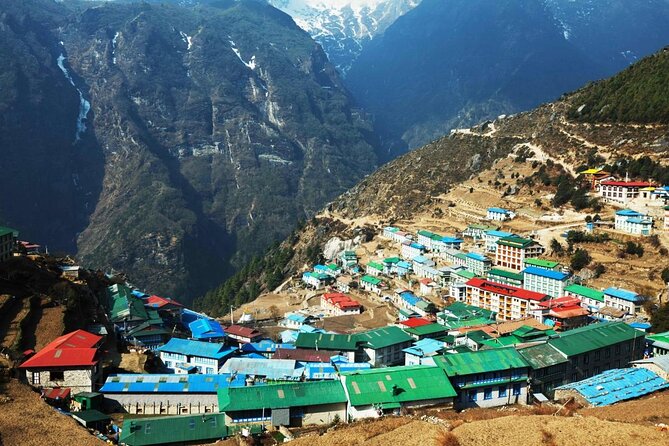
Namche is not just a sleeping stop. It is the main trading and service center of the Khumbu, and it gives you a chance to see how Sherpa communities support life and trekking in a high mountain region. Expect lodge accommodation and full-board meals, with personal purchases such as snacks, drinks, showers, charging, and phone use paid separately.
The key challenge is not simply distance. Your body is adjusting to thinner air, so pace matters more than speed. A good guide should keep the group moving at a sensible rate and watch for signs of altitude trouble.
Day 3: Acclimatization at 3446 meters
The schedule keeps you at Namche for a second night. This is one of the strongest features of the plan because it avoids a relentless upward march.
You may use the day to rest or take an acclimatization walk, but the supplied itinerary does not specify a particular excursion. Do not assume a fixed sightseeing program. The value is time at altitude, a slower pace, and a chance to check how your body is responding before the route climbs higher.
Several people who used Adventure Bound praised guides including Raji, Chakra, Santosh, and Raj for adjusting plans around physical condition and weather. That kind of flexibility is especially useful here. It does not remove altitude risk, but it can prevent the schedule from becoming more important than your health.
More Trekking Tours in Kathmandu
- Annapurna Circuit Trek with Tilicho Lake
★ 5.0 · 368 reviews - Everest Base Camp Trekking – 13 Day
★ 5.0 · 365 reviews - Everest Base Camp Trek
★ 5.0 · 350 reviews - Everest Base Camp Trek -14 Days
★ 5.0 · 321 reviews
Day 4: Tengboche brings monasteries and mountain views
From Namche, you trek to Tengboche at approximately 3820 meters. This section takes you farther into the protected Sagarmatha National Park, where the route passes through forested country and Sherpa settlements.
Tengboche is best known for its hilltop monastery, one of the cultural highlights of the route. The combination of Buddhist religious life, mountain scenery, and the steady walking trail gives this day more character than a simple transfer between lodges.
You should also expect the altitude to become more noticeable. The itinerary is not built around long rest stops every day, so an even pace and careful hydration matter. Full-board meals are included, but you should budget for extra water and personal supplies.
Day 5: Dingboche at 4,410 meters
The route then climbs to Dingboche, listed at 4410 meters. This is a major step toward the high point of the trek and another night when your guide should pay close attention to how you feel.
Dingboche is a settlement used by people heading toward Everest and other high peaks. It is also the second planned acclimatization stop, which gives the itinerary a sensible shape. You are not simply racing from Namche to Base Camp.
The walk can feel long and tiring, particularly for anyone new to multi-day trekking. The supplied information calls for a moderate fitness level, and that is a fair description. You do not need to be an expert mountaineer, but you do need to handle repeated days on foot at increasing altitude.
Day 6: A needed pause at Dingboche
The second acclimatization day is spent at Dingboche. This pause is valuable because the next nights are at Lobuche and Gorak Shep, both far higher than the main towns lower on the route.
The plan does not specify a mandatory side trip or exact activity for this day. Your guide may adapt the day to weather and the group’s condition. That flexibility was a repeated strength in accounts of guides such as Bibek, Fura, and Raji, who were praised for changing plans when needed and putting safety ahead of a rigid timetable.
You should use the day sensibly. Rest, eat, organize your layers, and ask the guide about the next two days. Personal preparation becomes more important as services become simpler and temperatures drop.
Day 7: Lobuche and the approach to the glacier country
Day 7 takes you to Lobuche at approximately 4930 meters. By now, the route has left the lower forest sections behind and feels much more exposed and high.
This is where the trek becomes a test of patience. You may walk slowly, take frequent breaks, and find that ordinary tasks require more effort. The reward is proximity to the high peaks and the knowledge that Everest Base Camp is close.
Accommodation remains twin-sharing lodge accommodation, but do not confuse included lodging with hotel comfort. Conditions at altitude are basic, and personal extras cost more. A sleeping bag and warm down jacket were supplied to some previous participants, but these items are not listed among the formal inclusions, so ask the operator directly before relying on them.
Day 8: Gorak Shep and Everest Base Camp
You trek to Gorak Shep at about 5140 meters, then continue to Everest Base Camp at approximately 5364 meters. This is the goal most people picture when they sign up, but it is also one of the hardest days because of the height and the accumulated fatigue.
Base Camp itself is a major milestone, though the famous summit view is not necessarily best from the camp. The route gives you access to the base of Everest and views toward several 8000-meter peaks. The achievement comes from reaching this remote point on foot, not from expecting a comfortable viewpoint or a long, relaxed visit.
The night at Gorak Shep is likely to feel stark compared with earlier stops. You are high, tired, and dependent on the guide’s judgment. If you feel unwell, say so clearly. A private group helps here because the guide can focus on your party rather than managing a large mixed group.
Day 9: Kala Patthar and the long return
The schedule calls for an early trek to Kala Patthar at 5554 meters, followed by a return to Pheriche at about 4243 meters. This is an excellent pairing: you reach Base Camp, then gain an even higher viewpoint before dropping back down.
Kala Patthar is often the visual high point of the trip because it offers broad views of Everest and the surrounding 8000-meter peaks. The price of that view is an early start and another demanding climb after the Base Camp day.
Returning to Pheriche is more than a change of scenery. Losing altitude helps after the high nights around Gorak Shep. It also begins the psychological shift from reaching the goal to getting safely back to Lukla.
Days 10 to 12: Retracing the trail to Kathmandu
The schedule then sends you back toward Namche, with the listed Day 10 elevation shown as 2840 meters, before continuing to Lukla on Day 11, also listed at 2840 meters. Those figures do not match the earlier Namche elevation of 3446 meters, so you should ask the operator to confirm the exact return-day stops and elevations before departure.
The return route is not merely dead time. You see familiar villages from a new direction, and the lower altitude can make walking feel easier. Still, tired knees and accumulated fatigue can make the descent surprisingly demanding.
Day 12 is the flight back to Kathmandu at about 1300 meters, followed by transfer to your hotel. Build in contingency time. A clear return flight is not guaranteed, and an extra Kathmandu night caused by weather or an early return is not covered by the package.
Guides, flexibility, and the human side of the trek
The strongest personal praise centers on guide service. Specific guides named in past accounts include Raji, Chakra, Santosh, Raj, Raman, Bibek, and Fura. Laxman Aryal is also identified as the company contact, and several people appreciated quick replies and help with planning.
The recurring practical theme is not grand speeches or polished extras. It is the guide’s ability to organize lodges and meals, solve problems, adjust the pace, and respond to changing weather or physical condition. One participant who could not complete the trek after a fall still described the guide as attentive, patient, and resourceful, which is a useful reminder that success should not be measured only by reaching Base Camp.
At the same time, guide quality can vary from one departure to another. Ask who will lead your group, how many people are in it, whether a porter is included, and what happens if the itinerary needs to change.
Weather delays, insurance, and the real risk
The biggest operational risk is the Kathmandu to Lukla flight. Delays and cancellations can happen in good trekking months, including October and November. Helicopter evacuation or charter flights may be possible, but the supplied estimate is about $3,000 per lift for up to five people, and bad weather can affect helicopters too.
You need travel and rescue insurance. Neither is included, and the trip provider specifically advises coverage. Check that your policy covers high-altitude trekking, medical treatment, evacuation, and weather-related disruption.
Keep contingency days at the end of the trip. If everything runs normally, you can use those days to explore Kathmandu or nearby destinations, but do not book a tight onward flight. The cancellation policy is strict: the experience is non-refundable and cannot be changed after booking.
Who should book this Everest trek?
I would recommend this trek to someone who wants the classic Everest route with a local guide and does not want to coordinate every permit, flight, lodge, and meal alone. It also suits a private group that values flexibility and direct guide attention.
It is less suitable if you need a fixed timetable, guaranteed flights, hotel-level comfort, or a low-risk holiday. The minimum age is eight, but age alone does not establish readiness. The stated requirement is moderate physical fitness, and altitude affects people differently.
Before paying, confirm the porter arrangement, the exact Kathmandu hotel nights included, the guide assigned to your group, and how delays are handled. Those questions will tell you more about the actual value than a glossy promise of an easy adventure.
Should you book the $1,380 Everest Base Camp trek?
I think the price is fair for the main inclusions: round-trip Lukla flights, meals, lodge accommodation, permits, airport transfers, and a private guide-supported route. The two acclimatization days and the addition of Kala Patthar make the schedule more sensible than a rushed Base Camp dash.
Book it if you can accept basic lodging, uncertain flight timing, extra personal costs, and the possibility of changing plans for safety. Skip it if your holiday dates cannot move or you are unwilling to purchase strong rescue insurance.
For the right walker, this is a well-supported way to reach Everest Base Camp without handing every logistical detail over to yourself. Just remember that the mountain gets the final vote.
FAQ
How long is the Everest Base Camp trek?
The experience lasts approximately 12 days, including the flights from Kathmandu to Lukla and back, the trek to Everest Base Camp, and the return to Kathmandu.
What is the highest point on the itinerary?
Kala Patthar is listed at 5554 meters. Everest Base Camp is listed at approximately 5364 meters.
Are flights between Kathmandu and Lukla included?
Yes. Round-trip flights between Kathmandu and Lukla, including departure taxes, are included.
Are meals included during the trek?
Yes. Breakfast, lunch, and dinner are included during the trekking portion.
Is accommodation included?
Twin-sharing lodge accommodation during the trek is included. Extra Kathmandu nights and meals caused by delays or an early return are not included.
Is a porter included?
No. Porter service is listed as an option, so you should confirm the arrangement and additional cost before departure.
Is the trek private?
Yes. This is a private activity, and only your own group participates.
What happens if the Lukla flight is delayed?
The operator will try to arrange the earliest available later flight, but delays may last hours or several days. Helicopter transport may be arranged at additional cost if conditions allow.
Do I need travel insurance?
Yes. Travel and rescue insurance are not included, and the provider advises arranging suitable coverage.
Can I cancel for a refund?
No. The experience is non-refundable and cannot be changed for any reason after booking.
Latest treks added in Kathmandu
- Private Manaslu Circuit Trek at Himalayas★ 5.0 · 3 reviews
- Ghorepani Poonhill Trek★ 5.0 · 5 reviews
- Ghorepani Poon Hill Trek★ 5.0 · 16 reviews
- Upper Mustang Trekking★ 3.0 · 2 reviews
- Amazing 1 Day Trekking Experience in Kathmandu Nepal★ 5.0 · 24 reviews
- Upper Mustang Trekking★ 5.0 · 2 reviews
- Upper Mustang Trek★ 5.0 · 5 reviews
- Upper Mustang Trekking★ 5.0 · 4 reviews
Everest Base Camp Treks, compared.






Browse the lists this tour appears in