
REVIEW · KATHMANDU
Private Multi Day Tour Everest Base Camp with Gokyo Lake Trek
The real prize here is the two-sided view of Khumbu: the classic route to Everest Base Camp, then the quieter Gokyo Valley with its turquoise glacial lakes. You also climb Kala Patthar and Gokyo Ri, giving you several strong mountain viewpoints rather than one quick look at Everest.
I like the careful altitude plan, with rest days at Namche and Dingboche, and I like the private format, since your group can set its own pace within the guide’s safety limits. The farewell gathering in Lukla, with local chang and Sherpa dancing, adds a human touch. The drawback is simple: this is a demanding high-altitude trek, and the long walking days, basic mountain lodging, and weather-sensitive flights require patience.
Key points at a glance
- Everest Base Camp and Gokyo Lakes in one trip: You see both of the Khumbu’s major trekking areas instead of choosing only one.
- Two acclimatization days: Namche and Dingboche include active rest walks to help your body adjust.
- Kala Patthar at 5,555 meters: This is one of the strongest viewpoints for Everest, Nuptse, Pumori, Lhotse, and nearby peaks.
- Private group format: Only your party takes part, with pickup and drop-off services included.
- Kathmandu culture at the end: Boudhanath, Pashupatinath, and Patan Durbar Square give the trip a cultural finish.
- Price and inclusions: The $3,000 price includes listed meals, entrance and monument fees, local and government fees, transport, and transfers, but not international or domestic airfare.
Why this route is more than a Base Camp walk
Many people picture Everest Base Camp as the whole point of a Nepal trek. It is certainly the headline stop, but the route feels more rewarding because it adds Gokyo Valley and two viewpoint climbs.
You begin in the busy Khumbu corridor, following the Dudh Koshi River through pine forest, suspension bridges, Sherpa villages, and Namche Bazaar. After the Everest Base Camp section, you cross toward Dragnag and Gokyo. The change is important. The trail becomes less about reaching a famous endpoint and more about lakes, glaciers, wide mountain views, and the quiet rhythm of high-altitude villages.
The private arrangement helps here. You are not tied to a large group’s pace, though you still need to follow the guide’s judgment. At high altitude, rushing is not a virtue. A slower group that eats, drinks, rests, and turns around when needed has a better chance of finishing well.
The company has earned praise for its pricing, dependable organization, and comfortable transport. Those are useful strengths in Nepal, where road and flight arrangements can shape the whole trip. Still, the supplied information does not name the guide or porter assigned to your group. I would ask for those details before paying, along with a clear list of what equipment and lodging are covered.
More Everest Base Camp Treks in Kathmandu
- Everest Base Camp Trek – 14 Days
★ 5.0 · 1,499 reviews - Everest Base Camp Trek
★ 5.0 · 842 reviews - Everest Base Camp Trekking
★ 5.0 · 485 reviews
Kathmandu to Lukla: the trip starts with logistics
Your airport representative meets you outside Tribhuvan International Airport with a Nepal Promote Treks & Expedition sign and takes you to your hotel by private tourist vehicle. On the first day, you receive a trek briefing and meet the trek leader or guide.
Bring your passport, three passport photographs, and a readable copy of your travel insurance policy to that meeting. It is a small but useful preparation step. This is also your best chance to ask about altitude, meals, weather delays, porter arrangements, and the walking pace.
The next morning begins with breakfast at about 7 a.m., followed by the flight from Kathmandu to Lukla. The tour includes pickup and drop-off services, but airfare is not included. The listed meeting time is 7:15 a.m. at Tribhuvan Airport, so confirm the exact flight plan with the operator.
From Lukla, you walk beside the Dudh Koshi toward Cheplung and Ghat, where lunch is planned, then continue to Phakding for the night. This first walking day lasts about six hours. It is a sensible introduction: the altitude is already noticeable, but the route is not yet one of the most punishing sections.
Flights to Lukla depend on good weather. If poor weather cancels the experience, the policy offers a different date or a full refund. Even with that protection, you should avoid scheduling an important international connection immediately after the trek.
Phakding to Namche Bazaar and the first acclimatization pause
From Phakding, the trail follows the Dudh Koshi through pine forest and several small settlements, including Benkar, Chumoa, and Monjo. Permits are checked along the way, and you cross the famous Tenzing-Hillary Bridge before the steep climb to Namche Bazaar.
This is a longer day, listed at about ten hours, so do not treat it as a casual walk. The suspension bridge, river crossings, and views of Thamserku give the day plenty of character, but the final rise into Namche tests your legs.
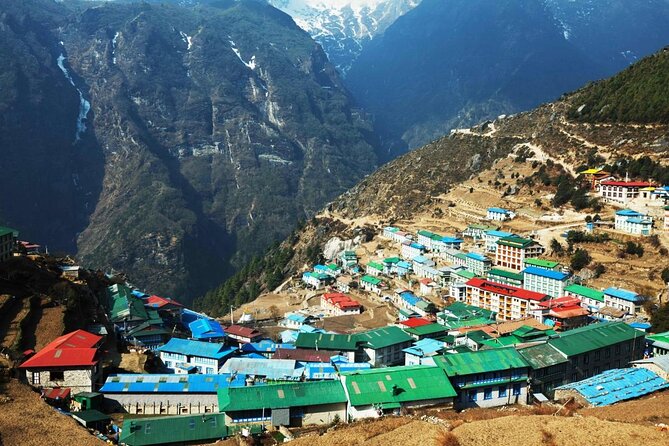
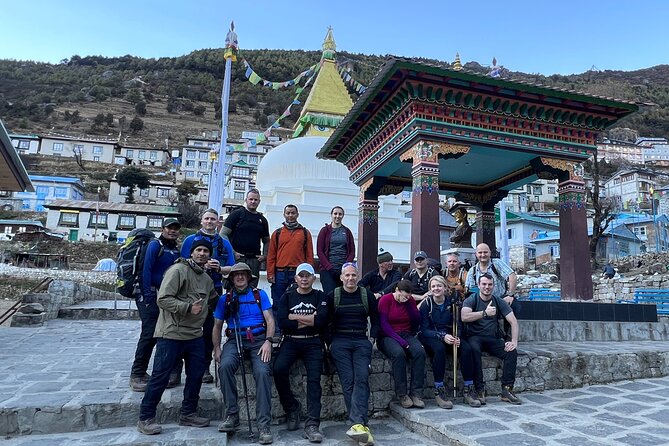
Namche is more than a supply stop. It is the main Sherpa trading center on this route, with markets, restaurants, and a chance to see how mountain communities connect with the trekking economy. Your acclimatization day includes an active walk toward Khumjung, at about 3,870 meters, plus time around Sagarmatha National Park.
I like this plan because you climb high and sleep lower, a common way to give your body time to adjust. You also get a better look at Sherpa life in Khumjung than you would from a quick pass through Namche. The day is listed as lasting around ten hours, but it is not a forward-moving day toward Base Camp. That distinction matters if you are counting your energy and expectations.
Tengboche and Dingboche: monasteries, mani stones, and mountain views
Leaving Namche, you climb toward Kyanjuma, descend to Phunki Tenga, and cross the Dudh Koshi again. The route then rises to Tengboche, home to one of the best-known monasteries in the Khumbu.
The itinerary highlights an overnight stay inside a Buddhist monastery temple. Confirm this point before departure, since mountain lodging arrangements can change and the description also refers to lodges elsewhere. Either way, Tengboche is a meaningful stop, with a strong connection to Tibetan Buddhist practice and fine views of the surrounding peaks.
The day is listed as 15 hours, which appears unusually long for the described route. Ask the operator to clarify the expected walking time. This is one of the few practical details I would want settled before booking.
The next day leads down to Debuche, across the Imja Khola, and uphill through Pangboche. Mani stones line parts of the trail, offering a reminder that this is a lived religious route, not just a mountain path. You finish in Dingboche, with views toward Lhotse, Island Peak, and Ama Dablam.
Dingboche includes another acclimatization day. Instead of continuing higher, you climb Nangkartshang Peak above the village. The effort gives you a close view of Ama Dablam, and the afternoon is free for rest or a walk around the village. This is exactly the sort of pause you want before the harder section ahead.
More Trekking Tours in Kathmandu
- Annapurna Circuit Trek with Tilicho Lake
★ 5.0 · 368 reviews - Everest Base Camp Trekking – 13 Day
★ 5.0 · 365 reviews - Everest Base Camp Trek
★ 5.0 · 350 reviews - Everest Base Camp Trek -14 Days
★ 5.0 · 321 reviews
Lobuche to Everest Base Camp and the best high-altitude days
From Dingboche, you continue along the lateral moraine of the Khumbu Glacier toward Lobuche. Stone memorials honor climbers who died on nearby peaks. This section can feel stark and emotional, and the altitude begins to affect your breathing.
The following day takes you toward Gorakshep and then onward to Everest Base Camp at about 5,364 or 5,365 meters. The figures vary slightly in the supplied details, but the message is the same: you are very high.
The route includes rocks, moraine, streams, and glacier terrain. Gorakshep is the last settlement in this part of Khumbu and serves as the stopping point for lunch before you continue. The walk to Base Camp is not a smooth path to a single scenic platform. Conditions underfoot can be uneven, and the famous Everest summit is not necessarily the clearest feature from Base Camp itself.
That is why Kala Patthar the next morning is so important. The climb reaches about 5,555 meters and is described as one of the hardest days, but the view rewards the effort. From the top, you look toward Everest, Nuptse, Pumori, Chagatse, and Lhotse.
The schedule lists the Kala Patthar start at 8 a.m. after a 7 a.m. breakfast. Many mountain itineraries use an earlier start for this viewpoint, so I would confirm the actual timing and expected walking conditions. Do not judge the climb by distance alone. At this height, every step costs more.
Dragnag and Gokyo Lakes: a different side of the Himalaya
After Kala Patthar, the route turns toward Dzongla and Dragnag. The supplied plan describes a stop around 4,830 meters, then a walk to Dragnag and across a high point near 4,700 meters before descending into Gokyo Valley.
The wording around Day 11 and Day 12 is not perfectly clear, so ask for the exact overnight locations. This section is important because you are moving between high settlements and crossing rough ground. Your guide should explain the route, expected hours, and contingency plan before you leave.
Gokyo is the visual change many people hope for. The valley contains six glacial lakes, regarded as sacred by Hindus and Buddhists. The lakes sit at different heights, with the highest listed at about 4,700 meters. Their clear water, glaciers, and surrounding peaks create a quieter scene than the Base Camp corridor.
The overnight stay is in a local lodge. Do not expect city comforts at this altitude. The reward is the setting and the chance to pause beside the lakes rather than simply pass through them.
The next day includes Gokyo Ri and continues to Phortse Thanga at about 3,680 meters. The route offers views toward Everest, Cho Oyu, Lhotse, and Gokyo Ri, along with forests, rivers, glaciers, villages, and contact with Sherpa communities.
This is a long day, listed at about ten hours. The descent helps, but tired legs can make downhill walking surprisingly hard. Take care on uneven surfaces and keep the pace steady.
Returning through Phakding and Lukla
From Phortse Thanga, the route drops toward the lower valleys and eventually Phakding. The itinerary refers to Phorchethanga and a campsite or stop around 2,800 meters, so confirm the exact overnight point.
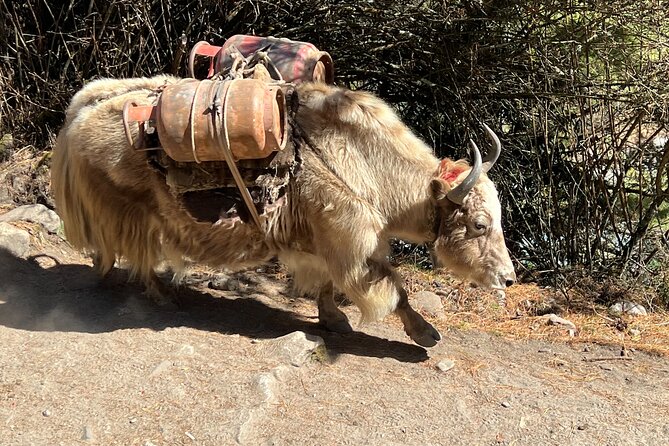
This part of the trip gives you a second look at the Dudh Koshi and the villages you may have passed quickly at the start. You might see traditional Sherpa homes, forest, rushing water, and yaks along the trail. The lower altitude should feel easier, but the journey still includes a demanding eight-hour day.
The last trekking day follows the river back toward Lukla. It is listed at about nine hours. In the evening, the group can celebrate with Sherpa guides and porters, share chang, and take part in traditional Sherpa dancing.
I like this farewell because it recognizes the people who make a trek possible. A private trip can otherwise feel focused only on your own achievement. Before drinking, remember that alcohol and altitude are a poor mix, so keep the celebration sensible.
Kathmandu’s final day of culture
After breakfast, you return to Kathmandu by flight, with the rest of the day free. The next day is devoted to Kathmandu Valley sights.
The schedule includes Boudhanath, one of Nepal’s largest Buddhist stupas, and Pashupatinath, a major Hindu shrine dedicated to Lord Shiva. You also visit Patan, or Lalitpur, and walk around Patan Durbar Square, with its Malla-era buildings and temples.
This final cultural day gives the trek a better frame. You are not only collecting mountain photographs. You are seeing the religious and architectural traditions that shape the region before and after the walk.
The final morning includes airport transfer around three hours before your scheduled flight. If your return flight is later, you may have time for last-minute shopping, but the schedule treats the trip as finished after breakfast.
What the $3,000 price really covers
At $3,000 per person, this is not a budget walk. The value depends on how much help you want with permits, transport, meals, local staff, and the complicated route between Everest Base Camp and Gokyo.
The listed inclusions cover entrance and monument fees, government and local fees, pickup and drop-off, an air-conditioned vehicle, 15 dinners, 15 lunches, and 17 breakfasts. Admission is specifically included for Everest Base Camp and Gokyo Ri. International and domestic airfare, travel insurance, and additional services are extra.
That last group matters. The Kathmandu to Lukla and Lukla to Kathmandu flights are domestic airfare, so budget for them separately. You also need insurance, and the operator asks for a copy of the policy at the pre-trip meeting.
The price looks most useful for people who want a private arrangement rather than a large group and who value having the route organized. It is less attractive if you already have Nepal transport, permits, and mountain logistics arranged independently.
Who should book this trek
You should consider this trip if you want the major Everest route plus Gokyo Lakes, have strong physical fitness, and can commit 18 days to Nepal. The private format suits couples, families with suitable fitness, or a group of friends who want one guide and one shared pace.
It is not a good match if you dislike long walking days, basic high-altitude lodging, uncertain flight schedules, or sudden itinerary changes. You should also be comfortable with cold, thin air and the possibility that weather affects flights or walking plans.
The operator has only a small number of published ratings, but the available praise focuses on good pricing, trustworthy service, and comfortable transport. That is encouraging, not proof that every detail will be perfect. Ask for the guide’s name, the porter arrangement, exact lodge standards, airfare cost, and clarification of the unusually long time estimates before you commit.
FAQ
How long does the trek last?
The full experience lasts approximately 18 days, including time in Kathmandu, the trek from Lukla, the return flight, and a Kathmandu Valley sightseeing day.
Where does the experience start?
It starts at Tribhuvan International Airport in Kathmandu, Nepal. The listed start time is 7:15 a.m.
Is airport pickup included?
Yes. Pickup and drop-off services are listed as included, with an airport representative meeting you outside the terminal.
Is this a private tour?
Yes. Only your group participates in the private tour or activity.
Is airfare included?
No. International and domestic airfare are not included. This includes the flights between Kathmandu and Lukla.
What meals are included?
The package lists 15 dinners, 15 lunches, and 17 breakfasts.
Is travel insurance included?
No. Travel insurance is not included. You are asked to bring a readable copy of your policy to the pre-trip briefing.
How fit do I need to be?
The tour states that participants should have a strong physical fitness level. The route includes long walking days and high-altitude sections up to about 5,555 meters.
What happens if bad weather cancels the trip?
If poor weather causes cancellation, you are offered a different date or a full refund.
Can I cancel for a refund?
You can receive a full refund if you cancel at least six full days before the experience starts. Cancellation two to six full days before the start can receive a 50 percent refund, while cancellation less than two full days before the start is not refunded.
Should you book it?
I would book this trek if you want the full Khumbu story: Sherpa villages, Tengboche, Everest Base Camp, Kala Patthar, Gokyo Lakes, Gokyo Ri, and Kathmandu’s major religious sites. The route is ambitious, but the two acclimatization days and private format give it a sensible structure.
Before booking, settle the unclear timing around Tengboche, Dragnag, and the days listed at 15 or 16 hours. Confirm airfare, guide and porter names, lodging, and the exact inclusions. If you are prepared for high altitude and you value having the major logistics handled, the $3,000 price can make sense for a private 18-day experience.
Latest treks added in Kathmandu
- Private Manaslu Circuit Trek at Himalayas★ 5.0 · 3 reviews
- Ghorepani Poonhill Trek★ 5.0 · 5 reviews
- Ghorepani Poon Hill Trek★ 5.0 · 16 reviews
- Upper Mustang Trekking★ 3.0 · 2 reviews
- Amazing 1 Day Trekking Experience in Kathmandu Nepal★ 5.0 · 24 reviews
- Upper Mustang Trekking★ 5.0 · 2 reviews
- Upper Mustang Trekking★ 5.0 · 4 reviews
- Upper Mustang Trek★ 5.0 · 5 reviews
Everest Base Camp Treks, compared.






Browse the lists this tour appears in