
REVIEW · KATHMANDU
Everest Base Camp Trekking
Everest Base Camp is not a quick mountain photo stop. It is a two-week walking journey from Kathmandu through Sherpa villages, Buddhist monasteries, suspension bridges, and thin air. You reach Everest Base Camp at 5,380 meters, then climb higher to Kala Patthar for the clearest views of Everest, Lhotse, Makalu, and Cho Oyu.
I like the sensible acclimatization day at Namche Bazaar, where you hike higher and sleep lower. I also like that the $1,700 price covers the big moving parts: Lukla flights, permits, guides, porters, meals, lodging, airport transfers, and Kathmandu hotel nights.
The catch is simple: this is a demanding trek, not a sightseeing tour with a little walking added. You should expect five to six hours on foot most days, basic tea houses, shared rooms when needed, cold conditions, and a real risk of altitude sickness. Lukla flights can also be delayed by weather.
Key points to know before booking
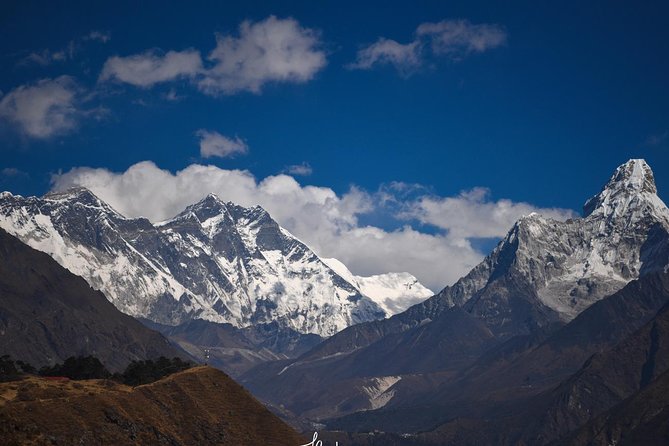
- Kala Patthar is the visual high point: At 5,545 meters, it gives you the broad mountain view that Everest Base Camp itself cannot.
- The trek uses a careful altitude pattern: A full acclimatization day in Namche and a gradual climb help your body adjust.
- Lukla flights are included: The package covers the Kathmandu to Lukla and Lukla to Kathmandu flights, but weather can still disrupt the schedule.
- Tea-house life is part of the experience: Rooms may be single, double, triple, or twin sharing, and private attached bathrooms are not guaranteed.
- Sherpa culture is woven into the route: You pass monasteries, Mani walls, schools, memorials, and traditional highland villages.
- The $1,700 cost is fairly broad: It includes permits, food, accommodation, staff costs, flights, and airport service, while drinks and personal expenses remain yours.
Why this 14-day route works
The classic Everest Base Camp route is popular for good reason. It gives you time to reach high altitude without rushing every day, and it includes two major goals: Everest Base Camp and Kala Patthar.
The route begins and ends in Kathmandu, but the real walking starts at Lukla. From there, you follow the Dudh Koshi River toward Phakding, Namche Bazaar, Tengboche, Dingboche, Lobuche, Gorakshep, and the base camp. You return by the same broad route, with a different view of the villages and peaks on the way down.
I would describe the physical level as moderate to strenuous. The company asks you to be able to walk five to six hours per day. High mountaineering skills are not needed, but earlier trekking experience helps. Jogging, cycling, swimming, or other regular exercise before the trip will make the long climbs and descents more manageable.
The highest risk is not technical climbing. It is altitude. You can be strong and still feel sick above 5,000 meters. The practical answer is to walk slowly, drink regularly, follow your guide’s advice, and take symptoms seriously.
More Everest Base Camp Treks in Kathmandu
- Everest Base Camp Trek – 14 Days
★ 5.0 · 1,499 reviews - Everest Base Camp Trek
★ 5.0 · 842 reviews - Everest Base Camp Trekking
★ 5.0 · 485 reviews
Kathmandu arrival and preparation
Your first day begins with airport pickup at Tribhuvan International Airport. A representative meets you outside the terminal, takes you to a three-star hotel in central Kathmandu, and helps with check-in.
You have time to rest or visit the Nepal Guide Treks office for trip information. A welcome dinner gives you an easy first evening before the early flight to Lukla.
Kathmandu accommodation is provided on a bed and breakfast basis. The package includes airport transfers, the hotel, and the welcome and farewell dinners, but personal spending in the city is not included. If you want a better hotel than the included three-star option, upgrades can be arranged for an added cost.
Lukla to Phakding: a gentle first taste of the Khumbu
Day two starts with an early flight from Kathmandu to Lukla, the gateway to the Everest region. The flight is part of the package, but do not build a tight international connection around it. Mountain weather can delay departures, and one company response specifically advises allowing an extra day or two when possible.
After landing, you start walking beside the Dudh Koshi River. The route passes Mani walls, which are stone walls carved with Buddhist prayers, before reaching Ghat and then Phakding.
This is a useful first day because the trail includes both uphill and downhill walking without taking you immediately to extreme altitude. You get your first taste of the route’s rhythm: walk during the day, eat at a tea house, and sleep in a simple lodge.
Phakding to Namche Bazaar
From Phakding, the route crosses small streams and climbs toward Bengar. You enter Sagarmatha National Park and complete the required registration before the steady ascent to Namche Bazaar.
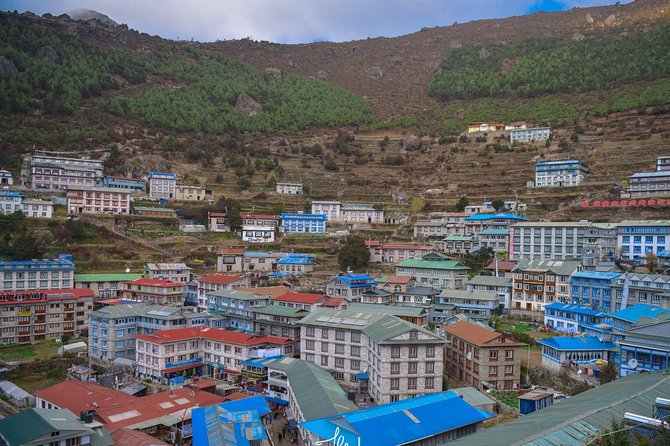
Namche is the Sherpa capital and one of the most memorable settlements on the route. It is a place to pause, look around, and adjust to the increasing altitude. The approach is not a flat stroll. You get repeated climbs and descents, with the final push into Namche testing your legs.
The national park section is also where the natural setting becomes more pronounced. The route passes through forest, river valleys, and high mountain country where you may see the changing flora and fauna of Sagarmatha National Park.
More Trekking Tours in Kathmandu
- Annapurna Circuit Trek with Tilicho Lake
★ 5.0 · 368 reviews - Everest Base Camp Trekking – 13 Day
★ 5.0 · 365 reviews - Everest Base Camp Trek
★ 5.0 · 350 reviews - Everest Base Camp Trek -14 Days
★ 5.0 · 321 reviews
Namche acclimatization and the Khumjung visit
Day four is not a lazy hotel day. You hike to a higher point and return to Namche to sleep at a lower elevation. This high walk, low sleep pattern gives your body a better chance to adjust.
The route climbs roughly 300 meters to Khumjung, where you visit local monasteries and schools. This is one of the better cultural parts of the trip because it takes you beyond mountain photography and into the daily life of the Sherpa community.
Namche is also an important checkpoint. Pay attention to how you feel here. Headaches and tiredness can happen, but worsening symptoms should never be brushed aside simply because the group has a schedule.
Mongla Pass and Tengboche monastery
After Namche, the trail reaches Mongla Pass at about 3,975 meters before continuing toward Tengboche. The pass brings wide views of the surrounding peaks, while Tengboche is home to the largest monastery in the region.
This day mixes scenery with culture in a satisfying way. The monastery is not just a photo stop. It helps explain the Buddhist traditions that shape the villages, prayer walls, and daily life along the trail.
The route also begins to feel more remote and more demanding. You are higher, the air is thinner, and the climbs require a slower pace. That is exactly where a good guide matters. The company has used guides named Krishna, Sonam Sherpa, Dandi Sherpa, and Pradip on different trips. Your assigned guide may differ, so confirm that before booking if a particular person matters to you.
Tengboche to Dingboche through alpine forest
The trail from Tengboche passes through alpine forest and small villages before following the Khumbila Khola Valley. As you climb toward Dingboche, the views open toward Nuptse, Cholatse, and other major peaks.
This section is valuable because the route changes character. Earlier days have more forest and river scenery. Here, the trees thin out and the open mountain setting becomes the main event.
Dingboche is a crucial stop before the final high-altitude push. The supplied schedule does not list a separate rest day here, so the steady pace becomes especially important. Do not treat a strong performance at lower altitude as proof that you can rush this section.
Dingboche to Lobuche and the climbers’ memorials
The route toward Lobuche climbs beside the steep terminal moraine left by the Khumbu Glacier. A moraine is a ridge of rock and debris carried and deposited by a glacier. The footing and slope can make this a tiring day.
Near the top, you pass memorials to climbers who died attempting Everest. This is a quiet and sobering part of the trek. The mountain is beautiful, but it is not harmless, and these memorials make that clear.
Lobuche is a practical overnight stop before the base camp push. Accommodation is in available tea houses, and the room may be private or shared depending on capacity and the number of people in your group. Attached bathrooms are not guaranteed, so you may use a public toilet outside your room.
The long day to Everest Base Camp
Day eight is the main goal. You leave early for Gorakshep, following the route alongside the Khumbu Glacier. The trail becomes tougher as you approach Gorakshep, and the final walk to base camp follows the lateral moraine of the glacier.
Everest Base Camp sits at 5,380 meters. You can expect a rocky, high-altitude route rather than a polished viewpoint or a permanent mountaineering camp open to casual visitors. The Khumbu Icefall is visible from the area, adding scale and drama to the setting.
A point many first-time trekkers miss is that Everest is not clearly visible from base camp because Lhotse blocks the view. That is why the next morning’s Kala Patthar climb matters so much.
You return to Gorakshep for the night. This is a long and tiring day, and the slow pace is not optional. You are high, the air is thin, and every step costs more effort.
Kala Patthar at 5,545 meters
The next morning brings the trek’s highest point, Kala Patthar at 5,545 meters. This is the best viewpoint on the route for the classic Everest panorama.
From the top, you can see Everest at 8,848 meters, Lhotse at 8,516 meters, Makalu at 8,481 meters, and Cho Oyu at 8,201 meters, along with many other snow-covered peaks.
The climb is not technical mountaineering, but it is physically serious because of the altitude. The reward is a broad view that base camp itself cannot provide. After the summit walk, you descend to Pheriche.
This is also where a practical tip matters: prepare your legs for downhill walking. One past participant specifically advised strengthening the hamstrings before the trek for knee comfort on descents. That is good advice. Going down can punish your knees more than going up.
The return through Tengboche and Namche
From Pheriche, you head down to Pangboche and cross the Imja Khola before climbing back to Tengboche. The descent is easier on your breathing, but it still includes steep sections and bridge crossings.
The following day brings a steep descent from Tengboche to the Dudh Koshi River. You cross a suspension bridge, pass Phunki Tenga, Tashinga, and Sansa, then return to Namche Bazaar for the night.
You may enjoy Namche more on the way back because the pressure of the high-altitude goal is gone. It is a good place to appreciate the villages, mountain trade routes, and Sherpa culture that you may have passed too quickly on the way up.
Namche to Lukla and the flight back
The final walking day runs from Namche to Lukla through forest and a series of short ups and downs. The trail crosses the Bhote Koshi River three times, followed by a final uphill section of about 45 minutes into Lukla.
It is not a free downhill finish. Your legs will already be tired, and the last climb can feel surprisingly sharp. Still, reaching Lukla gives you a clear sense that the walking portion is done.
The next morning, you fly back to Kathmandu. After hotel transfer, you can rest or walk through Thamel. The farewell dinner marks the end of the trek, and airport drop-off is arranged for your international departure. You should arrive at the airport three hours before your flight.
What the $1,700 price really covers
At $1,700 per person, the package has solid value if you want a guided, organized trek rather than arranging every detail yourself. The cost includes:
- Experienced guide and the required number of porters
- Breakfast in Kathmandu
- Breakfast, lunch, and dinner during the trek
- Tea-house accommodation during the walking days
- Three-star hotel accommodation in Kathmandu
- Trekking permits, government taxes, and paperwork
- Kathmandu to Lukla and Lukla to Kathmandu flights
- Airport pickup and drop-off
- Staff food, lodging, salary, and insurance
- First-aid kits
- Welcome and farewell dinners
You still pay for personal expenses, alcoholic drinks, and other beverages. Plan for extra spending beyond the headline price, especially if you want snacks, drinks, upgrades, or personal items along the route.
The group limit is 15 people. That is large enough to provide company but small enough for a guide to keep track of the group more easily than on a big coach-style trip. Room arrangements can be single, double, triple, or twin sharing. If the tea house is full, you may share with another person.
Food, lodging, and daily comfort
During the trek, all three meals are included. Breakfast and dinner are served at the tea house where you sleep, while lunch is eaten along the route at the next stop or at a lodge on the way.
The menu is described as offering food from around the world, but this is still mountain lodging. Expect practical, filling meals rather than restaurant-level choice. Tea houses are a major part of the experience, and their simple shared spaces give you time to meet other people walking the same route.
Comfort becomes more basic as you go higher. Attached bathrooms may not be available, and public toilets may be required. Twin sharing may also replace a private room. If you need hotel comfort every night, this is the wrong trip. If you can accept basic facilities in exchange for access to the high Himalaya, the arrangement is sensible.
Best months and weather concerns
The preferred seasons are spring, from March through May, and autumn, from September through November. Clear weather during these months gives you the best chance of seeing the major peaks.
December through February can suit people who want a less crowded route, but the cold will be more serious and mountain conditions can change quickly. June through August is monsoon season, with rain affecting the route and flight conditions.
The Lukla flight is one of the trip’s weak points because weather can interrupt it. A January departure in particular may face delays, and the company has adjusted schedules when flights were held up. Build flexibility into your wider Nepal plans.
Should you book this Everest Base Camp trek?
Book it if you want a structured 14-day route with guides, porters, meals, permits, flights, and airport transfers arranged in one package. It is especially suitable if you value Sherpa villages, monasteries, glacier views, and the satisfaction of reaching both base camp and Kala Patthar.
Think twice if you dislike basic lodging, shared bathrooms, long walking days, or uncertain flight schedules. You also need enough fitness for five to six hours of walking and the discipline to move slowly at altitude.
For most properly prepared hikers, the strongest parts are the careful Namche acclimatization day, the cultural stops at Khumjung and Tengboche, and the Kala Patthar panorama. Confirm your guide, room arrangement, Kathmandu hotel level, and contingency plan for Lukla delays before paying. If those details suit you, the $1,700 package offers a practical way to tackle one of the world’s great mountain treks without managing every permit and flight yourself.
FAQ
How long is the Everest Base Camp trek?
The experience lasts approximately 14 days, including airport arrival and departure, Kathmandu hotel nights, Lukla flights, the trek, and the farewell dinner.
Where does the trek start?
The organized trip starts at Tribhuvan International Airport in Kathmandu, Nepal. Airport pickup is provided.
What time is the listed meeting time?
The listed start time is 9:45 am at Tribhuvan International Airport in Kathmandu.
How high is Everest Base Camp?
Everest Base Camp is listed at 5,380 meters above sea level.
How high is Kala Patthar?
Kala Patthar reaches 5,545 meters and is the highest point of this trek.
Are flights between Kathmandu and Lukla included?
Yes. The package includes the Kathmandu to Lukla and Lukla to Kathmandu flights.
Are meals included?
Yes. Breakfast, lunch, and dinner are included during the trek. Kathmandu accommodation is provided with breakfast, and welcome and farewell dinners are included.
What type of accommodation is provided?
Kathmandu accommodation is in a three-star hotel unless you arrange an upgrade. During the trek, you stay in available tea-house lodges. Room arrangements may be single, double, triple, or twin sharing.
Do the tea houses have private attached bathrooms?
Private attached bathrooms are not guaranteed. You may need to use public toilets outside your room.
Is previous trekking experience required?
Previous trekking experience is helpful but not required. High mountaineering skills are not needed, but you should have moderate fitness and be able to walk five to six hours per day.
What is the best time to go?
The preferred months are March, April, May, September, October, and November. December through February can be quieter, while June through August is affected by monsoon rain.
What is not included in the $1,700 price?
Personal expenses, alcoholic drinks, and other beverages are not included.
Latest treks added in Kathmandu
- Private Manaslu Circuit Trek at Himalayas★ 5.0 · 3 reviews
- Ghorepani Poonhill Trek★ 5.0 · 5 reviews
- Ghorepani Poon Hill Trek★ 5.0 · 16 reviews
- Upper Mustang Trekking★ 3.0 · 2 reviews
- Amazing 1 Day Trekking Experience in Kathmandu Nepal★ 5.0 · 24 reviews
- Upper Mustang Trekking★ 5.0 · 2 reviews
- Upper Mustang Trek★ 5.0 · 5 reviews
- Upper Mustang Trekking★ 5.0 · 4 reviews
Everest Base Camp Treks, compared.






Browse the lists this tour appears in