
REVIEW · KATHMANDU
Annapurna Base Camp Trek
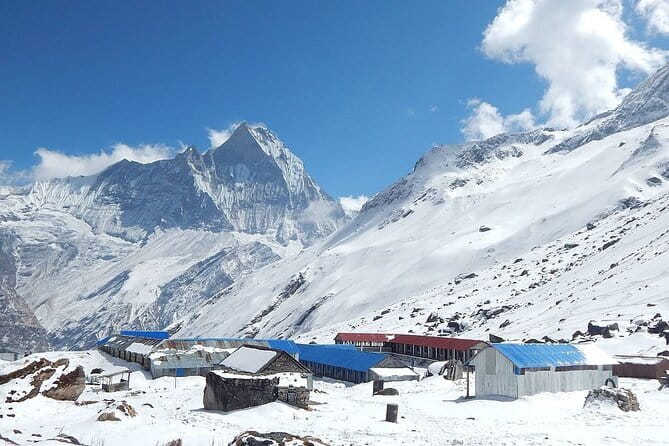
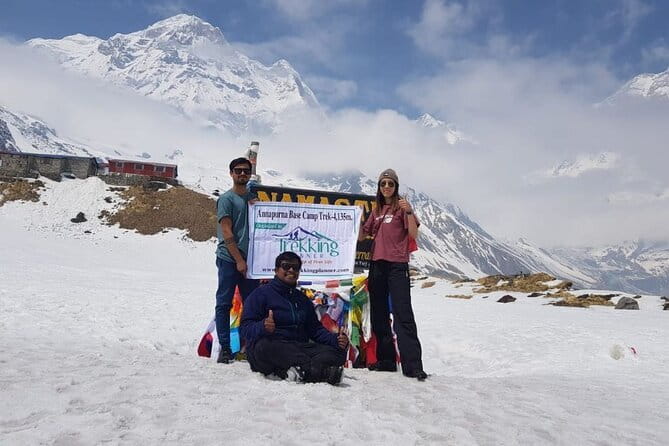
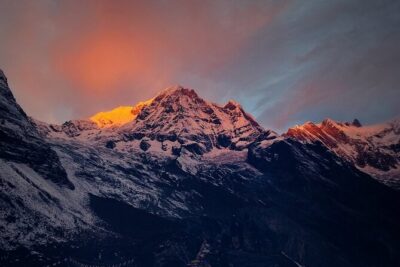
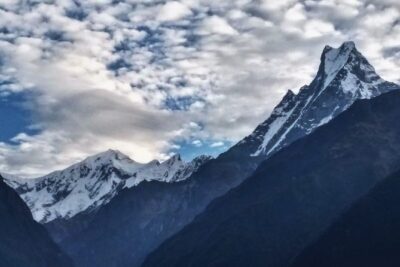
The reward here is a front-row mountain setting at 4,130 meters, where Annapurna I, Annapurna South, Machhapuchhare, and Hiunchuli ring the base camp. The route also gives you villages, suspension bridges, rhododendron woods, early-morning Poon Hill, and a soak in Jhinu’s hot springs.
I like two things right away: the route has a satisfying build from easy foothill walking to the high sanctuary, and the company handles the hard logistics, including permits, transport, meals, guides, and porters. The main catch is the long stair-heavy days, especially around Ulleri, Chhomrong, and the final approach to base camp.
Key details that shape this Annapurna trek
- The highest point is Annapurna Base Camp at 4,130 meters, surrounded by some of Nepal’s most dramatic peaks.
- Poon Hill adds a sunrise viewpoint at 3,210 meters before the route turns toward the Annapurna Sanctuary.
- The route mixes mountain culture and nature, passing Magar and Gurung villages, forests, waterfalls, and teahouses.
- A licensed English-speaking guide and one porter for every two clients are included, with a maximum group size of 15.
- The $1,350 price covers most major trek costs, including hotels, guesthouses, meals on trek, permits, and Kathmandu to Pokhara transport.
- The trek finishes with Jhinu hot springs and Phewa Lake boating, giving you a gentler ending after the high-country walking.
What the 13-day route really feels like
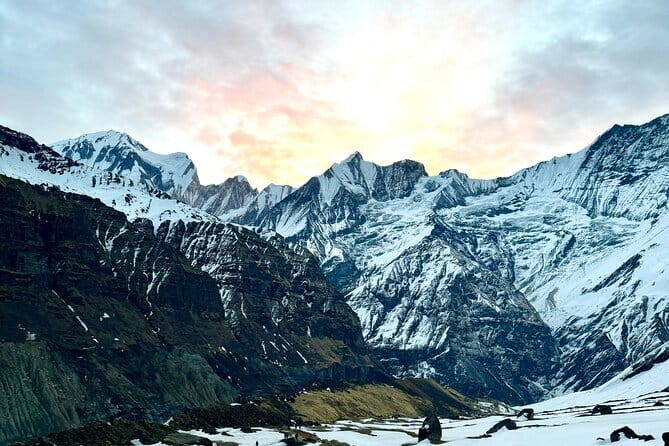
This is not a quick walk to a viewpoint. It is a full mountain journey with a gradual change in scenery and effort. You begin in Kathmandu, shift to the calmer lakeside city of Pokhara, then walk through lower valleys before entering the high Annapurna Sanctuary.
The route reaches its highest point on Day 8, then retraces much of the trail. That out-and-back shape is practical: it lets you see the mountains from changing angles and avoids a difficult high pass. It also means the return days can feel familiar, especially after the excitement of base camp.
You should expect roughly a moderate physical challenge, not a technical climb. There is no stated climbing requirement, but the itinerary includes steep ascents, steep descents, high altitude, and long days on stone steps. Several published accounts describe the walking as demanding but manageable, with one estimate of about 100 kilometers total and roughly 6,500 meters of accumulated elevation gain.
More Annapurna Treks in Kathmandu
- Annapurna Circuit Trek with Tilicho Lake
★ 5.0 · 368 reviews - Annapurna base camp trek 5 Days
★ 5.0 · 252 reviews - 14-Day Private Annapurna Base Camp Trek
★ 5.0 · 180 reviews
Kathmandu arrival and the move to Pokhara
Your trip begins at Tribhuvan International Airport, where an Ace the Himalaya representative meets you with a sign and takes you to your hotel by private vehicle. A pre-trip meeting takes place on the first or second day, and you need your passport, three passport photos, and a readable travel insurance copy.
That meeting is useful for more than paperwork. It is your chance to meet the trekking leader, settle any balance, sign the trip forms, and ask final questions about the route and equipment. Bring proof that your insurance covers emergency high-altitude rescue and evacuation. That coverage is not included in the tour price.
On Day 2, you leave early for the tourist bus station. The bus to Pokhara departs around 7:30 a.m. and the journey takes most of the day. Pokhara is a good reset after Kathmandu. It sits beside Phewa Lake and offers broad views toward Annapurna, Machhapuchhare, Dhaulagiri, Lamjung Himal, and Manaslu when conditions are clear.
The bus is included, but you should not expect a fast transfer. A long road day can be tiring, yet it also keeps the package cost lower than using private transport or a flight. You spend two nights in a three-star hotel in Pokhara, giving you time to rest before and after the trek.
Tikhedhunga and the first taste of trail life
The walking begins after a private vehicle takes you from Pokhara to Nayapul. From there, you walk beside the Modi Khola and reach Birethanti, a busy village with shops and teahouses.
The trail follows the Bhurungdi Khola toward Hille and Tikhedhunga. At about 1,570 meters, Tikhedhunga is a sensible first night because the walking is short and relatively easy. You get a gentle introduction to the rhythm of the trek: walk, pause, eat, and settle into a simple mountain guesthouse.
This day is valuable because it does not ask too much too soon. You can check your boots, adjust your pack, and learn how your guide organizes the pace before the harder climbs begin.
Ulleri and Ghorepani: the first serious climb
Day 4 brings the famous climb to Ulleri, a large Magar village at about 2,070 meters. This section is known for its many stone steps, and you should take the warning seriously. Several accounts offer the same practical advice: train on stairs and pack lightly because porters carry the load.
After Ulleri, the trail becomes more gradual as it passes through oak and rhododendron forest toward Banthanti and Nangethanti. Ghorepani sits at about 2,840 meters and is one of the best-known stopping points in the region.
The forest is a major part of the appeal here. In the right season, rhododendrons add color to the route, while the rising altitude begins to change the feel of the walk. Ghorepani is also your launch point for Poon Hill, so an early night matters.
Another trail to compare in Kathmandu:
- Everest Base Camp Trek – 14 Days
★ 5.0 · 1,499 reviews - Everest Base Camp Trek
★ 5.0 · 842 reviews - Everest Base Camp Trekking
★ 5.0 · 485 reviews - Everest Base Camp Trekking – 13 Day
★ 5.0 · 365 reviews
Poon Hill sunrise and the turn toward Tadapani
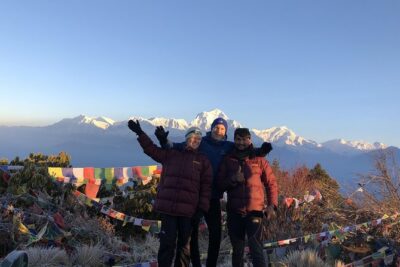
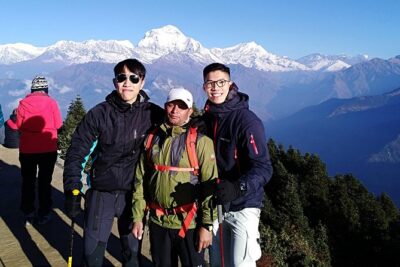
You start before dawn for the one-hour climb to Poon Hill at 3,210 meters. The viewpoint is the main reason for the early alarm. From the ridge, you look toward the high Himalayan range as the sun rises, then return to Ghorepani for breakfast.
This is one of the most rewarding additions to the itinerary because you get a major mountain panorama before reaching base camp. It also gives you a clear sense of scale. The peaks are not distant scenery for long. Over the next few days, you walk deeper into them.
After breakfast, the trail follows ridges and forest toward Deurali, descends to Banthanti, and then turns toward Tadapani. The day combines an early uphill push with more walking afterward, so the sunrise comes at a cost. If clouds block the view, the pre-dawn effort may feel less worthwhile, but the forest route still carries the day.
Chhomrong and the changing mountain villages
From Tadapani, the trail drops steeply through rhododendron forest. You pass Gurjung, associated with the Gurung people, before an easier stretch leads to Chhomrong at about 2,140 meters.
Chhomrong is an important point on the route. From here, the trail turns more firmly toward the Annapurna Sanctuary, and the valley begins to feel narrower and more enclosed. The constant up-and-down pattern can surprise you. Even when the map shows a modest distance, stairs and steep slopes add work.
The cultural side of the trek is strongest in these villages. You are not simply walking through empty mountain country. You pass homes, teahouses, farms, and settlements that support the route. The package includes guesthouse accommodation in twin-share or dormitory rooms, so expect simple facilities rather than hotel comfort once you leave Pokhara.
Bamboo, Dovan, and the narrowing Modi Khola valley
From Chhomrong, the trail drops to the Chhomrong Khola, then climbs toward Khuldighar. It passes through bamboo and rhododendron woods, often close to the river, and continues toward the Himalayan Hotel area and Dovan.
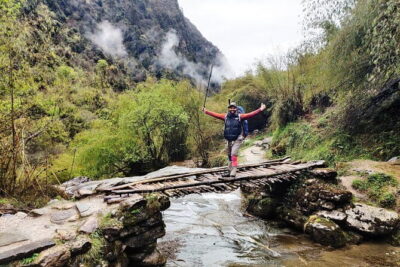
This stretch has a different mood from the open viewpoints around Poon Hill. The valley narrows, the forests become thicker, and the route follows steep slopes and river corridors. You should expect damp sections, uneven rock, and repeated changes in height.
The itinerary lists Dovan for Day 7, while the description continues toward the Himalayan Hotel. The exact overnight stop can depend on trail conditions and local arrangements, so confirm the night’s destination with your guide. That sort of flexibility is normal on a mountain route, but it is useful to know in advance.
The Annapurna Sanctuary and base camp at 4,130 meters
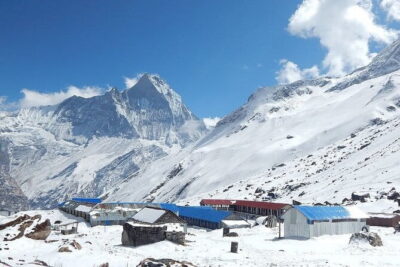
The route climbs past Hinko Cave and Deurali to Machhapuchhare Base Camp. Despite its name, this is not a climbing base camp because climbing Machhapuchhare is not permitted.
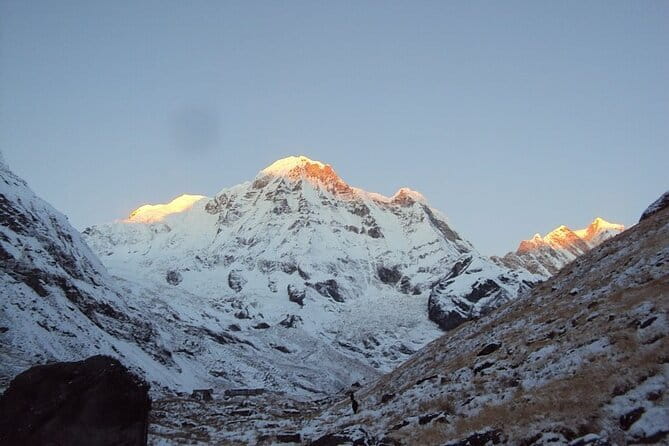
From there, about two more hours of walking takes you to Annapurna Base Camp. The mountains close around the route, creating the high bowl known as the Annapurna Sanctuary. Annapurna I rises to 8,091 meters, while Annapurna South, Machhapuchhare, and Hiunchuli complete the wall of peaks around you.
This is the emotional center of the trek, but it is also where you need to respect altitude. At 4,130 meters, cold, fatigue, and thin air can make a straightforward trail feel much harder. Keep your pace steady, follow your guide’s advice, and do not treat the summit-like destination as a reason to rush.
The included guide is one of the package’s strongest practical features. Staff named in recent bookings include Ramesh Karki, Raj Kumar, Maddy, Ganesh, Shyam, Resham, and others, but your assigned leader is not guaranteed in advance. The consistent value is the organized support system: one porter for every two clients, a lead guide, and assistant support on some departures.
The return to Bamboo and Jhinu hot springs
After the base camp night, you retrace the route down toward Bamboo. The descent drops about 1,700 meters toward the Modi Khola, and the change in height is hard on the knees even though breathing becomes easier.
From Bamboo, you pass back through forest and Chhomrong, then descend steeply to Jhinu Danda. This is one of the smartest features in the plan. Instead of ending with a plain road transfer, you get time at natural hot springs, a welcome reward after several days of steps.
You should not mistake the hot springs for a luxury spa. The appeal is the setting and the chance to rest your legs in warm natural water. Bring a small change of clothes and keep your main pack manageable.
A relaxed walk to Pokhara and the final evening
From Jhinu, the trail follows the right side of the Modi Khola for about four and a half hours to Birethanti. This is described as one of the easier and more relaxing walks of the trek, with a gentler finish before you reach Nayapul.
A one-hour drive returns you to Pokhara. After checking into the hotel, you go to Phewa Lake for a boating trip to Barahi Temple. This gives you a calm contrast to the high trail and lets you enjoy Pokhara without immediately moving on.
Day 12 is the return drive to Kathmandu. The evening includes a farewell dinner at a traditional Nepalese restaurant with cultural performances. If you have extra time, the operator can help arrange add-ons such as Chitwan, rafting, shopping, or mountain biking, though those are not part of the $1,350 package.
What the $1,350 price includes
For 13 days, the price is strong if you value having the major logistics arranged. Included are airport transfers, two hotel nights in Kathmandu, two hotel nights in Pokhara, eight nights in guesthouses, trekking permits, a licensed English-speaking guide, porter support, tourist bus transport between Kathmandu and Pokhara, and vehicle transport between Pokhara and Nayapul.
You also receive breakfast for all 12 mornings, plus nine lunches and nine dinners. Meals in Kathmandu and Pokhara are not included, nor are alcoholic drinks, hot and cold drinks, international airfare, visa fees, personal gear, travel insurance, or tips.
That list matters. The package is not all-inclusive once you count drinks, city meals, equipment, insurance, and gratuities. Still, it removes the largest planning burden and bundles the services you need to reach base camp.
Tipping is expected for the trekking staff and driver, so include it in your budget. The free duffel bag and sun hat are useful extras, but you should still bring suitable layers, footwear, rain protection, and personal trekking equipment.
Who should book this trek?
I would choose this trip if you want a guided Himalayan trek with a clear route, porter support, and a mix of mountain scenery and village life. It suits people with a moderate fitness level who can handle repeated stairs, steep descents, and several hours of walking at altitude.
It is less suitable if you want private rooms throughout, short walking days, or complete control over transport times. The group can reach 15 people, and the tourist bus to Pokhara takes much of a day. The guesthouses are simple, and the high section can be physically demanding.
The strongest reason to book is the balance of sights. You get Poon Hill, the Annapurna Sanctuary, several ethnic villages, forest trails, hot springs, Phewa Lake, and a farewell meal in one organized trip. The strongest reason to pause is the effort required. This is a real trek, not a sightseeing tour with a few walks added.
Cancellation is allowed for a full refund up to three full days before the start time. Poor weather may lead to a new date or a full refund, and the company requires travel insurance that covers high-altitude rescue and evacuation.
Should you book the Annapurna Base Camp Trek?
Book it if you want a well-supported route to one of Nepal’s great mountain amphitheaters and you are ready for long stair days. I especially like the way this plan builds from Pokhara and lower villages to Poon Hill, then finishes with hot springs and a lake boat ride.
Before paying, ask about your likely guide, current road conditions, room arrangements, and the expected daily walking times. Pack light, train on stairs, budget for tips and city meals, and treat the altitude with respect. If those points suit you, the $1,350 price buys a practical and memorable route through the Annapurna region.
FAQ
How long does the Annapurna Base Camp Trek take?
The trip lasts approximately 13 days, beginning and ending in Kathmandu. It includes time in Kathmandu and Pokhara, the trek to Annapurna Base Camp, the return walk, and airport transfers.
What is the highest point on the trek?
Annapurna Base Camp is the highest point, at 4,130 meters or 13,549 feet.
Is Poon Hill included?
Yes. The route includes an early-morning hike to Poon Hill at 3,210 meters for sunrise views over the Himalayan range.
What accommodation is included?
The package includes twin-share or double rooms in three-star hotels in Kathmandu and Pokhara, plus guesthouse accommodation in twin-share or dormitory rooms during the trek.
Are meals included?
Breakfast is included for all 12 mornings. Nine lunches and nine dinners are included, while lunch and dinner in Kathmandu and Pokhara are not included. Alcoholic and other hot or cold drinks are also excluded.
Is a guide and porter included?
Yes. The package includes a licensed English-speaking trekking guide and one porter for every two clients. The maximum group size is 15 people.
What fitness level is needed?
The activity requires a moderate physical fitness level. You should be ready for steep climbs, many stone steps, long descents, and walking at high altitude. Personal trekking equipment and insurance are not included.
Latest treks added in Kathmandu
- Private Manaslu Circuit Trek at Himalayas★ 5.0 · 3 reviews
- Ghorepani Poonhill Trek★ 5.0 · 5 reviews
- Ghorepani Poon Hill Trek★ 5.0 · 16 reviews
- Upper Mustang Trekking★ 3.0 · 2 reviews
- Amazing 1 Day Trekking Experience in Kathmandu Nepal★ 5.0 · 24 reviews
- Upper Mustang Trekking★ 5.0 · 2 reviews
- Upper Mustang Trek★ 5.0 · 5 reviews
- Upper Mustang Trekking★ 5.0 · 4 reviews
Annapurna Base Camp Treks, compared.
Trekking in Annapurna/Langtang/Everest/Upper Mustang regions
Read our review →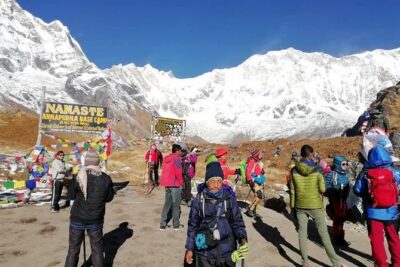
Kathmandu to Annapurna Base Camp (ABC) 5-Day Trek
Read our review →
Browse the lists this tour appears in