REVIEW · KATHMANDU
Upper Mustang Tiji Festival Trek 2024 – 18 Days
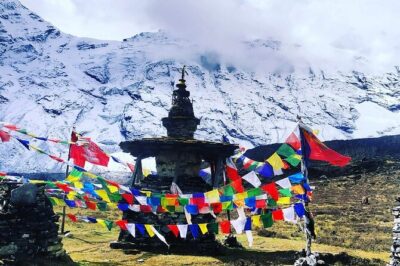
Upper Mustang’s Tiji Festival gives you something rare: a long Himalayan trek built around a living religious ceremony. You walk through dry, wind-carved valleys to Lo Manthang, then watch monks perform ritual dances before Choedhe Monastery. I especially like the mix of remote mountain scenery and a real cultural event, not a festival staged for outsiders. I also like the route’s variety, from Kagbeni’s old lanes to the salt mine at Chhuksang and the 44-room Chhosar Cave.
The main catch is the altitude and the pace. Several days involve five to six hours of walking, with passes above 3,600 meters and Lo Manthang at roughly 3,850 meters. The supplied festival date is May 19 to 21, 2020, so you should confirm the exact 2024 dates before booking. Wind, dust, flight delays, and basic mountain accommodation are all part of the deal.
Key points at a glance
- Three days of Tiji in Lo Manthang: The trip is timed around monks’ ritual dances on the first, second, and final days of the festival.
- A restricted Himalayan region: Your price includes the Upper Mustang restricted-area permit, a major cost and planning hurdle.
- A flight-and-trek route: You fly to Pokhara, then Jomsom, and begin walking from Kagbeni rather than spending extra days on a long road journey.
- Ancient sites beyond the festival: The route includes Namgyal Gompa, Choedhe Gompa, Ghar Gompa, Muktinath, and Chhosar Cave.
- A private 18-day arrangement: Your group travels privately, with airport pickup, a guide, meals and lodging during the trek, and domestic flights included.
- A moderate but serious physical challenge: The itinerary includes long walking days, dry terrain, steep climbs, and high passes.
Why Tiji makes this trek special
Tiji is a three-day Buddhist festival held in Lo Manthang, traditionally connected with the battle between Dorje Jono and his demon father. The story centers on protecting Upper Mustang from destruction, and monks express it through masked dances and ritual movement.
You’ll see the first performance after lunch on Day 9. Day 10 adds visits to important religious sites before the second festival session. On Day 11, you visit Chhosar Cave in the morning and return to Lo Manthang for the final performance.
That timing gives the trip a clear purpose. You are not simply ticking off villages and mountain passes. You reach the walled city in time for a major local event, then have enough time to look around instead of rushing in for a single afternoon.
The festival takes place in front of Choedhe Monastery. Expect a public religious ceremony rather than a polished stage show. You should dress respectfully, follow local instructions, and be ready for crowds around the performance area. The schedule places you in Lo Manthang for all three days, which is one of the strongest features of the route.
More Trekking Tours in Kathmandu
- Everest Base Camp Trek – 14 Days
★ 5.0 · 1,499 reviews - Everest Base Camp Trek
★ 5.0 · 842 reviews - Everest Base Camp Trekking
★ 5.0 · 485 reviews
Kathmandu begins with temples and practical preparation
Day 1 is simple. A company representative meets you at Tribhuvan International Airport and transfers you to your pre-booked hotel. That pickup matters after an international flight, especially if you arrive tired or are handling trekking gear.
Day 2 is a full day around Kathmandu Valley. The planned stops are Basantapur Durbar Square, the Monkey Temple, Boudhanath Stupa, and Pashupatinath Temple. You travel by private tourist vehicle, which makes it easier to cover four major sites in one day.
This is a busy introduction to Nepal. Basantapur gives you palace squares and traditional architecture. Boudhanath offers a calmer Buddhist setting, while Pashupatinath is one of the country’s most important Hindu religious sites. The Monkey Temple provides broad city views and another look at Kathmandu’s religious life.
Temple and monastery entry fees during Kathmandu and Pokhara sightseeing are not included, so carry money for those charges. Lunch and dinner in Kathmandu are also your responsibility. That gives you freedom to choose your meals, but it means the advertised price is not an all-inclusive city package.
Pokhara adds a lake day before the mountains
On Day 3, you take a short scenic flight to Pokhara. After checking in and refreshing, the plan includes boating on Phewa Lake, a visit to Tal Barahi Temple, an evening walk, and dinner beside the lake.
This is a useful pause before the trek. Pokhara is less intense than Kathmandu, and the lake gives you a relaxed afternoon before the early flight to Jomsom. The short flight also saves you from a much longer overland journey.
The day is not a mountain walk, so it may feel easy compared with what follows. That is a good thing. Use it to organize your bag, charge batteries, and prepare for several days in high, dry country. Personal expenses, including drinks, phone calls, laundry, showers, and battery charging, are not covered.
Kagbeni is the real start of the walk
Day 4 begins with an early flight from Pokhara to Jomsom. After breakfast in Jomsom, you walk three to four hours to Kagbeni.
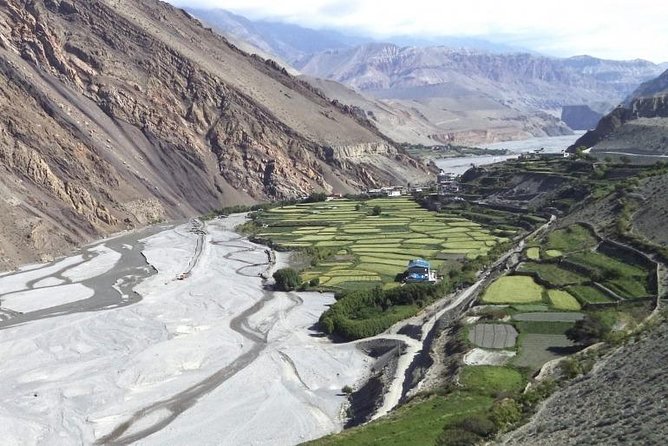
Kagbeni is an atmospheric first stop. The plan includes time to explore the village and its ancient Buddhist monastery. This is where the route begins to feel different from the standard Nepal circuit. The settlement sits at the edge of the Upper Mustang route, and its old lanes and religious buildings provide a strong first look at the region’s Tibetan-influenced culture.
The flight to Jomsom is practical but weather can affect mountain aviation. The itinerary does not provide a detailed backup plan for delays, so avoid scheduling an international departure immediately after the tour ends. The final day includes flights from Jomsom to Pokhara and then Kathmandu, but mountain flights can require patience.
Another trail to compare in Kathmandu:
- Annapurna Circuit Trek with Tilicho Lake
★ 5.0 · 368 reviews - Everest Base Camp Trekking – 13 Day
★ 5.0 · 365 reviews - Everest Base Camp Trek
★ 5.0 · 350 reviews - Everest Base Camp Trek -14 Days
★ 5.0 · 321 reviews
Four walking days lead to Lo Manthang
From Kagbeni, the route becomes more demanding and more rewarding.
On Day 5, you walk five to six hours toward Tsaile. The trail passes through Tangbe at 3,060 meters, Tetang at 3,040 meters, and Chhuksang at 2,980 meters. Lunch is planned at Chhuksang.
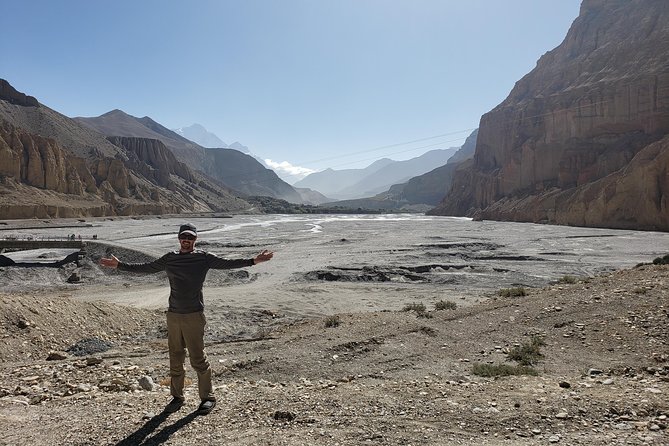
These villages break up a stark, treeless setting. The route is not green hill country. It is dry, open, and shaped by wind and erosion. You should expect strong sun, dust, and limited shade. The altitude is already noticeable, so keep your pace steady and drink regularly.
Day 6 brings a harder route toward Ghiling. You climb above Samar, descend into a large gorge, cross cool streams, and pass juniper trees before climbing to a ridge. The trail reaches Taklam La Pass at 3,624 meters, with views toward Damodar Danda, Yakawa Kang, and Tilicho Peak.
This is one of the trip’s best walking days, but also one of its tougher ones. The path includes steep sections and narrow stretches. After the pass, you descend to the whitewashed village of Ghiling. Take the long downhill seriously, since tired legs can make loose ground awkward.
Day 7 leads to Dhakmar. The itinerary highlights Himalayan views and ancient Buddhist monasteries, though it does not list the walking distance or exact hours. That uncertainty is worth discussing with the operator before departure. You should know how much climbing is planned and where lunch and overnight accommodation will be arranged.
On Day 8, you reach Lo Manthang. The trail passes through villages and climbs gradually to the windy Lo Pass at about 3,850 meters. From here, you get your first view of the walled city.
That approach is one of the emotional high points of the trip. After days of walking through open valleys, the walls of Lo Manthang give you a clear sense of arrival. The altitude and wind can make the final stretch feel longer than the distance suggests, so this is not a day to race.
Lo Manthang gives you three festival days
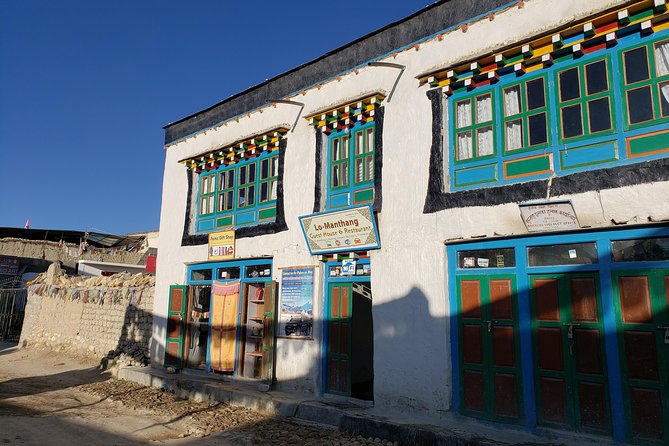
Day 9 allows time to explore Lo Manthang before the first Tiji performance after lunch. The city is the center of the trip, and you should save energy for both sightseeing and the ceremony.
Day 10 includes Namgyal Gompa, Choedhe Gompa, and Tingkhar before the second festival session. In the evening, you have time to meet local people and learn about local customs and daily life.
Day 11 combines a morning visit to Chhosar Cave with the final festival performance. Chhosar Cave is described as having 44 living rooms, and the area also includes old Buddhist monasteries. The visit adds an archaeological and domestic side to the trip. You are not only seeing religious buildings, but also a remarkable example of how people used the surrounding rock for shelter and daily life.
Lo Manthang accommodation is likely to be basic compared with Kathmandu and Pokhara. The supplied plan includes accommodation during the trek, but it does not specify hotel names or room standards. Ask before paying if you need a private bathroom, reliable hot water, or charging access every night.
The return route finds new sites
The return is not simply the same walk in reverse.
On Day 12, you trek to Dhakmar by way of Gyakar village and Ghar Gompa. The gompa is said to be more than 1,200 years old and is known for its rock paintings. Local belief holds that a wish made there will come true.
The route gives you a second look at the region from a different direction. Ghar Gompa is particularly valuable because it adds old religious art to the better-known festival and monastery visits. Keep expectations realistic: the itinerary does not specify the condition of the paintings or the exact time spent inside.
Day 13 returns to Ghiling. The plan warns that the daytime wind can be dusty and recommends walking or exploring villages in the morning and evening. That is sound advice. The middle of the day may be uncomfortable on exposed trails, and a slower schedule lets you enjoy the village rather than simply push through the dust.
Day 14 takes you to Chhuksang, with more views of the mountains and a visit to a local salt mine. This is a nice change from monasteries and passes. It shows how work and trade have shaped life in a dry region where farming is limited.
Muktinath and the Kali Gandaki finish the trek
Day 15 takes you to Muktinath, an important Hindu pilgrimage site visited by Nepali and Indian devotees. You also get views of the Himalaya from the temple area.
Muktinath gives the trip a broader religious frame. Upper Mustang is strongly connected with Tibetan Buddhism, but this stop shows the importance of Hindu pilgrimage in the same mountain region. The site can feel busy and devotional compared with the quieter villages, so treat it as a place of worship first and a sightseeing stop second.
On Day 16, you walk beside the Kali Gandaki River toward Jomsom. The trail is described as relatively flat and downhill, with views of Dhaulagiri and Nilgiri. After five to six hours, you reach the Jomsom airport area.
This is a long final walking day. Even if the route is easier underfoot, you have already spent two weeks at altitude. Good footwear and a sensible pace still matter. Jomsom is a practical ending point, with the airport providing the link back to Pokhara.
What the $2,500 price covers
At $2,500 per person, the package has solid value if you want a guided private trek and do not want to arrange permits, meals, lodging, and domestic flights yourself.
The price includes:
- Upper Mustang restricted-area permit
- Guide salary, food, accommodation, and insurance
- Breakfast, lunch, and dinner during the trek
- Kathmandu to Pokhara and return flights
- Pokhara to Jomsom and return flights
- Kathmandu sightseeing by private vehicle
- Breakfast throughout the 17 nights listed in the plan
- Airport pickup and departure transfer
The permit alone is important. Upper Mustang is a restricted region, so independent planning is more involved than booking an ordinary Nepal trek. Having the permit arranged, along with a guide and transport, removes much of the paperwork.
The package is less generous in the cities. Lunch and dinner in Kathmandu and Pokhara are excluded, as are sightseeing entry fees in both places. Personal costs such as bottled or boiled water, showers, laundry, phone calls, drinks, and battery charging are also extra.
You should also budget for an additional Kathmandu night if you return early from the mountains or have a late departure. The itinerary includes domestic flights on Day 17, but delays can happen, so keep some flexibility around your international flight.
Who should book this trek
I would recommend this trip to you if you want a private route with a strong cultural focus and are comfortable with high-altitude walking. The Tiji dates are the key reason to choose it. If you are mainly looking for easy mountain views, this is too demanding.
You should have moderate physical fitness, but that phrase deserves a practical reading. Expect several five to six hour walking days, steep climbs, dry exposed ground, and passes above 3,600 meters. The itinerary does not list acclimatization days, so ask the operator how the guide handles altitude problems and changes to the schedule.
The company has used staff named Mukesh, Samsher, Tsering, and drivers on other Nepal arrangements, with particular praise for organization, courtesy, and preparation. The information does not confirm which guide will lead this specific Tiji trek, so ask for the assigned guide’s name and experience before departure.
Cancellation is flexible only up to three full days before the start time. After that point, the payment is not refunded and changes are not accepted.
Should you book the Upper Mustang Tiji Festival Trek?
Book it if you want a rare festival-centered Himalayan journey, not just a standard trek. The combination of Lo Manthang, three days of Tiji, ancient gompas, Chhosar Cave, Muktinath, and the Kali Gandaki route gives you plenty of substance for the price.
Before booking, confirm the 2024 festival dates, exact accommodation, assigned guide, walking distances for Days 7 and 12, and the plan for flight delays. If those details suit you and you are ready for altitude, wind, dust, and basic conditions, this is a strong choice for an active cultural trip into one of Nepal’s least accessible regions.
FAQ
How long is the Upper Mustang Tiji Festival Trek?
The planned duration is 18 days, including arrival and departure transfers, Kathmandu sightseeing, Pokhara, domestic flights, the trek, and three days in Lo Manthang for the Tiji Festival.
Where does the trip begin?
The trip begins at Tribhuvan International Airport in Kathmandu, where a company representative provides airport pickup and transfers you to a pre-booked hotel.
What date is the Tiji Festival scheduled for?
The supplied information lists the festival as May 19 to May 21, 2020. You should confirm the correct 2024 dates before booking because the provided date is not a 2024 schedule.
Are domestic flights included?
Yes. The package includes flights between Kathmandu and Pokhara, plus flights between Pokhara and Jomsom, including the return journeys shown in the itinerary.
Is the Upper Mustang permit included?
Yes. The Upper Mustang restricted-area permit fee is included in the package price.
What meals are included?
Breakfast, lunch, and dinner are included during the trek. Lunch and dinner in Kathmandu and Pokhara are not included.
How physically difficult is the trek?
The activity requires a moderate level of physical fitness. The route includes five to six hour walking days, steep and dry terrain, high passes, and Lo Manthang at approximately 3,850 meters.
Is this a private tour?
Yes. It is described as a private tour and activity, with only your group participating.
Latest treks added in Kathmandu
- Private Manaslu Circuit Trek at Himalayas★ 5.0 · 3 reviews
- Ghorepani Poonhill Trek★ 5.0 · 5 reviews
- Ghorepani Poon Hill Trek★ 5.0 · 16 reviews
- Upper Mustang Trekking★ 3.0 · 2 reviews
- Amazing 1 Day Trekking Experience in Kathmandu Nepal★ 5.0 · 24 reviews
- Upper Mustang Trekking★ 5.0 · 2 reviews
- Upper Mustang Trek★ 5.0 · 5 reviews
- Upper Mustang Trekking★ 5.0 · 4 reviews
Kathmandu Trekking Tours, compared.