
REVIEW · KATHMANDU
Manaslu Circuit Trek
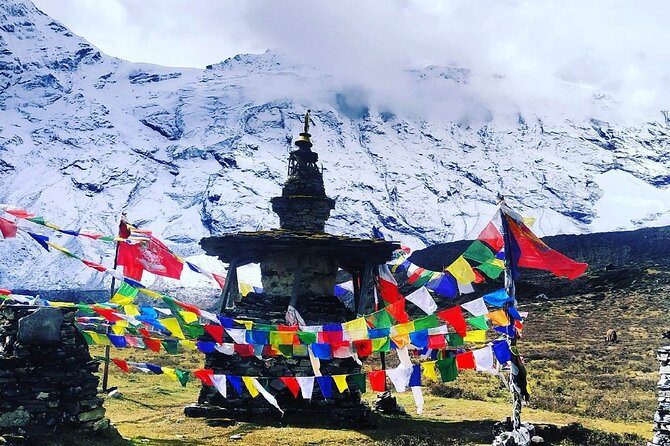
The Manaslu Circuit is at its best when the trail shifts from warm river valleys and Hindu villages to high, dry country shaped by Tibetan Buddhist culture. You’ll pass waterfalls, slate-paved streets, carved Mani walls, yak pastures, and finally cross Larkya La at 5,160 meters, with Manaslu and the Annapurna range spread around you.
I like the steady change in scenery and culture, especially the villages of Lho, Samdo, and Sama Gaon. I also like that the $1,950 price includes permits, guide, porter, meals, sleeping bag, down jacket, transfers, and basic safety gear. The main catch is the road: the opening and closing drives are long and rough, and the pass day demands good fitness and careful acclimatization.
Key points to know before booking
- Larkya La is the big test: The 5,160-meter pass brings the trek’s finest mountain views, but it is a long day over rocky ground and frozen lakes.
- Culture changes as you walk: The route begins among Hindu Nepali villages and gradually reaches Tibetan Buddhist communities with gompas, Mani walls, prayer flags, and yak shelters.
- Sama Gaon is your essential rest stop: The acclimatization day allows time for Birendra Tal, Punggen Gompa, or the Manaslu Base Camp area.
- This is a private trip: Only your own group takes part, with a licensed English-speaking guide and one porter for every two people.
- Guesthouses are basic: Accommodation is generally twin-sharing in the best available local lodges, not hotel-style comfort.
- The route is physically serious: You need moderate fitness, comfort on uneven trails, and patience for early road transfers.
What you are really paying for at $1,950
At $1,950 per person, this is not simply a walking holiday. The fee covers the parts of a Himalayan trek that can be awkward to arrange on your own: necessary permits and entry fees, surface transport from Kathmandu, an English-speaking guide, porters, guesthouses, meals, and trekking equipment such as a sleeping bag, down jacket, and duffel bag.
That makes the price reasonable for a supported private trek, particularly because the Manaslu route requires permits and organized access. You also receive an oximeter and first-aid kit, useful safeguards on a route that climbs high above the tree line.
Still, keep extra money aside. International flights, insurance, drinks, laundry, personal gear, staff tips, alcohol, and any expenses not listed are excluded. Hot and cold drinks can add up in the mountains, so your final cost will be higher than the advertised price.
The accommodation is mainly twin-sharing in the best available guesthouses. Think simple rooms and practical shelter rather than polished comfort. That is part of the trade-off for reaching remote villages, but you should be comfortable with basic facilities before booking.
More Manaslu Treks in Kathmandu
- Manaslu Circuit Trek
★ 5.0 · 292 reviews - Manaslu Circuit Trek:
★ 5.0 · 106 reviews - Manaslu Circuit Trek (15 Days)
★ 5.0 · 50 reviews
Kathmandu to Soti Khola: a rough road into the hills
Your start time is 6:00 a.m., with pickup in Kathmandu near Tridevi Sadak. The first day is mostly a road journey to Soti Khola, and it is not a gentle introduction. Expect dirty, difficult roads, shared jeeps in parts of the approach, and a long transfer before your boots see much trail.
The reward is the changing view outside the vehicle. Rice fields, waterfalls, village greenery, slate-roofed houses, and the old market at Arkhet make the drive more interesting than a simple transfer. Soti Khola itself is small, green, and a clear sign that the route is leaving Kathmandu’s orbit.
You should treat this day as a travel day, not a relaxed sightseeing day. If rough roads make you uncomfortable, this is one of the main points to consider before committing.
Soti Khola to Jagat: river gorges and suspension bridges
The trail from Soti Khola to Machha Khola brings the first real taste of the Budhi Gandaki basin. The path is rocky and often slippery, with waterfalls, tropical vegetation, steep rises, and drops. You cross suspension bridges and pass through Liding and Lapubesi, a village tucked against a lush hill.
Machha Khola is a useful overnight stop because it has several accommodation options and a medical clinic. That practical detail matters on a route where small problems are easier to handle early than later. You will still be walking on rough ground, so sturdy footwear and a steady pace are more useful than speed.
The next day leads toward Jagat through Tatopani, Dobhan, Shyaule Bhatti, and Yaru. The Budhi Gandaki narrows between river and cliff, then drops in striking cascades. After roughly two to three hours beyond Yaru, you reach Jagat, where slate-paved streets give the village a more settled feel.
Jagat is tied to tourism, farming, education, and government work. Its lodges are basic, but the village has a distinctive stone character and marks a gradual change from the lower valley.
Jagat to Deng: the valley begins to close in
From Jagat, you climb along the riverbed and over a rocky point with views toward Shringi Himal. The route continues on the left bank of the Budhi Gandaki, then climbs toward Philim.
At Philim, the trail north is marked toward Larkya La. Forest replaces some of the open lower-valley feel, and the gorge becomes more dramatic. After Ekle Bhatti, you cross high above a spectacular section of river gorge, with pine trees framing the view.
The gradual climb to Deng is a good example of why this circuit feels varied. You are not simply walking toward one mountain. The route keeps changing underfoot and overhead, from river crossings to forest, from warm vegetation to colder high-country terrain.
More Trekking Tours in Kathmandu
- Everest Base Camp Trek – 14 Days
★ 5.0 · 1,499 reviews - Everest Base Camp Trek
★ 5.0 · 842 reviews - Everest Base Camp Trekking
★ 5.0 · 485 reviews - Annapurna Circuit Trek with Tilicho Lake
★ 5.0 · 368 reviews
Deng to Namrung: carved Mani walls and fir forest
The day from Deng to Namrung crosses the Budhi Gandaki by suspension bridge, then climbs through Rana and Bihi. The trail repeatedly enters and leaves gorges, crosses the Serang Khola, and makes a sharper climb before circling into Ghap.
Ghap is one of the cultural highlights. Its Mani walls carry intricate carvings of Buddhas in meditation. These are not decorative extras placed for visitors. They are part of the spiritual texture of the route, and you should walk past them respectfully, keeping to the usual clockwise practice when the trail allows.
Beyond Ghap, the route enters fir forest. Birds, wooden bridges, narrow canyons, and cool shade make this section feel very different from the lower river valley. Namrung arrives after about an hour and a half of climbing from Ghap, offering a picturesque stopping point before the highest portion of the circuit.
Namrung to Sama Gaon: Manaslu appears in full
From Namrung, the route passes through Bhanzam, with barley fields and stone homes between the hills. At Lihi, you get a broad mountain view that includes Manaslu, the 8,163-meter peak that gives the trek its identity.
The trail then crosses the Hinang Khola and reaches Lho. A large gompa sits above the village, and the higher viewpoint gives you an impressive look toward Manaslu. This is one of the places where the cultural and mountain sides of the trek come together: stone houses, Buddhist architecture, and a huge snowy summit in the same view.
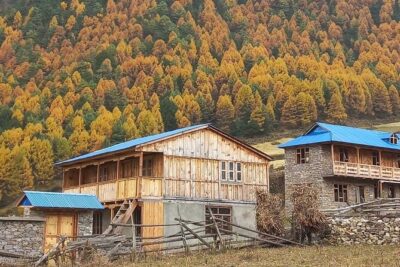
From Lho, you climb through compressed forest toward Shyala. Its stone and wood houses sit tightly together, giving the village a compact, high-mountain feel. The route then follows slopes drained by the Punggen Glacier before continuing toward Sama Gaon.
This is an important stretch of the trek. The air is getting thinner, the views are opening, and the villages feel more connected to Tibetan Buddhist life than to the Hindu culture of the lower valleys.
Sama Gaon: use the rest day wisely
Sama Gaon is not a day to waste in bed unless you are unwell. It is your planned acclimatization stop, and it gives your body time to adjust before the route climbs toward Samdo, Dharamsala, and Larkya La.
You can explore around the village or visit Birendra Tal, Pema Chyoling Lhakang, Punggen Gompa, and the Manaslu Base Camp area. The provided schedule does not specify exact distances or walking times for these side trips, so ask your guide which option fits your condition and the day’s weather.
I particularly like this pause because it gives the trek room to breathe. You are not racing from lodge to lodge. You have time to look around under Manaslu, check your kit, and prepare for the highest days ahead.
Sama Gaon to Samdo: yak country and thin air
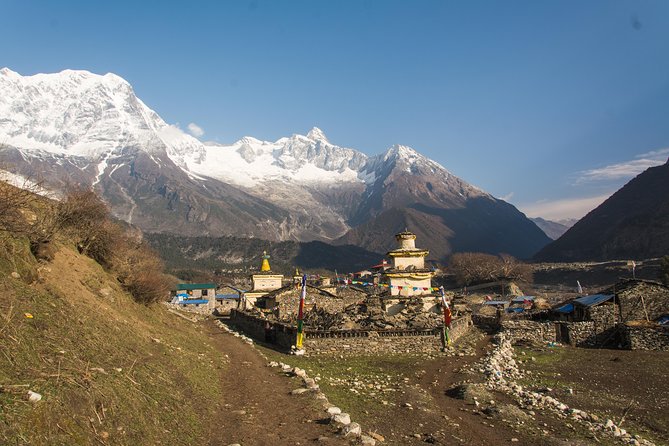
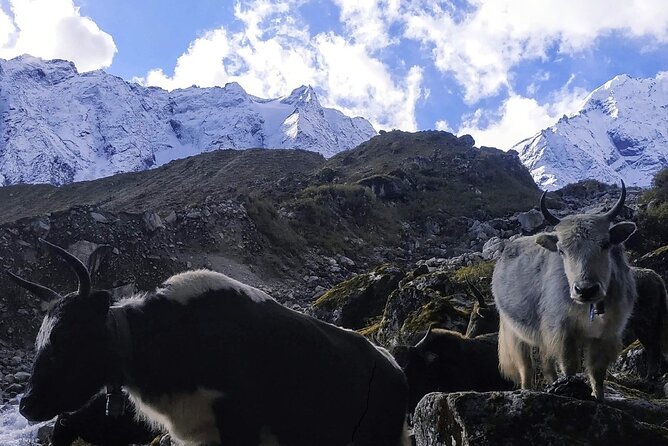
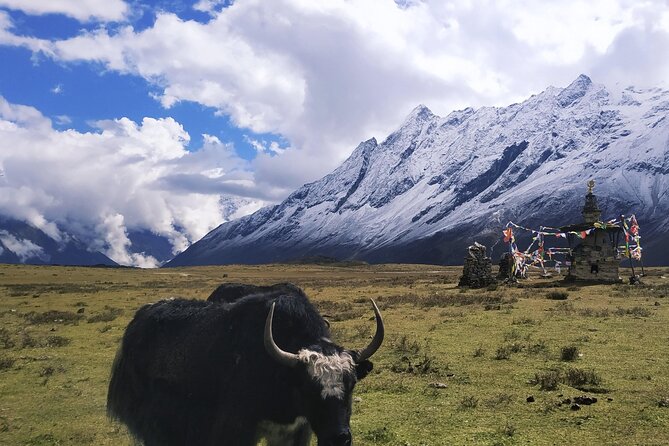
The trail climbs toward frozen Birendra Tal at about 3,450 meters, under the Manaslu Glacier. From there, the walking becomes easier for a time, crossing yak pastures lined with long Mani walls.
Keep an eye out for marmots standing near their burrows. Small details like this add life to an otherwise stark high-altitude setting. You then climb to a ridge, drop to a wooden bridge over the Budhi Gandaki, and continue toward the white chorten above Samdo.
Samdo is strongly associated with yak herding. You may see more animal and hay shelters than human accommodation, which tells you how closely daily life here depends on livestock. It is a memorable village, but the basic facilities and altitude make it a place for an early night rather than a long evening.
Samdo to Dharamsala: the last stop before the pass
Leaving Samdo, you descend on a broad trail to the much-reduced Budhi Gandaki. A route toward Tibet branches away to the right, while you climb left past a Mani wall and through juniper country.
The trail crosses two gorges on narrow tracks before reaching Dharamsala, also called Larke Phedi. Accommodation here is particularly simple: the stop is described as a stone hut with three rooms and an almost complete roof. This is the kind of night when a warm sleeping bag and down jacket are more valuable than a comfortable lounge.
Dharamsala offers a full view of the Manaslu range and serves as the staging point for the pass. Listen closely to your guide about the next morning’s timing, clothing, food, and pace. The pass crossing is the hardest part of the route, and a calm, steady approach matters.
Crossing Larkya La at 5,160 meters
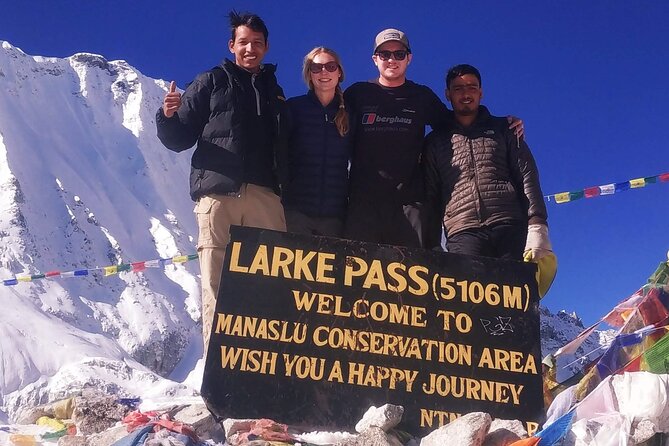
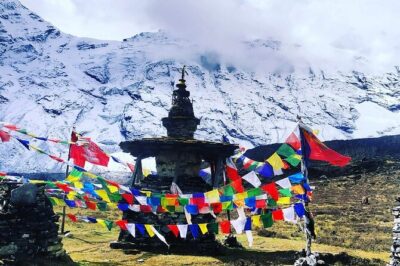
The pass day begins with a gradual climb behind Dharamsala beside the moraine of the Larke Glacier. The terrain is rocky, and the climb is long. You pass four frozen lakes before making the final ascent to Larkya La, marked by prayer flags.
At the top, you can see the Manaslu range and the Annapurna range. This is the trek’s big visual payoff, but the pass should not be treated as a photo stop with a little walking attached. Altitude, cold, uneven ground, and the length of the day all demand respect.
After the pass, you descend across moraine toward Bimthang. The downhill does not make the day effortless. Tired legs can find loose rock harder than an uphill trail, so take your time and use trekking poles if you have them.
Bimthang to Dharapani: forest after the high point
Bimthang brings a welcome change. The route south crosses lush ground below Bimthang Glacier and climbs to a prayer-flagged viewpoint surrounded by mountains, with Manaslu visible to the southeast.
The trail then enters a fir forest and reaches a lonely house at Yak Kharka, where you can stop for lunch. From there, the forest continues until Goa and then Dharapani. After the stark country around the pass, this return to trees and thicker vegetation feels dramatic.
Dharapani is the final overnight stop on the walking portion described here. You will likely feel the difference in altitude, but also the accumulated fatigue from many days on uneven trails.
Dharapani to Kathmandu: the road returns
The next stage uses an off-road jeep for about four hours to Beshisahar. The route gradually descends to Syange, climbs toward Gharmu Phant, and then drops again to Beshisahar.
The final day is a drive from Besisahar back to Kathmandu through lush hills and broad river networks. On arrival, you are transferred to a five-star hotel for the night. That hotel finish is a noticeable comfort after basic mountain lodges, though the included information does not identify the hotel or specify its facilities.
The road section is a practical end to the trek, not a sightseeing tour in its own right. Build patience into your expectations, especially if traffic or road conditions slow the journey.
Guides, porters, meals, and safety support
You receive a local government licensed English-speaking guide and one porter for every two people. That porter arrangement keeps your personal load manageable, but it does not mean you can pack without limits. Bring only what you can sensibly hand over, and keep valuables, documents, medication, and anything you need during the day in your own daypack.
The package includes breakfast for 12 days, lunch for 11 days, and dinner for 12 days. Drinks are not included, so budget separately for anything beyond the supplied meals.
The operator’s trekking staff include people named Prakash and Shiva in guide roles, with Shree involved in organizing the service. If you have a preference or a previous contact, ask at booking who will lead your particular departure.
An oximeter, first-aid kit, and route map are provided. These tools support good decisions, but they do not replace travel insurance or medical judgment. You must arrange your own insurance, and it should cover trekking at the elevations involved.
Who should book the Manaslu Circuit?
I would choose this trip if you want a long, demanding mountain route with strong cultural interest and a private support team. It suits people who value village life, Buddhist architecture, changing scenery, and a major high pass more than polished accommodation.
It is less suitable if you want short walking days, comfortable hotels throughout, or smooth roads. The route includes rough transport, slippery and rocky trails, suspension bridges, cold high-altitude nights, and a strenuous pass crossing.
The private format is useful if you want your group to move at its own pace. You still need to follow the guide’s advice, especially around acclimatization and the pass, but you are not sharing the trip with a large mixed group.
Booking confirmation is provided at the time of purchase. Free cancellation is available up to 24 hours before the 6:00 a.m. start time. Poor weather can lead to a different date or a full refund, while changes or cancellations inside 24 hours are not accepted.
Should you book this Manaslu trek?
Book it if you want a serious 13-day Himalayan circuit with permits, guide, porter, meals, gear, and transport arranged in one package. The strongest reasons are the cultural transition from Hindu Nepal to Tibetan Buddhist communities, the views around Manaslu, and the crossing of Larkya La.
Think carefully if rough roads, basic guesthouses, or high-altitude walking would make you miserable. For a fit walker who accepts those limits, the $1,950 cost offers solid practical value and a route that feels far more personal than a quick mountain viewpoint excursion.
FAQ
Where does the Manaslu Circuit Trek start?
The trek starts with pickup in Kathmandu at 6:00 a.m. near Tridevi Sadak, Kathmandu 44600, Nepal. The first transfer goes toward Soti Khola.
How long is the Manaslu Circuit Trek?
The experience lasts approximately 13 days. The schedule includes the road journey from Kathmandu to Soti Khola, the trek around Manaslu, transport to Beshisahar, and the return drive to Kathmandu.
Is this a private tour?
Yes. Only your own group participates in the private tour or activity.
What is the highest point on the route?
The highest point is Larkya La, at 5,160 meters. The pass is reached after Dharamsala and before the descent to Bimthang.
What accommodation is included?
The package includes the best available guesthouses during the trek, mainly in twin-sharing rooms. A five-star hotel transfer is provided when you return to Kathmandu on the final day.
Are meals included?
Breakfast is included for 12 days, lunch for 11 days, and dinner for 12 days. Alcohol and hot and cold drinks are not included.
Are a guide and porter included?
Yes. You receive a local government licensed English-speaking trekking guide and one porter for every two people.
What equipment is provided?
A down jacket, sleeping bag, duffel bag, oximeter, first-aid medical kit, and Manaslu Circuit route map are included. Personal trekking equipment and travel insurance are not included.
Latest treks added in Kathmandu
- Private Manaslu Circuit Trek at Himalayas★ 5.0 · 3 reviews
- Ghorepani Poonhill Trek★ 5.0 · 5 reviews
- Ghorepani Poon Hill Trek★ 5.0 · 16 reviews
- Upper Mustang Trekking★ 3.0 · 2 reviews
- Amazing 1 Day Trekking Experience in Kathmandu Nepal★ 5.0 · 24 reviews
- Upper Mustang Trekking★ 5.0 · 2 reviews
- Upper Mustang Trek★ 5.0 · 5 reviews
- Upper Mustang Trekking★ 5.0 · 4 reviews
Manaslu Circuit Treks, compared.
16 Day Private Manaslu Circuit Trek from Kathmandu
Read our review →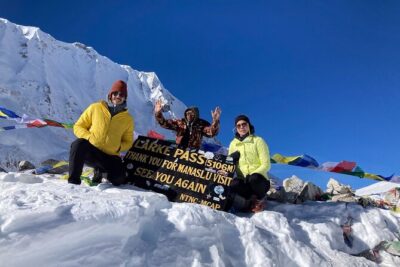
10 Days Manaslu Circuit Trek in Larke La Pass
Read our review →Browse the lists this tour appears in