
REVIEW · KATHMANDU
Annapurna Circuit Trek
The Annapurna Circuit gives you a rare change of scenery every few days: river valleys and waterfalls give way to pine forest, high mountain villages, a stark Mustang desert, and the prayer-flagged Thorong La Pass. This is not a gentle sightseeing holiday. The pass reaches 5,416 meters, and the climb from Tatopani to Ghorepani is a serious uphill day.
I like the thoughtful acclimatization stop in Manang and the second night in Tatopani, where hot springs offer real relief. I also like the practical package: airport pickup, permits, sleeping bag, down jacket, guide, porter, transport, and most meals are included. The main drawback is the long itinerary and basic mountain lodging. Expect shared rooms, simple facilities, early starts, and a few rough road journeys.
Key points before you book
- Thorong La is the main test: You start around 4 a.m. and climb for about four hours before descending to Muktinath.
- The scenery changes dramatically: The route moves from the Marsyangdi River to high alpine country, then through Mustang’s dry Kali Gandaki Valley.
- Manang provides a useful rest day: The schedule includes a monastery visit, Gangapurna Glacier Lake, and short acclimatization walks.
- Tatopani adds a proper recovery stop: You get a full day for hot springs, food, and rest before climbing toward Ghorepani.
- Poon Hill finishes the trek well: An early sunrise walk offers views of Annapurna South, Hiunchuli, and Tukuche Himal.
- The $2,240 price covers a lot: Hotels, guesthouses, meals, permits, transport, guide, porter support, and equipment are included, but insurance, drinks, tips, and international airfare are extra.
Kathmandu begins with temples, stupas, and paperwork
Your trip starts at Tribhuvan International Airport, where an Ace the Himalaya representative meets you and drives you to your hotel. A pre-trek meeting takes place on the first or second day. Bring your passport, three passport photos, and a readable copy of your travel insurance policy. You may also need to settle any remaining balance and sign the trip documents.
The first full day combines three of Kathmandu Valley’s major sights. At Pashupatinath Temple, you view the Hindu complex from the eastern bank of the Bagmati River because entry into the main temple is limited to Hindus. The riverside setting and active religious ceremonies make this more than a quick photo stop.
Boudhanath Stupa offers a different mood. Buddhist pilgrims circle the enormous white stupa, turning prayer wheels beneath the watchful eyes painted on its tower. Your visit lasts about 45 minutes, so it gives you an introduction rather than a long study of the site.
Bhaktapur Durbar Square rounds out the day with brick courtyards, pagoda temples, the Palace of 55 Windows, and the five-story Nyatapola Temple. The three stops make sense together, but the schedule is full. You will spend much of the day moving through traffic between sites, so do not expect a slow, quiet tour of Kathmandu.
More Annapurna Treks in Kathmandu
- Annapurna Circuit Trek with Tilicho Lake
★ 5.0 · 368 reviews - Annapurna base camp trek 5 Days
★ 5.0 · 252 reviews - 14-Day Private Annapurna Base Camp Trek
★ 5.0 · 180 reviews
The road from Besisahar reaches the walking trail
On day three, you take a public bus from Kathmandu to Besisahar, a trip of about six hours. From there, a shared four-wheel-drive vehicle continues to Syange for roughly two hours. You see rivers, waterfalls, and rural scenery, but this is a long transport day with limited comfort.
The trek begins properly near Syange. You follow the Marsyangdi River toward Tal, with a gradual ascent, waterfalls, and a growing sense that road travel is giving way to foot travel. The itinerary descriptions list unusually high time figures for several walking days, but the actual walking stages are generally described as about four to seven hours. Treat the listed hours as itinerary formatting errors, not literal hiking times.
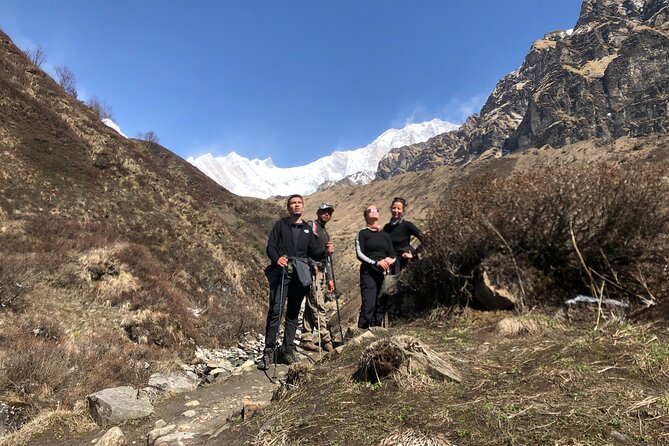
From Tal to Danakyu, the route leaves the lower river valley and brings better mountain views. Annapurna II and Pisang Peak begin to appear, while old villages and waterfalls add interest between the longer uphill stretches.
The walk to Chame is described as an easier four-hour day. Chame is the Manang district headquarters and has more facilities than the earlier villages. That matters after several nights in small guesthouses, though you should still expect basic mountain accommodation rather than hotel comforts.
Upper Pisang and Ngawal bring the best early mountain views
From Chame, the trail reaches Upper Pisang after about six hours. You pass through forest and along the Marsyangdi River before seeing the Paungda Dada rock face, a large curved wall that looks almost scooped from the mountainside.
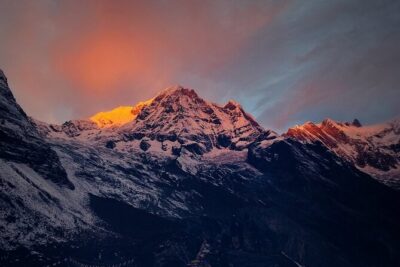
Upper Pisang is a good place to slow down and look south toward Annapurna II. The following morning, an early start lets you see first light on the peak before walking to Ngawal. The higher route to Ngawal climbs about 400 meters more than the lower option, but it rewards you with broad views of Annapurna II, Annapurna III, Pisang Peak, gorges, and high-altitude plants.
This part of the circuit shows why the route is worth taking on foot. You are not simply driving to a viewpoint. The scenery changes through forests, meadows, cliffs, and traditional villages, and the altitude begins to make each climb feel more deliberate.
Manang gives you time to adjust
The walk from Ngawal to Manang takes about six hours and passes hills, wetlands, stupas, and a lama school. Manang is one of the livelier settlements on the route, with more places to eat and rest than the smaller villages behind you.
The scheduled acclimatization day is one of the trip’s most important features. Instead of climbing higher immediately, you take short walks around Manang, visit a monastery, and hike to Gangapurna Glacier Lake before returning to your accommodation.
You should not treat this as a wasted day. The altitude rises quickly after Manang, and the rest day gives your body a chance to adjust before the route reaches 4,000 meters and beyond. It also breaks up the trek with some local sightseeing. If you feel unwell, tell your guide early rather than trying to prove your toughness.
Another trail to compare in Kathmandu:
- Everest Base Camp Trek – 14 Days
★ 5.0 · 1,499 reviews - Everest Base Camp Trek
★ 5.0 · 842 reviews - Everest Base Camp Trekking
★ 5.0 · 485 reviews - Everest Base Camp Trekking – 13 Day
★ 5.0 · 365 reviews
Yak Kharka and Thorong Phedi prepare you for the pass
After Manang, the route climbs steadily toward Yak Kharka at about 4,000 meters. You pass through Tenki Manang and follow the Jarsang Khola Valley, where vegetation becomes sparse and yaks replace much of the lower valley’s greenery.
The next stage reaches Thorong Phedi at about 4,450 meters. The route first climbs, drops to cross a river at approximately 4,310 meters, then rises again to the guesthouses. This up and down can feel frustrating, but it is part of the approach to the pass.
Accommodation here is basic and demand is high. Keep your evening simple, organize your layers and water, and follow your guide’s advice about the early start. The crossing depends on weather and snow conditions. Heavy snow can make the pass difficult or impossible, and strong winds become a bigger issue later in the morning.
Thorong La is the trek’s demanding centerpiece
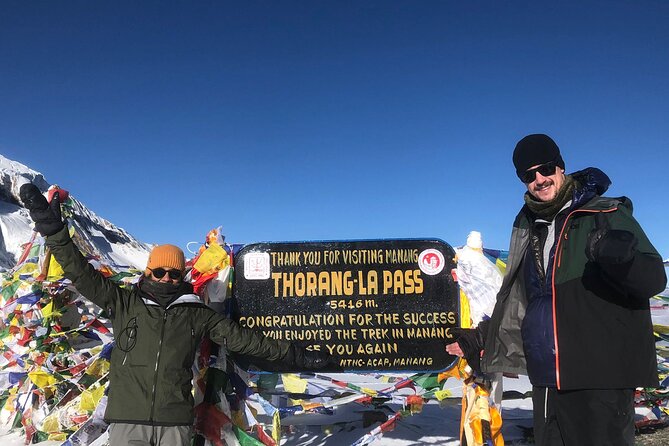
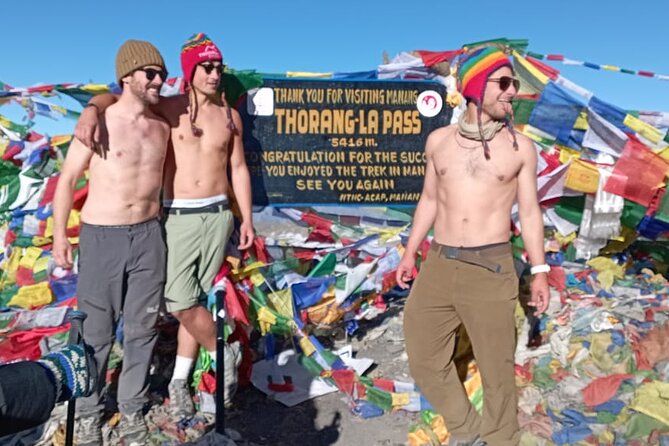
The pass day starts around 4 a.m. The goal is to reach Thorong La between 9 and 10 a.m., before wind and weather typically worsen. The climb takes about four hours, and the route is easy to follow in normal conditions, though altitude, cold, and snow can turn a straightforward trail into a hard day.
At 5,416 meters, Thorong La is not a casual viewpoint. You need warm layers, gloves, a hat, sturdy boots, water, and a pace you can sustain. The down jacket and sleeping bag supplied for the trek help, but personal equipment remains your responsibility.
Prayer flags and chortens mark the top, with broad mountain views in good weather. Then comes a long descent of about four hours to Muktinath. The descent can be tough on knees and feet, even after the main climb is over.
Muktinath is a sacred place for both Hindus and Buddhists. Its name is linked with nirvana, and the site adds cultural meaning to a day already packed with physical effort. You should expect to arrive tired, so this is not the time to schedule anything beyond rest and a simple meal.
Mustang changes the color of the journey
From Muktinath, the scenery shifts sharply. The green river valleys give way to dry slopes and a desert-like setting as you follow the Kali Gandaki River toward Jomsom.
Jomsom is the administrative center of Mustang and a much larger town than the settlements higher on the trail. Traditional houses, stupas, and the broad river valley give the route a strong sense of place, while the additional facilities make it a welcome overnight stop.
The next descent reaches Tatopani through the Kali Gandaki Valley. Along the way, you pass through the world’s deepest gorge, identified on the route as Kopchepani. This is one of the trek’s most striking geographical moments, with huge mountains rising on either side of the river corridor.
Tatopani is more than another overnight stop. It is a recovery point, with natural hot springs where you can soak, shower, eat local food, and enjoy a drink. The full rest day here is a smart design choice after Thorong La and the long descent from the high country.
Ghorepani brings a hard climb and a rewarding finish
The route from Tatopani to Ghorepani is one of the itinerary’s hardest walking days. You climb about 1,620 meters over roughly seven hours, passing Magar and Gurung villages along the way.
This is a major uphill push after a long trek, so your fitness matters. The reward is a high village with views toward Annapurna South, Hiunchuli, and Tukuche Himal. You may be tired enough to appreciate an early dinner and a quiet night more than another activity.
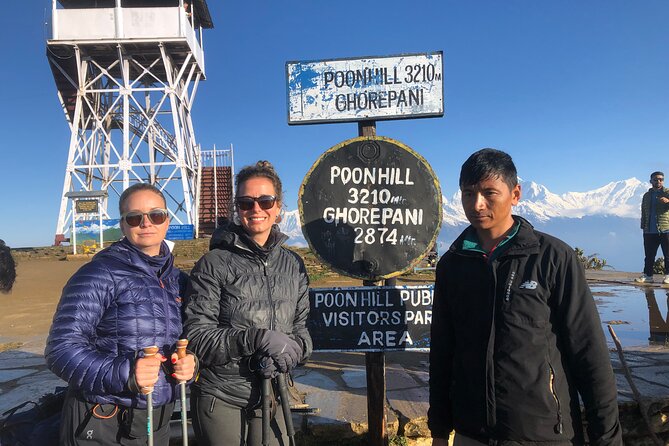
The next morning starts before sunrise with an hour-long walk to Poon Hill at 3,210 meters. Weather permitting, the viewpoint opens to sunrise over the high Himalayas. You stay for about an hour, then return to Ghorepani for breakfast before descending through rhododendron forest and along ridges to Tikhedhunga.
Poon Hill is a fitting final mountain viewpoint because it gives you a wide panorama without another high pass. It is still an early and chilly start, so keep warm clothing accessible rather than buried in your duffel.
Pokhara adds caves, temples, and a softer landing
After a short final walking section, you reach Nayapul and drive about an hour to Pokhara. The next day covers several sights around the city.
At Bindhyabasini Temple, you visit a hilltop religious site dedicated to Goddess Bhagwati. Devi’s Fall is a brief stop where water drops into a deep gorge, and nearby Gupteshwor Mahadev Cave adds a darker, more enclosed experience. Some passages require crawling, so this stop may not suit everyone.
The Seti River Gorge offers another quick look at the forces shaping Pokhara. The Tibetan Refugee Camp, Tashi Ling, is known for woolen carpets and handicrafts made by Tibetan settlers who came to Nepal in the 1950s.
These visits are short, often only 10 to 25 minutes each. They work well as an overview of Pokhara, but you will not have much time at any one site. If you want a slower lakeside stay, ask about extending the trip rather than trying to fit extra sightseeing into this schedule.
What the $2,240 price really covers
At $2,240 per person, this is not a bare-bones trek. Three hotel nights in Kathmandu and two in Pokhara are included, along with 16 nights in trekking guesthouses. You also get a licensed English-speaking guide, one porter for every two clients, permits, airport transfers, ground transport, most meals, a duffel bag, sun hat, down jacket, and sleeping bag.
Breakfast is included for all 21 mornings. Dinner is included on 17 nights and lunch on 16 days. That leaves meals in Kathmandu and Pokhara, alcoholic and other drinks, and personal purchases for your own budget.
You still need travel insurance covering high-altitude emergency rescue and evacuation. International airfare, the Nepal entry visa, personal trekking equipment, and tips for the trekking staff and driver are also extra. Tipping is expected, so include it in your planning.
The group size is capped at 15. That is small enough for a guide to keep track of the group, but large enough that you should not expect a private trek. The company has used guides including Ganesh, Nimesh, Madan, Janu, Ram, and Aamod, with particular praise for their care on difficult days, pacing, acclimatization support, and help at the pass.
Who should book this trek
You should consider this trip if you want the full circuit with support already arranged. It suits people with moderate physical fitness who can handle repeated walking days, high altitude, early starts, steep climbs, and simple guesthouses.
It is a good fit if you want Kathmandu and Pokhara included rather than arranging separate trips. It also suits first-time Himalayan trekkers who value a guide, porter support, permits, transport, and an established route.
Think twice if you dislike shared rooms, public buses, rough roads, cold mornings, or changing plans due to snow and weather. The itinerary requires flexibility. Poor weather can lead to a different date or a full refund, but mountain conditions can still affect the route while you are in Nepal.
You can cancel for a full refund up to three full days before the local start time. Changes made inside that window are not accepted.
Should you book the Annapurna Circuit Trek?
I would book this trek if your priority is variety and support rather than luxury. The combination of Thorong La, Muktinath, the Mustang side of the circuit, Tatopani’s hot springs, Poon Hill, and two major Nepal cities gives you a lot for 22 days.
The strongest reasons to choose it are the careful acclimatization day in Manang, the full recovery day in Tatopani, and the included guide and porter structure. The main caution is that this remains a serious high-altitude trek, not a comfortable coach tour with occasional walks.
If you can train for long uphill days, buy proper insurance, and accept basic mountain lodging, the price offers solid value. If you want an easier experience, choose a shorter trek at lower altitude instead.
FAQ
How long is the Annapurna Circuit Trek?
The experience lasts approximately 22 days, including arrival and departure transfers, Kathmandu and Pokhara sightseeing, the trek, transport days, and the farewell dinner.
Where does the trek start and end?
It starts at Tribhuvan International Airport in Kathmandu and ends back at the airport after the return to Kathmandu.
What is the highest point on the route?
The highest point is Thorong La Pass at approximately 5,416 meters.
Is airport pickup included?
Yes. An airport representative meets you outside Tribhuvan International Airport and transfers you to your hotel. An airport drop-off is also included at the end.
Are meals included?
Breakfast is included for 21 days, dinner for 17 nights, and lunch for 16 days. Lunch and dinner in Kathmandu and Pokhara are not included, and drinks are extra.
Is accommodation included?
Yes. The package includes three hotel nights in Kathmandu, two hotel nights in Pokhara, and 16 nights in trekking guesthouses. Rooms are twin-share or double in the cities and twin-share or dormitory style during the trek.
Is a guide and porter included?
Yes. A licensed English-speaking trekking guide and one porter for every two clients are included.
What equipment is supplied?
A down jacket and sleeping bag are supplied for the trek and must be returned. A duffel or kit bag and sun hat are also included, but personal trekking equipment is not.
Latest treks added in Kathmandu
- Ghorepani Poonhill Trek★ 5.0 · 5 reviews
- Ghorepani Poon Hill Trek★ 5.0 · 16 reviews
- Private Manaslu Circuit Trek at Himalayas★ 5.0 · 3 reviews
- Upper Mustang Trekking★ 3.0 · 2 reviews
- Amazing 1 Day Trekking Experience in Kathmandu Nepal★ 5.0 · 24 reviews
- Upper Mustang Trekking★ 5.0 · 2 reviews
- Upper Mustang Trek★ 5.0 · 5 reviews
- Upper Mustang Trekking★ 5.0 · 4 reviews
Annapurna Base Camp Treks, compared.

Trekking in Annapurna/Langtang/Everest/Upper Mustang regions
Read our review →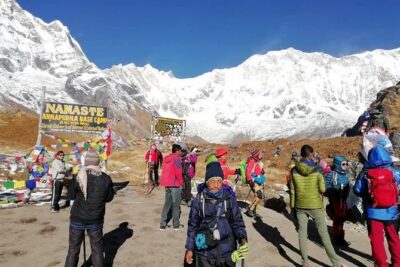
Kathmandu to Annapurna Base Camp (ABC) 5-Day Trek
Read our review →Browse the lists this tour appears in