
REVIEW · KATHMANDU
Annapurna Base Camp Trekking
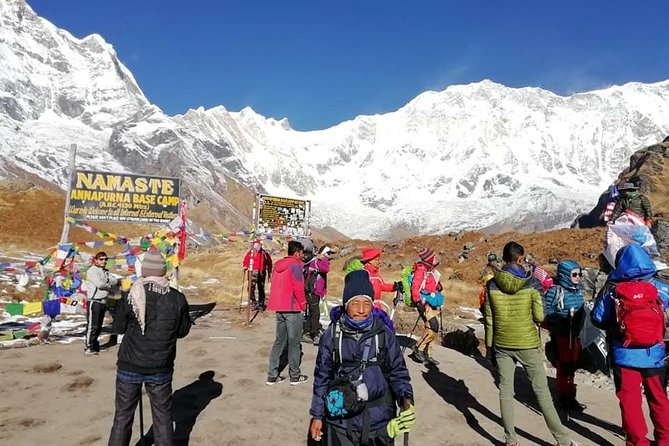
Annapurna Base Camp gives you a lot in 14 days: rhododendron forests, Gurung villages, hot springs, and a high mountain sanctuary reached on foot. The route builds from Kathmandu and Pokhara to Poon Hill, then climbs into the Annapurna massif, where Annapurna I, Machhapuchhre, Hiunchuli, and Annapurna South surround the base camp.
I like the sensible support package, especially the airport transfers, trekking permits, full-board meals, guesthouses, and certified English-speaking guide. I also like the mix of scenery and culture, from the Gurung village of Chhomrong to Ghandruk’s museum and the evening farewell meal in Kathmandu. The main consideration is physical effort: long days, steep steps, rocky paths, and altitude up to 4,130 meters demand moderate fitness.
Key points to know before booking
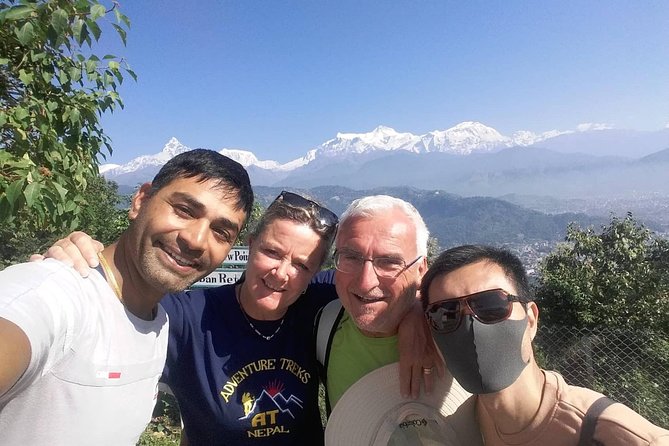
- Poon Hill adds a superb mountain viewpoint before the route turns toward the Annapurna Sanctuary.
- Annapurna Base Camp reaches 4,130 meters, so the uphill days require steady pacing.
- Gurung and Magar villages give the trek a human side, not just mountain scenery.
- The package includes meals, lodging, permits, transport, and a guide, which makes planning simpler.
- Jhinu Danda offers a hot-spring stop after the high point of the trek.
- This is a private trip for your group, rather than a set group departure.
Why this Annapurna route works so well
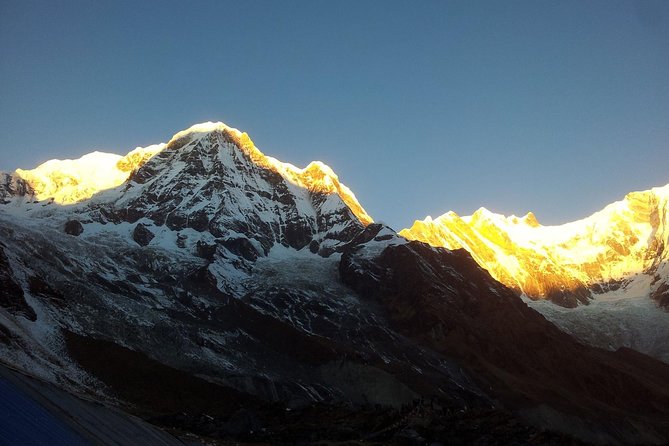
The appeal of this trek is its variety. You begin with city temples and lakeside Pokhara, then move through terraced farmland, oak and rhododendron woods, stone steps, bamboo forest, waterfalls, glaciers, and high mountain viewpoints.
You also get two different mountain experiences. Poon Hill gives you a broad view across Dhaulagiri, Annapurna, and Manaslu. Annapurna Base Camp feels more enclosed and immediate, with peaks rising around the sanctuary. The first is a grand lookout. The second places you inside a ring of mountains.
At $1,600 per person, the price is not simply paying for a walking route. It covers 14 days of linked services: airport pickup and drop-off, Kathmandu and Pokhara lodging with breakfast, trekking guesthouses, a tourist bus between Kathmandu and Pokhara, sightseeing in Kathmandu, meals during the trek, permits, a guide, guide insurance and expenses, a medical kit, and a farewell dinner.
That can be good value if you want one company to handle the moving parts. You still pay separately for international flights, your Nepal visa, travel and rescue insurance, drinks and personal bills, and tips. Tipping your guide and porter is expected, so include it in your budget.
More Annapurna Treks in Kathmandu
- Annapurna Circuit Trek with Tilicho Lake
★ 5.0 · 368 reviews - Annapurna base camp trek 5 Days
★ 5.0 · 252 reviews - 14-Day Private Annapurna Base Camp Trek
★ 5.0 · 180 reviews
Days 1 and 2: Kathmandu temples and a soft landing
Your trip begins at Tribhuvan International Airport, where a private vehicle takes you to your hotel. If you arrive during the day, Thamel gives you an easy first walk through Kathmandu. If you arrive late, rest is the smarter choice before sightseeing and trekking begin.
The second day is devoted to Kathmandu Valley sightseeing. The route can be shaped around your interests and includes UNESCO World Heritage sites in the categories of stupas, temples, and palaces. You have about five hours for this outing.
I like this opening because it gives you time to adjust before the trek. It also places Nepal’s religious and architectural traditions next to the outdoor portion of the trip. The practical limit is time. Five hours is enough for a useful introduction, not a full survey of the valley.
The company’s named contact, John Shrestha, is described as helping with equipment and answering questions. That is useful if you arrive without every trekking item sorted. Still, the package does not state that equipment rental is included, so expect personal gear to remain your responsibility.
Day 3: The road from Kathmandu to Pokhara
You travel by tourist bus from Kathmandu to Pokhara, a journey listed at about six hours. The road passes towns, villages, rivers, and terraced farmland before reaching Pokhara, Nepal’s City of Lakes.
Pokhara is more relaxed than Kathmandu and gives you an important pause before the walking starts. In the evening, you can stroll around Phewa Lake. The city also offers activities such as paragliding, zip lining, and bungy jumping, though those are not part of this trek.
The bus is included, which keeps the cost down compared with arranging a private vehicle. The tradeoff is less control over stops and timing. You should treat this as a transfer day, not as a major sightseeing day.
Days 4 and 5: Ulleri steps, forest, and Ghorepani
After breakfast, a vehicle takes you from Pokhara to Naya Pul, the trailhead. The route then enters oak and rhododendron forest and follows the famous Ulleri stairs toward Tikhedunga and Ulleri.
This is your first real test. The trail includes steps, boulders, steep sections, bridges, cliffs, and villages. The description calls the path gentle in places, but the stairs can still feel demanding at the start of a long trek. Take the day at a steady pace rather than trying to prove anything early.
On day five, you continue toward Ghorepani through Banthanti and Nangethanti. Oak and rhododendron forest surrounds the trail, with lunch planned around Nangethanti. Ghorepani is valued for its views toward Dhaulagiri and the Annapurna ranges.
These days show why the route is popular. The forest changes with elevation, village life breaks up the walking, and the first mountain views begin to reward the effort. The downside is that the trail is not flat or quiet in the physical sense. You should be comfortable with several hours of uphill and downhill walking.
Another trail to compare in Kathmandu:
- Everest Base Camp Trek – 14 Days
★ 5.0 · 1,499 reviews - Everest Base Camp Trek
★ 5.0 · 842 reviews - Everest Base Camp Trekking
★ 5.0 · 485 reviews - Everest Base Camp Trekking – 13 Day
★ 5.0 · 365 reviews
Day 6: Poon Hill and the forest trail to Tadapani
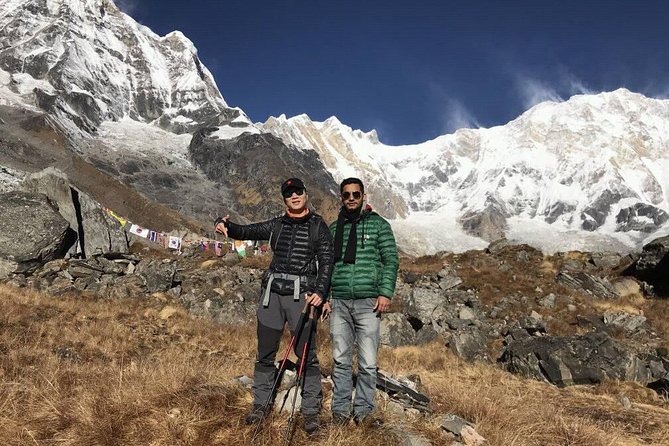
Poon Hill is one of the strongest points of the itinerary. From this viewpoint, you can see Dhaulagiri, Annapurna, and Manaslu. It gives you a broad sweep of the high peaks before the trail turns deeper into the Annapurna region.
After Poon Hill, the route to Tadapani rises and falls through forest and over rocky steps. The day is listed at about six hours. You get a fine mountain payoff, but the descent and later uphill sections still require energy.
This is an excellent place to manage your expectations. Poon Hill is a viewpoint, not the final goal, and the trek continues afterward. Save enough strength for Tadapani rather than treating the morning view as the end of the day.
Day 7: Chhomrong and the Gurung setting
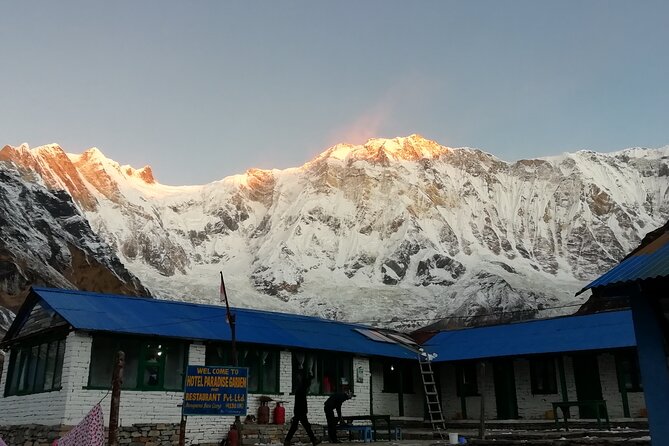
The trail to Chhomrong moves downhill and through rhododendron and oak forest. By afternoon, you reach the Gurung village of Chhomrong, set below the Annapurna massif.
Chhomrong is one of the more memorable cultural stops because you have time to explore rather than simply pass through. The village also gives you views of Annapurna South and Machhapuchhre, often called Fish Tail.
I like this balance of village time and mountain scenery. The trek is not reduced to a series of viewpoints. You see how settlements fit into the route and get a better sense of the people and traditions connected with the mountains.
Days 8 and 9: Bamboo forest, Machhapuchhre Base Camp, and Annapurna Base Camp
The itinerary’s day labels are not perfectly clear here. Day eight is labeled Ghandruk, but the description follows the route from Chhomrong through Chhomrong Khola, Sinuwa, Bamboo, and the Himalaya Hotel. Day nine then continues through Hinko Cave, Deurali, Machhapuchhre Base Camp, and Annapurna Base Camp. The actual route description makes clear that these are the approach and summit days of the trek.
From Chhomrong, you descend a long staircase of about 2,500 steps to Chhomrong Khola. Then the trail climbs again toward Khuldighar and Sinuwa. Bamboo is damp and cold, and the forest changes as you continue through rhododendron woodland toward the Himalaya Hotel.
This is a demanding section. You face repeated downhill and uphill work, steep trail, gorge sections, and rocky steps. The reward is a changing mountain environment, including views toward glaciers and waterfalls.
The following day takes you higher through Hinko Cave and Deurali to Machhapuchhre Base Camp. Vegetation becomes thinner, and the valley opens around you. From Machhapuchhre Base Camp, the listed views include Machhapuchhre, Hiunchuli, Annapurna South, Annapurna I, Annapurna III, Gandharvachuli, and Gangapurna.
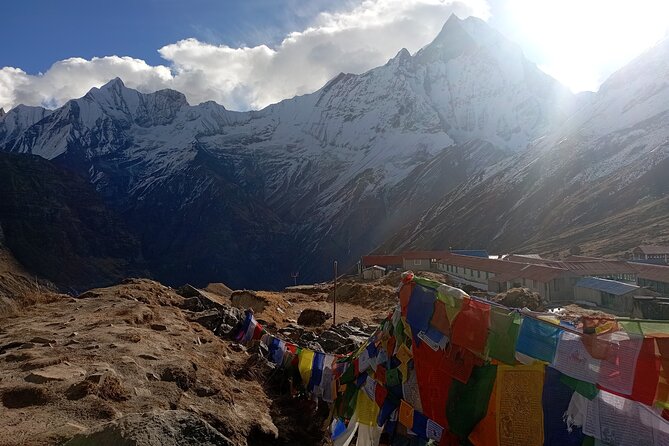
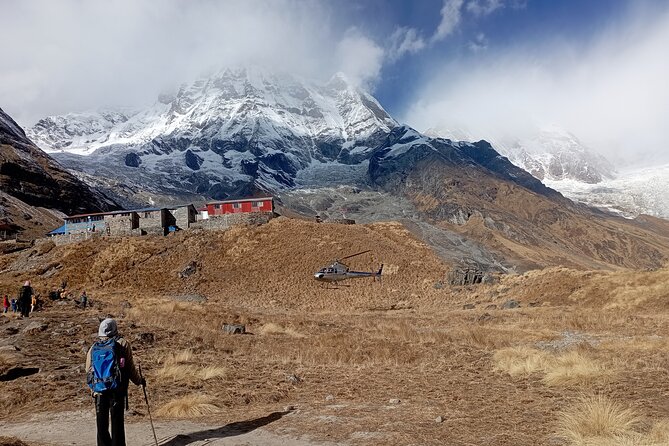
Annapurna Base Camp sits at 4,130 meters. The route takes about two more hours from Machhapuchhre Base Camp according to the description. At the destination, you get broad views of Machhapuchhre, Annapurna South, Annapurna I, Hiunchuli, and other peaks.
The itinerary lists only six minutes for this stop, which is clearly not a useful measure of the walking day. Read the narrative instead: this is the trek’s major high-altitude push and should be treated as a full day of effort. You need to take altitude seriously, follow your guide’s pace, and use the medical support provided as a backup rather than a substitute for insurance.
Days 10 and 11: Return through Bamboo and Jhinu Danda
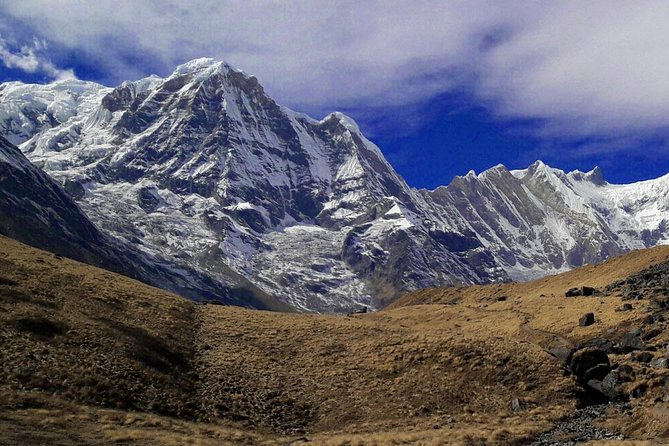
After reaching base camp, the trail retraces its route downhill. You return through bamboo, rhododendron, and oak forest, with further mountain views along the way. The downhill direction is easier in some ways, but steep steps can be hard on knees and legs.
From Bamboo, you climb again to Chhomrong Khola, then descend toward Jhinu Danda. The day is listed at about six hours. The hot spring is the reward here, giving you a chance to rest after the high point of the trek.
Jhinu Danda is well placed in the itinerary. You do not finish at base camp and rush straight to transport. Instead, you get a slower recovery day with a memorable natural stop.
Days 12 and 13: Ghandruk, Pokhara, and the return to Kathmandu
The route continues downhill to Ghandruk, where you can see Annapurna South and Fish Tail. A visit to the local museum adds context about Gurung culture and traditions.
From Ghandruk, the trail continues down to Kimche and Nayapul. A jeep or bus then returns you to Pokhara. This is a useful closing section because it combines a final village visit with an uncomplicated route back to the city.
On day 13, you return by tourist bus from Pokhara to Kathmandu. The road scenery changes from forest to areas with less vegetation, with rivers, streams, and hilly views along the way.
That return drive can feel long after the trek, but the included bus keeps the arrangement simple. In Kathmandu, the trip ends with a farewell dinner at a typical Nepali restaurant and a Nepali dance performance.
Day 14: Airport transfer and the included support
A company representative takes you from the hotel to the airport in a private vehicle. The activity begins and ends at Tribhuvan International Airport, making the arrival and departure transfers easy to understand.
During the trek, accommodation is in twin-sharing guesthouses. In Kathmandu and Pokhara, you receive twin-sharing hotel accommodation with breakfast. Trekking meals include breakfast, lunch, and dinner, along with tea or coffee.
The guide package includes a Nepal Government certified English-speaking local trekking guide. Guide salary, lodging, meals, transport, and insurance are included, as are the ACAP and TIMS permits and a medical kit. You also receive a trip accomplishment certificate.
Who should book this trek?
I would choose this trip if you want a classic Nepal trek with strong scenery but do not want to arrange every permit, transfer, meal, and hotel yourself. It suits a private group that values a fixed 14-day plan and a local English-speaking guide.
You should be ready for moderate physical effort. The route includes long days of five to seven hours, repeated stairs, rocky sections, steep uphill and downhill walking, and altitude reaching 4,130 meters. The package does not describe special support for limited mobility, so it is not a sensible choice if you cannot manage sustained walking.
The trek also suits people who want more than mountain photographs. Chhomrong, Ghandruk, the Gurung museum, Kathmandu’s temples, and the Nepali farewell dinner give the trip cultural weight.
Should you book the Annapurna Base Camp trek?
Book it if you want a well-supported classic route with Poon Hill, Annapurna Base Camp, Gurung villages, and a hot spring in one trip. At $1,600, the included transport, meals, accommodation, permits, guide costs, and airport service make the price reasonable for a private 14-day arrangement.
Think twice if you want a short, easy walk or dislike long road transfers. You also need separate travel and rescue insurance, visa fees, personal spending money, and tips. Free cancellation is available up to 24 hours before the start time, but changes or cancellations inside that window are not accepted for a refund.
FAQ
How long does the Annapurna Base Camp trek take?
The experience lasts approximately 14 days, including Kathmandu, Pokhara, the trek, return transport, and airport transfer.
What is the highest point of the trek?
Annapurna Base Camp is at 4,130 meters.
Is transportation from Kathmandu to Pokhara included?
Yes. Tourist bus transportation from Kathmandu to Pokhara and back to Kathmandu is included.
Are airport transfers included?
Yes. Pickup from Tribhuvan International Airport and return drop-off are provided in a private vehicle.
What meals are included during the trek?
Breakfast, lunch, and dinner are included during the trekking portion, along with tea or coffee.
Is accommodation included?
Yes. Twin-sharing hotel accommodation with breakfast is included in Kathmandu and Pokhara. Twin-sharing guesthouse accommodation is provided during the trek.
Are trekking permits included?
Yes. The ACAP permit and Trekkers Information Management System, or TIMS, permit card are included.
Is this a private tour?
Yes. Only your group participates in the activity, and a Nepal Government certified English-speaking local trekking guide is provided.
Latest treks added in Kathmandu
- Ghorepani Poonhill Trek★ 5.0 · 5 reviews
- Ghorepani Poon Hill Trek★ 5.0 · 16 reviews
- Private Manaslu Circuit Trek at Himalayas★ 5.0 · 3 reviews
- Upper Mustang Trekking★ 3.0 · 2 reviews
- Amazing 1 Day Trekking Experience in Kathmandu Nepal★ 5.0 · 24 reviews
- Upper Mustang Trekking★ 5.0 · 2 reviews
- Upper Mustang Trek★ 5.0 · 5 reviews
- Upper Mustang Trekking★ 5.0 · 4 reviews
Annapurna Base Camp Treks, compared.




Trekking in Annapurna/Langtang/Everest/Upper Mustang regions
Read our review →


Kathmandu to Annapurna Base Camp (ABC) 5-Day Trek
Read our review →Browse the lists this tour appears in