
REVIEW · KATHMANDU
Annapurna Base Camp Trek
The best part of this trek is the steady change in scenery. You begin with rivers, stepped fields, and Pokhara’s Phewa Lake, then walk through bamboo and rhododendron woods before reaching the snowbound bowl of Annapurna Base Camp at 4,130 meters. Along the way, Magar and Gurung villages give the route a human side.
I like the sensible mix of mountain walking and local life, and I like that the package includes a guide, permits, meals, transport, and one porter for every two trekkers. The natural hot springs at Jhinu Danda are another fine touch. The main drawback is the long bus travel on both the first and last days, plus several steep descents that can be hard on your knees.
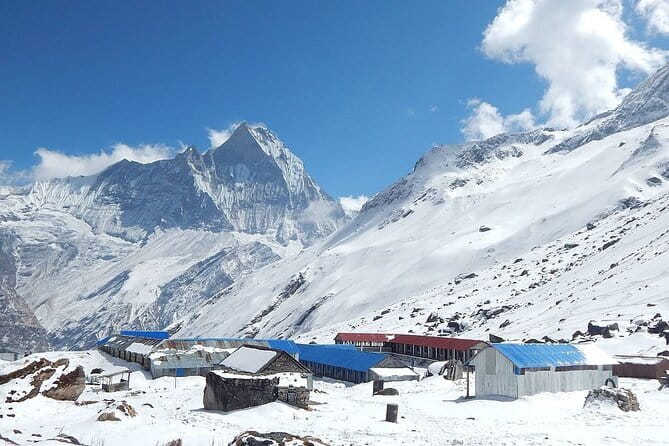
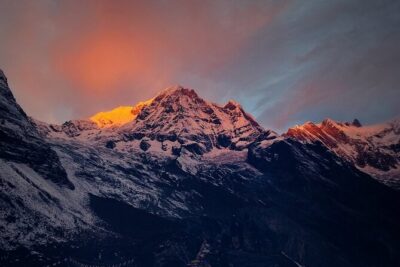
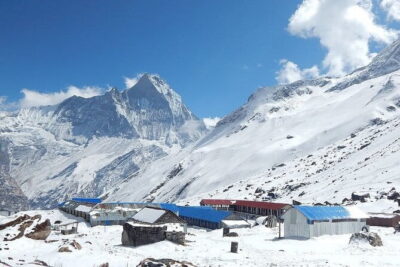
- Reach Annapurna Base Camp at 4,130 meters: Walk into the Annapurna Sanctuary with views toward Annapurna I, Annapurna III, Machhapuchhre, Dhaulagiri, and Hiunchuli.
- Walk through bamboo and rhododendron forests: The route changes from warm foothills to cooler, higher forest and open mountain country.
- Meet the Magar and Gurung communities: Villages, teahouses, chortens, and gumbas add cultural interest to the trail.
- Relax at Jhinu Danda’s hot springs: The springs offer a welcome rest after steep walking.
- Travel with practical support: A professional guide, porter support, ACAP permit, TIMS, meals, and transport are included.
- Expect a moderate but demanding route: The trek suits independent walkers and first-time trekkers with a reasonable fitness level, but altitude and stairs still require care.
Why the Annapurna Base Camp route works so well
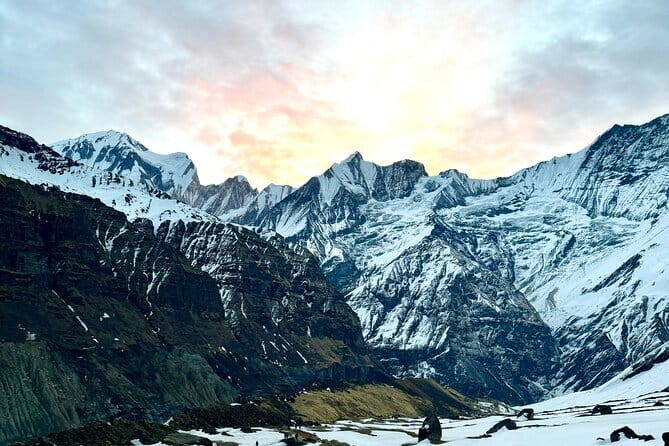
Annapurna Base Camp gives you a satisfying Himalayan trek without requiring weeks on the trail. In nine days, you move from Kathmandu to Pokhara, walk into the Annapurna Sanctuary, reach 4,130 meters, and return by the same broad route.
That compact plan is the attraction. You see a great deal in a short time, with forest, farming country, rivers, waterfalls, villages, and high mountain views packed into one journey. The route is also culturally engaging. Magar and Gurung communities live along the lower sections, and you pass local guesthouses, chortens, and gumbas as you climb.
The route is described as moderate, and that is fair if you already walk regularly. You do not need technical climbing skills, but you do need to handle repeated uphill sections, uneven stone paths, and long descents. The highest night is at Annapurna Base Camp, so the altitude is not a small detail. Walk slowly, drink plenty of water, and tell your guide if you feel unwell.
This is a private activity, meaning only your group takes part. That can make the pace and daily rhythm easier to manage than a large group departure. The information provided does not name the guide, so you should confirm the guide’s name and language before booking if that matters to you.
Day 1: Kathmandu to Pokhara by seven-hour bus
The first day is mostly about getting into position. You leave Kathmandu after a quick breakfast and travel by tourist bus to Pokhara, at about 850 meters.
The road passes rivers, stepped fields, gravelly gorges, and forest. This is not a quick transfer. Seven hours on a bus can feel long, especially after an early start, but it gives you a useful look at rural Nepal before the walking begins.
Pokhara is a pleasant change of pace. It is known as the city of lakes, and Phewa Lake is the main draw. You can take a boat ride and, if the water and weather cooperate, see reflections of the Annapurna range and Machhapuchhre. The plan includes a hotel night in Pokhara on a bed-and-breakfast basis, with a welcome dinner arranged by the trekking company.
A practical point: pickup is offered, and airport pickup and drop-off by private vehicle are included. Still, ask exactly where the 5:15 am meeting point is and how the first morning will work. A clear start matters when you have a full day of road travel ahead.
More Annapurna Treks in Kathmandu
- Annapurna Circuit Trek with Tilicho Lake
★ 5.0 · 368 reviews - Annapurna base camp trek 5 Days
★ 5.0 · 252 reviews - 14-Day Private Annapurna Base Camp Trek
★ 5.0 · 180 reviews
Day 2: Nayapul to Jhinu Danda and the first real walking
After breakfast, you drive about 42 kilometers from Pokhara to Nayapul, taking roughly 1.5 hours. The walking starts at Birethanti, a village near the Modi River.
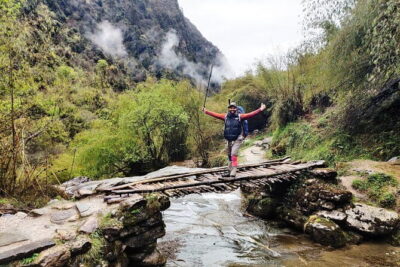
This first trail day introduces the route’s main ingredients: bamboo forest, waterfalls, swimming holes, village paths, and changing views of the foothills. You walk to Jhinu Danda at 1,760 meters, where you spend the night in a teahouse or local guesthouse.
Jhinu Danda is more than a place to sleep. It is known for its natural hot springs, although the itinerary places the main hot-spring stop on Day 7 after the return walk. If you are hoping to use the springs, confirm the timing with your guide, since tired legs may make the visit especially welcome.
The day is not simply a gentle warm-up. Nepal’s trails often use stone steps and uneven ground, and the route toward Jhinu Danda includes a good amount of ascent. Take it steadily rather than trying to match someone else’s pace.
Day 3: Jhinu Danda, Chhomrong, Sinuwa, and Bamboo
The third day takes you from Jhinu Danda to Bamboo at 2,245 meters in about five hours. The trail first drops toward Chhomrong, then climbs again toward Sinuwa.
This up-and-down pattern is common in the Annapurna region. It can be surprising on paper because the final distance may not look extreme, yet the stairs and repeated changes in height make the day more tiring than a simple walk across level ground.
Chhomrong is an important village on the route, and the path beyond it brings you farther into the sanctuary. You will see more forest and a greater sense of separation from the road network. At Bamboo, the setting becomes quieter and more enclosed, with vegetation around the local teahouses.
The inclusion of three meals each day during the trek is useful here. You do not need to plan every meal stop yourself, and you can focus on walking, resting, and keeping your pack organized. Hot showers, battery charging, drinks, laundry, and bar bills are not included, so keep extra Nepalese rupees available for personal costs.
Day 4: Bamboo to Deurali through thick forest
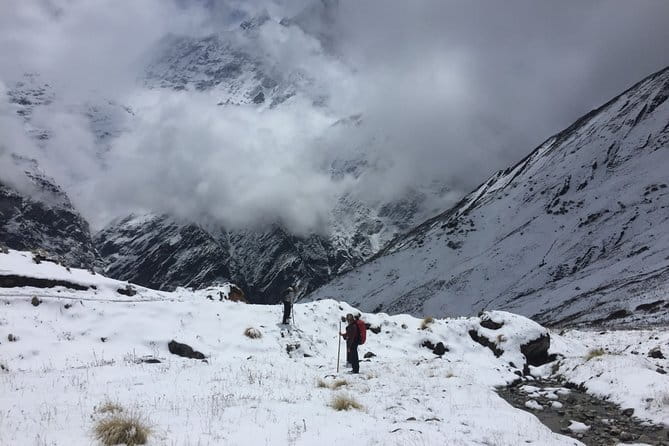
From Bamboo, you climb to Deurali at 3,210 meters, taking about five hours. The trail moves through dense bamboo and rhododendron forest, with the mountains appearing more often as you gain height.
The Hinku Cave area is one of the notable points on this section. You also begin to feel the approach of the higher mountains, including Hiunchuli and Machhapuchhre. The forest is not just decoration. It gives shade and makes the route feel sheltered before the trail opens into the more exposed high country.
This is also where altitude begins to demand more attention. You are not yet at the highest point, but Deurali is already above 3,000 meters. Walk at a calm pace and avoid treating the trek as a race. Your guide should help set a sensible rhythm, but you still need to speak up about headaches, nausea, unusual tiredness, or breathing problems.
Overnight accommodation is in a local guesthouse or teahouse. Facilities are basic, and the package does not include hot showers or charging. That is normal for a mountain trek, but it is worth preparing for before you leave Kathmandu.
Another trail to compare in Kathmandu:
- Everest Base Camp Trek – 14 Days
★ 5.0 · 1,499 reviews - Everest Base Camp Trek
★ 5.0 · 842 reviews - Everest Base Camp Trekking
★ 5.0 · 485 reviews - Everest Base Camp Trekking – 13 Day
★ 5.0 · 365 reviews
Day 5: Deurali to Machhapuchhre Base Camp and Annapurna Base Camp
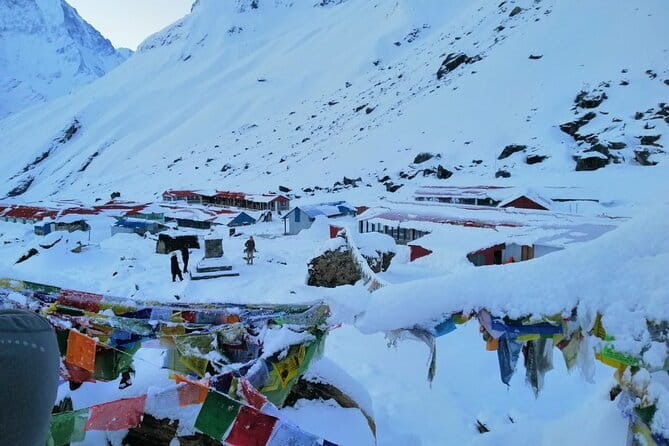
This is the central day of the trek. From Deurali, you walk into the Annapurna Sanctuary and first reach Machhapuchhre Base Camp at about 3,700 meters. The full walk to Annapurna Base Camp takes roughly five to six hours, depending on pace and conditions.
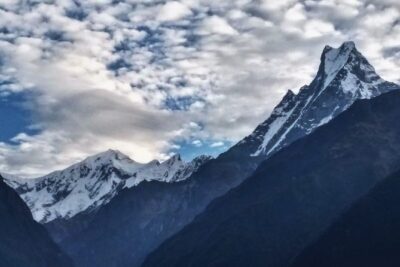
The scenery changes quickly. The dense forest gives way to a broad high mountain setting, with snow peaks enclosing the route. At Machhapuchhre Base Camp, you can look toward Annapurna I, Annapurna III, and the distinctive profile of Machhapuchhre, also known as Fishtail.
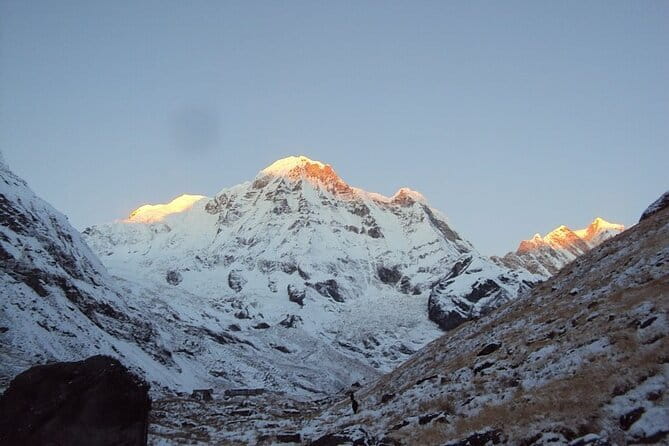
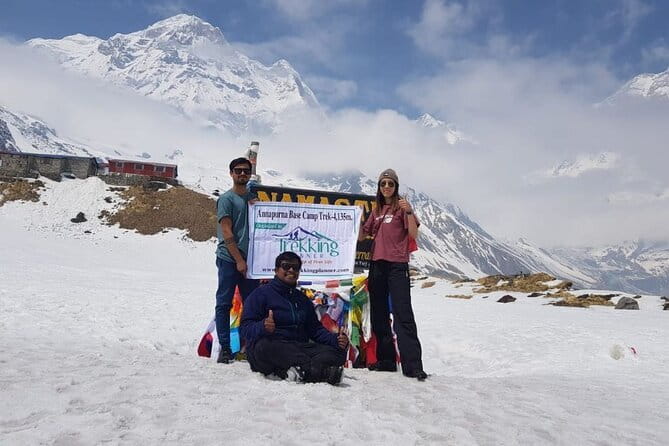
The final section to Annapurna Base Camp takes another two to three hours. At 4,130 meters, the base camp sits below Annapurna I, one of the world’s highest mountains. The views also include Dhaulagiri, Machhapuchhre, and Hiunchuli, creating the enclosed mountain bowl that makes the sanctuary so memorable.
This is the day when patience pays off. The altitude may slow you down, and the trail can feel harder than the distance suggests. Keep your camera ready, but do not let photos distract you from the conditions underfoot. You spend the night in a local guesthouse or teahouse, with hot food included.
The high point is not only the view. Reaching the base camp gives the entire route a clear purpose. You have moved from lake country and village paths into the heart of the mountains, without taking on a technical climb.
Day 6: A long descent from Annapurna Base Camp to Bamboo
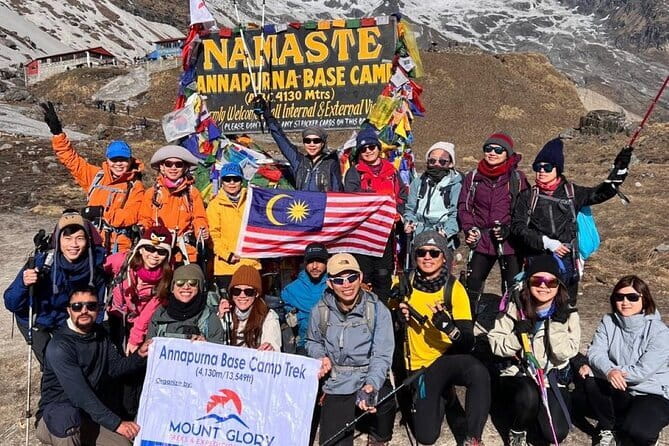
The return begins with a descent to Bamboo at 2,245 meters. The walking time is about 6.5 to seven hours, making this one of the longer days.
Going downhill sounds easy until your knees begin to complain. The trail can be uneven, and tired legs make slips more likely. Trekking poles can be useful, although they are not listed as part of the included equipment, so ask what you need to bring yourself.
You retrace the route beside the Modi River, moving back through forest and past mountain villages. The lower altitude should feel easier for many people, but the length of the day still calls for care. Eat regularly, drink water, and use your stops to loosen your legs rather than rushing through them.
The return route may feel familiar, but it is not repetitive in every way. Light changes, weather shifts, and the direction of your views can make the same trail look different. Bamboo is another teahouse night, with accommodation and meals arranged through the trek.
Day 7: Bamboo to Jhinu Danda and the hot springs
From Bamboo, you walk back to Chhomrong and then descend steeply to Jhinu Danda. The walk takes about 5.5 hours.
This is another day when the downhill sections deserve respect. The route passes bamboo, rhododendron, and other vegetation, and the familiar villages provide a sense that the trek is nearing its end. Still, the steep trail into Jhinu Danda can be demanding after several days on foot.
The reward is the natural hot spring. Soaking your legs in warm water is a fine way to mark the final mountain night, especially after the long descent from the sanctuary. The springs are a natural feature of the stop, not a luxury spa, so keep your expectations simple.
You spend the night in a local guesthouse. This is a good place to enjoy the social side of the route, eat a proper meal, and prepare for the final walking day.
Day 8: Jhinu Danda to Nayapul, then Pokhara
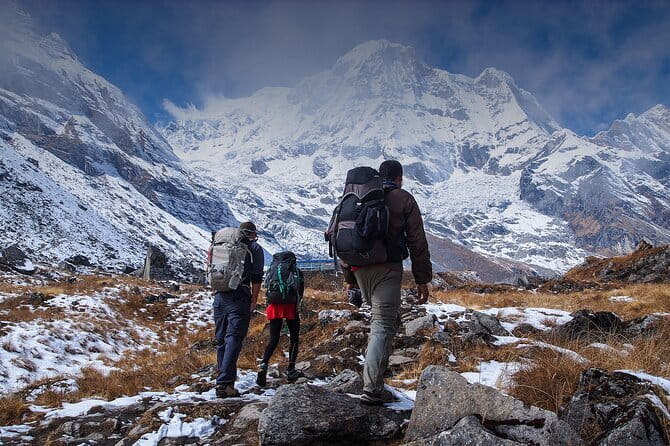
The final trail day takes about five hours from Jhinu Danda to Nayapul, followed by a 1.5-hour car ride to Pokhara.
The walking is described as easier than some earlier sections, though you still need to manage uneven ground and the accumulated fatigue of the trek. Birethanti marks the return to the road, and the drive to Pokhara gives you a chance to rest without having to walk the final miles.
Back in Pokhara, you can freshen up at the hotel and explore the city. The plan allows time to walk through the streets and visit some of its landmarks. Since the package includes hotel accommodation in Pokhara on a bed-and-breakfast basis, you have a more comfortable night before the long bus ride back to Kathmandu.
Extra nights in Pokhara are not included if your plans change, so add them separately if you want more time by Phewa Lake.
Day 9: Pokhara to Kathmandu
The final day is another scenic seven-hour tourist bus ride. Lunch is planned somewhere along the way, and you return to Kathmandu for a farewell dinner and hotel night before departure the following day.
The two long bus days are the clearest weakness in this itinerary. They are practical and keep the trip within nine days, but they reduce the amount of time you have in Pokhara and add a tiring finish. If you value a faster return, ask the operator if another transport option is available, though none is included in the stated plan.
What the $819.49 price covers
At $819.49 per person, the cost is best judged by what it removes from your planning list. The package includes airport pickup and drop-off by private vehicle, transport described in the itinerary, a Pokhara hotel night, a professional trek guide, guide and porter insurance, government and local taxes, meals during the trek, the Annapurna Conservation Area Permit, TIMS documentation, and one porter for every two trekkers.
That porter ratio is important. You still need to carry a daypack with personal essentials, but you are not expected to haul all your belongings over the pass and stairs yourself. It also means you should pack sensibly. A lighter bag makes the guide and porter’s work easier.
The price does not include Nepal’s visa, international flights, Kathmandu food or accommodation, personal travel and rescue insurance, hot showers, battery charging, laundry, drinks, bar bills, tips, or extra Pokhara nights. Rescue insurance deserves special attention because it is your responsibility, and the trek reaches 4,130 meters.
The package offers solid value for someone who wants transport, permits, meals, and trekking support organized in one booking. It is less attractive if you already have Kathmandu accommodation and prefer to arrange each transfer independently.
Who should book this trek
I would recommend it to an independent-minded first-time trekker who wants support without joining a large group. The route is moderate rather than technical, and the private format lets your group travel together at its own pace.
It also suits experienced walkers who want a compact Annapurna trip with a clear goal. The mix of forest, villages, hot springs, and high peaks gives you more variety than a route focused only on mountain views.
You should think twice if you dislike long road transfers, basic teahouse accommodation, steep stairs, or sleeping at high altitude. You also need enough fitness for five to seven hours of walking on several days. Service animals are allowed, but the physical demands and trail conditions should be discussed with the provider before booking.
The operator, Himalayan Holyland Treks and Expedition, has been praised for an attentive approach and a young Nepalese adventure crew. One French-language account describes an 11-day trip that combined Poon Hill with Annapurna Base Camp, which is not the same as this nine-day route, so confirm exactly what your booking includes.
Free cancellation is available if you cancel at least 24 hours before the local start time. Changes or cancellations made later are not accepted for a refund.
Should you book the Annapurna Base Camp Trek?
Book this trek if you want the major Annapurna views, local mountain culture, and forest walking in a tightly planned nine-day package. The included guide, permits, meals, porter support, and transport make the cost easier to justify, while the hot springs at Jhinu Danda add a welcome finish.
Before paying, confirm the guide’s name and language, the exact pickup point, accommodation standards, baggage limits, and the transport plan between Kathmandu and Pokhara. If you can handle early starts, long bus rides, steep trails, and basic mountain lodging, this is a well-rounded way to reach Annapurna Base Camp without arranging every detail yourself.
FAQ
How long does the Annapurna Base Camp Trek take?
The planned duration is approximately nine days, beginning and ending in Kathmandu.
What is the highest point on the trek?
Annapurna Base Camp is at 4,130 meters. Machhapuchhre Base Camp is reached earlier at about 3,700 meters.
Is transportation from Kathmandu to Pokhara included?
Yes. The itinerary includes tourist bus travel between Kathmandu and Pokhara on Days 1 and 9. The transfer from Nayapul to Pokhara on Day 8 is by car.
Are meals included during the trek?
Yes. Breakfast, lunch, and dinner are included during the trekking portion. Food in Kathmandu is not included.
Is accommodation in Pokhara included?
Hotel accommodation in Pokhara is included on a bed-and-breakfast basis. Extra nights caused by changes to the itinerary are not included.
Is a guide provided?
Yes. A professional trekking guide is included.
Is porter support included?
Yes. An experienced porter is provided at a ratio of one porter for every two trekkers. Porter and guide insurance is included.
Are permits included in the price?
Yes. The Annapurna Conservation Area Permit and TIMS documentation are included, along with government and local taxes.
What fitness level is required?
A moderate physical fitness level is required. The trek includes several days of roughly five to seven hours of walking, uneven trails, steep climbs, steep descents, and a high point of 4,130 meters.
Latest treks added in Kathmandu
- Private Manaslu Circuit Trek at Himalayas★ 5.0 · 3 reviews
- Ghorepani Poonhill Trek★ 5.0 · 5 reviews
- Ghorepani Poon Hill Trek★ 5.0 · 16 reviews
- Upper Mustang Trekking★ 3.0 · 2 reviews
- Amazing 1 Day Trekking Experience in Kathmandu Nepal★ 5.0 · 24 reviews
- Upper Mustang Trekking★ 5.0 · 2 reviews
- Upper Mustang Trek★ 5.0 · 5 reviews
- Upper Mustang Trekking★ 5.0 · 4 reviews
Annapurna Base Camp Treks, compared.

Trekking in Annapurna/Langtang/Everest/Upper Mustang regions
Read our review →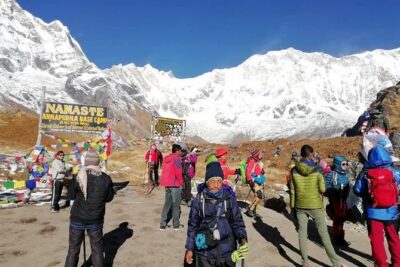
Kathmandu to Annapurna Base Camp (ABC) 5-Day Trek
Read our review →Browse the lists this tour appears in