
REVIEW · KATHMANDU
Annapurna Base Camp Trek
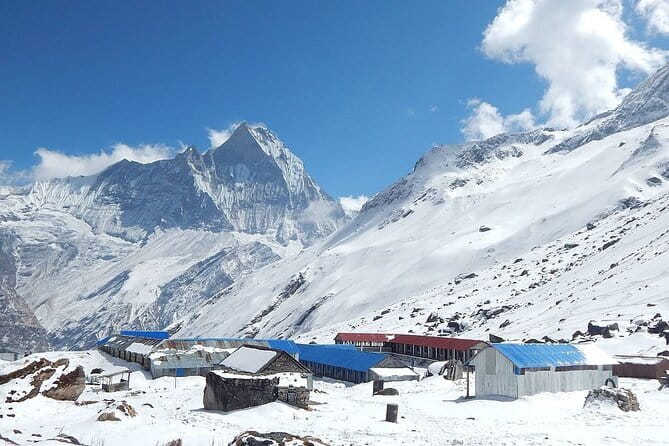
Annapurna Base Camp gives you a big Himalayan goal without asking you to cross a high mountain pass. The route climbs from village paths near Ghandruk to Annapurna Base Camp at 4,130 meters, then drops through Bamboo to the hot springs at Jhinu Danda. You get snow peaks, local teahouses, and a clear sense of progress each day.
I like the private-group setup, which keeps the pace and daily decisions within your own party. I also like the practical package: permits, guide, porter support, airport transfers, Kathmandu and Pokhara lodging, meals, snacks, and a company duffel bag are all covered. The main caution is the altitude and the long walking days. A moderate fitness level is required, and the short 11-day schedule leaves little spare time if weather or fatigue causes delays.
Key points to know before booking
- Reach 4,130 meters at Annapurna Base Camp, the highest point of the route.
- Start and finish with Pokhara, giving the trek a useful break from Kathmandu traffic and airport routines.
- Sleep in teahouses, with basic mountain lodging rather than resort comfort.
- Use a guide and shared porter service, with one porter provided for every two people.
- Finish at Jhinu Danda’s hot spring, a welcome reward after the descent from the high country.
- Expect a private trip at $1,099, with major trekking costs included but insurance, visas, and personal gear extra.
Why this 11-day route works
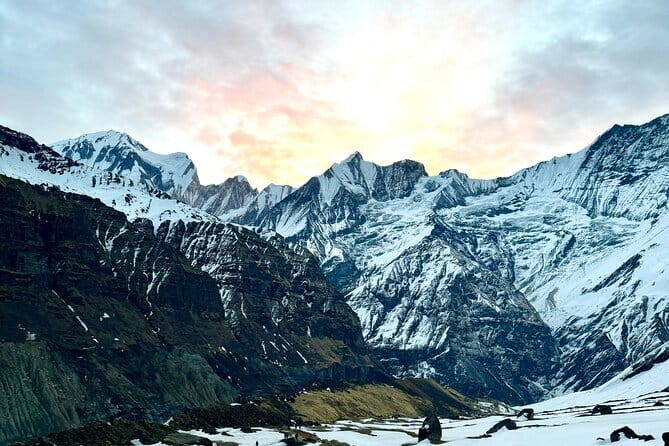
I see this as a compact introduction to Himalayan trekking. You are not spending the whole trip in one remote valley. The plan links Kathmandu, Pokhara, traditional mountain villages, forest paths, high-altitude scenery, and a hot spring before returning to the cities.
The route is also sensible in broad outline. You gain height gradually from Pokhara at about 820 meters, pass through Ghandruk at 1,940 meters and Chomrong or Sinuwa, then continue upward to Deurali at 3,230 meters before the final climb to base camp. After reaching 4,130 meters, you descend quickly toward Bamboo and Jhinu Danda.
That descent matters. Annapurna Base Camp is the dramatic target, but the return route gives your legs a break from constant climbing. You will still work hard, but the trip is not an 11-day uphill grind.
The tour is described as a private activity, so only your group participates. That is useful if you want to walk at your own pace, stop for photos, or keep the group small. The tradeoff is that private trekking can feel less social than joining a large group, though you will still share teahouse areas and trails with people from many countries.
More Annapurna Treks in Kathmandu
- Annapurna Circuit Trek with Tilicho Lake
★ 5.0 · 368 reviews - Annapurna base camp trek 5 Days
★ 5.0 · 252 reviews - 14-Day Private Annapurna Base Camp Trek
★ 5.0 · 180 reviews
Kathmandu to Pokhara: the trip gets moving
Day one begins with airport pickup and a hotel transfer in Kathmandu. The plan allows time to prepare for the trek and sleep in Kathmandu. Two nights of Kathmandu accommodation with breakfast are included in the overall package, though the listed schedule shows the first overnight here and the final departure from Kathmandu.
Your arrival day may be tiring after an international flight, so the preparation time is useful. You should use it to check your personal equipment, organize your day pack, and confirm what goes into the company duffel bag. The duffel is included, as is a company T-shirt.
On day two, you take a tourist bus from Kathmandu to Pokhara. This is a practical choice rather than a luxurious one. Bus travel keeps the price down and connects the two cities without adding another flight to the plan. You overnight in Pokhara at about 820 meters, with breakfast included.
Pokhara is more than a transit stop. It gives you a lower-altitude night before the walking begins and breaks up the journey. You also return here after the trek, with a second included night before heading back to Kathmandu.
The meeting point is Serene Himalaya Treks and Expedition on Chaksibari Marg in Kathmandu, with a stated start time of 6:45 am. The booking information identifies the experience provider as Overland Trek Nepal, while the meeting point and tour description use the Serene Himalaya name. I would confirm the exact office and operating company before departure so there is no confusion on the first morning.
Ghandruk brings the first real mountain walking
Day three starts with private transport from Pokhara to Nayapul, a journey listed at about 1.5 hours. From Nayapul, you begin walking toward Ghandruk at 1,940 meters.
This is where the trip changes character. You leave the city behind and move into a mountain route with village life, stone paths, and views toward the Annapurna range. Ghandruk is a strong first trekking stop because it is high enough to feel like the mountains have begun, but not yet so high that altitude dominates the day.
I like the use of private transport for the Pokhara to Nayapul connection. It removes one layer of local transport uncertainty and lets your guide manage the start of the walking section. You will still want comfortable shoes, water, and a light day pack close at hand.
Teahouse accommodation is included throughout the trek. This means simple lodging designed around walkers, not polished hotel rooms. The package also includes staff accommodation, food, salaries, insurance, and medicine for the guide and support team.
Chomrong and Sinuwa set up the climb
On day four, you trek from Ghandruk to Chomrong at 2,230 meters, or possibly to Sinuwa. The exact overnight stop can depend on pace and local conditions, so you should see this as a flexible part of the schedule.
Chomrong is an important point on the route because the next days carry you deeper toward the high mountains. Sinuwa is lower, at least in the listed route sequence, and may make the following day longer. Ask your guide which overnight stop is planned for your group and how that affects the next morning.
The route does not include a separate acclimatization day. That is the biggest practical issue for anyone comparing this trip with longer Annapurna Base Camp programs. You gain altitude steadily and reach 4,130 meters within a few walking days, so you need to take symptoms seriously and tell your guide if you feel unwell.
The tour is designed for people with moderate physical fitness. That phrase should not be treated lightly. You need to manage repeated walking days, uphill and downhill sections, basic lodging, and changing weather. You do not need to be a technical climber, but you should be ready for a demanding trek.
Another trail to compare in Kathmandu:
- Everest Base Camp Trek – 14 Days
★ 5.0 · 1,499 reviews - Everest Base Camp Trek
★ 5.0 · 842 reviews - Everest Base Camp Trekking
★ 5.0 · 485 reviews - Everest Base Camp Trekking – 13 Day
★ 5.0 · 365 reviews
Sinuwa to Deurali: forest gives way to high country
Day five runs from Sinuwa to Deurali at 3,230 meters. This is one of the more important days for pacing because the elevation rises sharply compared with the opening stages.
The route description gives no exact walking hours, so I would not plan other activities around the daily schedule. Start early, keep your pack light, and use the porter arrangement well. One porter is provided for every two people, so you will need to agree with your companion about shared luggage and keep only essentials with you during the day.
The included food helps keep the logistics straightforward. The package lists 10 breakfasts, 8 lunches, and 7 dinners, along with tea house accommodation. Snacks include biscuits or Oreo cookies, peanuts, fruit such as apples or pomegranates, and one Snickers chocolate per person during the trek.
That is a thoughtful touch on a route where small calories can matter. Still, the food plan is not all-inclusive outside the stated meals. Lunch and dinner in Kathmandu and Pokhara are excluded, and drinks, bottled water, hot water, battery charging, donations, and other personal purchases are extra.
At Deurali, the experience becomes more serious. You are sleeping above 3,000 meters and preparing for the route’s highest point. This is the place to listen to your guide, drink enough water, and avoid treating the next day as a race.
Annapurna Base Camp at 4,130 meters
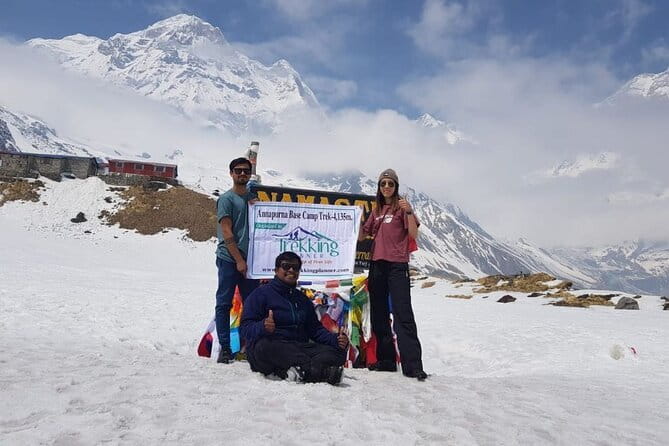
Day six is the central event: Deurali to Annapurna Base Camp. The itinerary lists the base camp elevation as 4,130 meters.
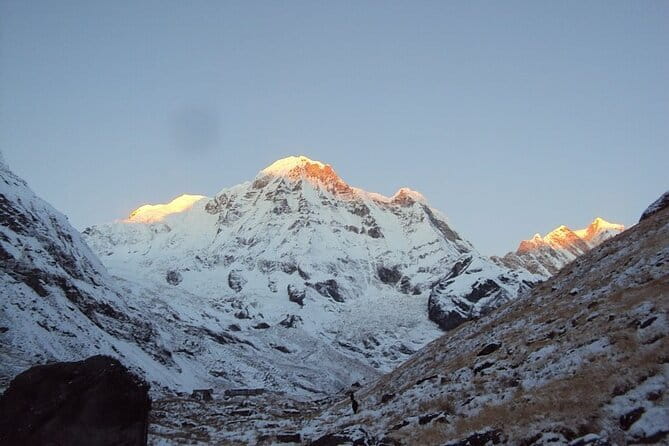
The value of this day is not just reaching a sign or checking off a name. You have moved from low valleys and villages into a high mountain setting where the Annapurna massif becomes the focus. The supplied feedback describes the panoramic Annapurna views in October as a major highlight, and October is also identified in that account as the month of one successful trip.
Weather controls how much you see. Mountain conditions can change, and the operator states that the experience requires good weather. If poor weather forces cancellation, you are offered another date or a full refund. That policy is reassuring, but it does not remove the need for flexibility.
The base camp overnight is one of the more demanding parts of the itinerary. The schedule moves from Deurali to base camp in a single day, so you should expect a serious effort. No walking times are provided, and I would not assume an easy or short day.
At this altitude, your guide’s role is especially important. Nick is named in the supplied account as part of the team connected with an October 2024 Annapurna Base Camp trip, along with guides and porters. However, the booking details do not promise that Nick will lead every departure, so confirm the assigned guide if that matters to you.
The return through Bamboo and Jhinu Danda
Day seven descends from Annapurna Base Camp to Bamboo at 2,310 meters. This is a welcome loss of altitude, although downhill walking can be tough on knees and ankles after the previous day.
Bamboo is a practical overnight stop that breaks up the return rather than forcing one very long descent. The forested setting and lower elevation should feel easier than base camp, but you still need to watch your footing and manage fatigue.
Day eight continues from Bamboo to Jhinu Danda at 1,780 meters. The listed reward is a hot spring, and it is easy to understand why this stop belongs in the itinerary. After several days of steep trails and basic mountain lodging, warm water offers a simple physical reset.
The hot spring is also one of the route’s most human touches. Annapurna Base Camp supplies the great mountain moment. Jhinu Danda supplies the relief afterward. I like that the itinerary includes both rather than ending immediately after the summit day.
On day nine, you trek from Jhinu Danda to Nayapul, then take transport back to Pokhara. You overnight in Pokhara, with breakfast included. The return drive means you can finish the walking section without adding another night on the trail.
What the $1,099 price covers
At $1,099, this is not a bare trek where you only pay for a guide and find everything else yourself. The price includes airport pickup and drop-off, trekking permits, the Annapurna Conservation Area entry permit, teahouse accommodation, an English-speaking guide, porter support, staff insurance and medicine, and ground transport listed in the schedule.
It also covers two nights in Kathmandu with breakfast and two nights in Pokhara with breakfast. The Pokhara to Nayapul transfer is private, while the longer Kathmandu to Pokhara and return legs use tourist buses.
The package includes a TIMS card, company duffel bag, T-shirt, medical kit, trip certificate, government taxes, and local taxes. Those details add real value because permits, staff costs, luggage support, and transfers can quickly become a pile of separate expenses.
You still need to budget for international airfare, the Nepal entry visa, travel insurance, emergency evacuation, personal equipment, water, cold drinks, battery charging, hot water, donations, and tips. Tipping is expected for the guide and porter. Lunch and dinner in Kathmandu and Pokhara are also on you.
I would regard the price as good value for a first-time Nepal trek if you already own suitable clothing and boots. It is less attractive if you need to buy all your personal gear or want a long acclimatization schedule with spare days.
Who will get the most from this trek
I would recommend this trip to an active first-time Himalayan trekker who wants a clear goal and a managed route. The guide, permits, porter arrangement, accommodation, meals, and transfers take care of the major moving parts.
It also suits couples, friends, or families of adults who prefer a private group rather than a fixed large departure. The private format gives you more say in the daily rhythm, though the mountain schedule still sets limits.
I would think twice if you dislike basic lodging, have no experience with several consecutive walking days, or need a generous weather buffer. The 11-day plan is efficient, but it is not leisurely.
Before booking, ask about the exact walking hours, the planned overnight stop between Ghandruk and Sinuwa, the number of people in your private party, the assigned guide, and how altitude concerns are handled. Those answers will tell you more about the day-to-day experience than the headline price.
Should you book the Annapurna Base Camp Trek?
I would book it if your priority is reaching Annapurna Base Camp with the main practical costs organized for you. The route offers a strong mix of village walking, high mountain views, teahouse life, porter support, and a hot spring finish.
I would not choose it if you want a slow acclimatization program or a luxury trek. The rapid climb to 4,130 meters and the long walking days demand respect.
For the right person, this is a focused and fairly priced Himalayan trip. Pack light, train for hills, buy travel insurance that covers trekking and emergency evacuation, and keep a little flexibility in your plans. The mountain views are the headline, but the well-planned return through Bamboo and Jhinu Danda may be what makes the whole journey feel manageable.
FAQ
How long does the Annapurna Base Camp Trek take?
The planned duration is approximately 11 days, including arrival in Kathmandu, transport to and from Pokhara, the trek, and departure.
What is the highest point of the trek?
Annapurna Base Camp is listed at 4,130 meters.
Is the trek private?
Yes. The experience is described as a private activity, with only your group participating.
What accommodation is included?
Two nights in Kathmandu and two nights in Pokhara with breakfast are included. During the trek, you stay in teahouses.
Is a guide included?
Yes. An English-speaking guide is included, along with guide and staff costs, insurance, and medicine.
Is porter service included?
Yes. The package provides one porter for every two people as a basic arrangement.
What is not included in the price?
International airfare, Nepal’s entry visa, travel insurance, emergency evacuation, personal equipment, water, cold drinks, battery charging, hot water, donations, tips, and other unlisted expenses are not included. Lunch and dinner in Kathmandu and Pokhara are also excluded.
Latest treks added in Kathmandu
- Private Manaslu Circuit Trek at Himalayas★ 5.0 · 3 reviews
- Ghorepani Poonhill Trek★ 5.0 · 5 reviews
- Ghorepani Poon Hill Trek★ 5.0 · 16 reviews
- Upper Mustang Trekking★ 3.0 · 2 reviews
- Amazing 1 Day Trekking Experience in Kathmandu Nepal★ 5.0 · 24 reviews
- Upper Mustang Trekking★ 5.0 · 2 reviews
- Upper Mustang Trek★ 5.0 · 5 reviews
- Upper Mustang Trekking★ 5.0 · 4 reviews
Annapurna Base Camp Treks, compared.




Trekking in Annapurna/Langtang/Everest/Upper Mustang regions
Read our review →


Kathmandu to Annapurna Base Camp (ABC) 5-Day Trek
Read our review →Browse the lists this tour appears in