
REVIEW · KATHMANDU
Annapurna Base Camp Trek
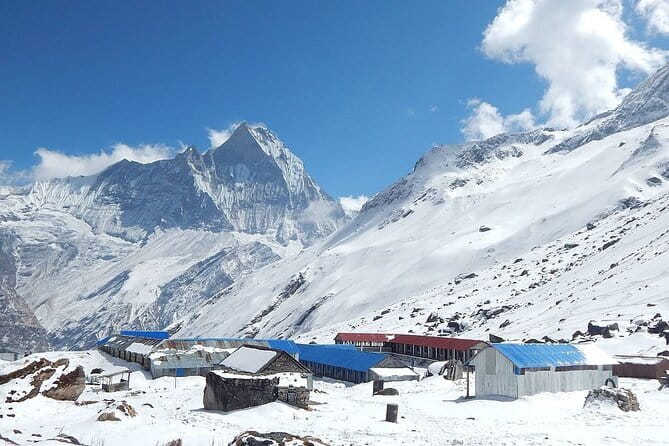
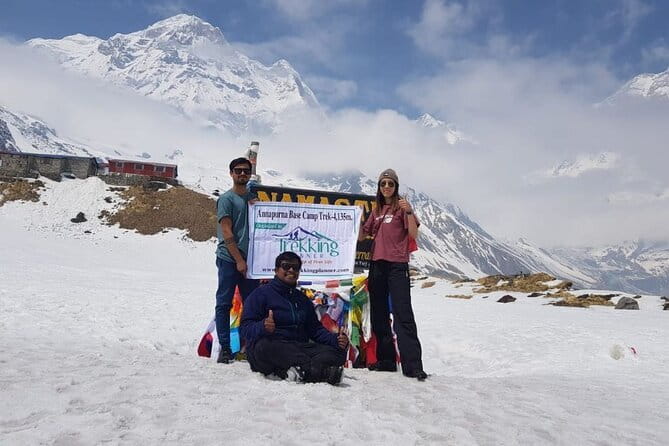
Annapurna Base Camp is the big prize here: after days of stone steps, forest trails, waterfalls, and mountain villages, you reach a high basin ringed by Himalayan peaks at 4,130 meters. It is a dramatic payoff, but getting there requires real effort, especially on the steep trail between Jhinu Danda, Bamboo, Deurali, and Machhapuchhre Base Camp.
I like the way this trip combines a properly supported trek with time in Kathmandu and Pokhara. I also like the practical package: guides, porters, meals, permits, a first-aid kit, sleeping bags, and down jackets are included. The main point to check is transportation between Kathmandu and Pokhara, since the description refers to a short flight while the day-by-day plan also describes a five- to six-hour drive.
Key points to know before booking
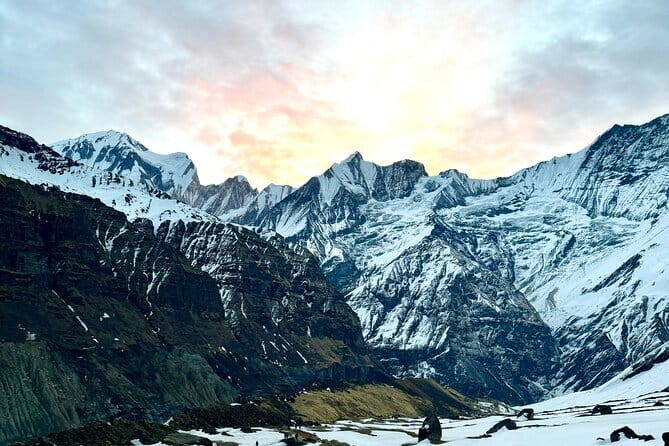
- Annapurna Base Camp at 4,130 meters: The route reaches the base camp after passing Machhapuchhre Base Camp, with views of Annapurna I, Annapurna South, Hiunchuli, Fishtail, Annapurna III, and Ganggapurna.
- A demanding but manageable mountain route: You should have moderate physical fitness for steep stone steps, long downhill sections, rough paths, and altitude.
- Gurung villages and forest trails: The route passes through Jhinu Danda, Chhomrong, Bamboo, Dovan, Deurali, and other settlements, with rhododendron, oak, and bamboo forest along the way.
- Two hot-spring stops: Jhinu Danda gives you a chance to relax in natural hot springs on the way up and again after returning from base camp.
- Strong logistical support: One porter is provided for every two trekkers, with a maximum load of 30 kilograms, while an assistant guide, permits, meals, and mountain gear are included.
- A small group of up to 15 people: This is more personal than a large coach tour, but it is still a group trek rather than a private walk.
What the $906.67 price covers
At $906.67 per person, this trip is priced as a supported trekking package rather than a simple guided walk. The cost includes three nights in Kathmandu, two nights in Pokhara, lodging and food during the trek, transportation, permits, guide services, porter support, a first-aid medical box, VAT, company service charges, and a farewell dinner.
That list matters because mountain costs add up quickly. The Annapurna Conservation Area fee and TIMS card are included, so you do not need to arrange those separately. You also receive a sleeping bag and down jacket on rent, useful if you do not want to buy bulky cold-weather gear for one trek.
Food is included on the mountain route, with breakfast, lunch, and dinner listed for the trekking days. Food in Kathmandu and Pokhara is not included, nor are international flights, the Nepal visa, insurance, rescue costs, extra baggage, personal spending, or tips for the guide and porters.
The price is strongest for someone who wants a single booking to handle the main moving parts. If you already have mountain equipment, do not need hotel nights, or plan to arrange your own transport, you may find a cheaper independent setup. The value here is convenience and support, not bare-bones travel.
More Annapurna Treks in Kathmandu
- Annapurna Circuit Trek with Tilicho Lake
★ 5.0 · 368 reviews - Annapurna base camp trek 5 Days
★ 5.0 · 252 reviews - 14-Day Private Annapurna Base Camp Trek
★ 5.0 · 180 reviews
Days 1 and 2: Kathmandu to Pokhara
Your first day begins with airport pickup at Tribhuvan International Airport. After immigration, a representative drives you to Hotel Green Horizon in Thamel, Kathmandu’s main tourist district. The stated airport transfer can take up to two hours, depending on traffic and arrival conditions.
Thamel is a useful base before a trek. You are close to restaurants, shops, trekking services, and the company’s meeting point at Pyramid Galli. The hotel stay gives you a place to rest and meet the team before leaving the capital.
The next day begins with a trek briefing and an introduction to your guide. One guide named in the supplied material is Shiva, and the porter is Bishal. Suman is identified as the airport greeter. If those staff members are assigned to your departure, you will have a clear point of contact from the moment you land.
The plan for reaching Pokhara needs clarification. The overview describes a roughly 30-minute flight, while the day-by-day details describe a scenic road journey through hills, terraces, rivers, a picnic stop, and a holy temple. Since the return to Kathmandu is specifically described as a five- to six-hour drive, ask the operator if your departure uses flights, road transport, or a mix of both.
Pokhara is a welcome change of pace. You stay near Lakeside, where you can walk along the busy tourist area, browse souvenirs, and prepare for the mountain section. This is not just a transfer point. It gives you time to settle in before the trail begins.
Day 3: Nayapul, river trails, and Jhinu Danda
The trek starts after a drive of about an hour and a half to Nayapul. This is a familiar gateway into the Annapurna region, with remote settlements, temples, rivers, and mountain views along the road.
From Nayapul, the trail follows the Modi River toward Jhinu Danda. You pass Chandrakot, Pritam Deurali, Tolga, and Landruk, with suspension bridges and stone steps along the way. The route rises and falls rather than simply climbing in a straight line, so the first day can feel harder than the distance suggests.
Jhinu Danda is especially appealing because of its natural hot springs. The springs sit below the settlement, and reaching them adds another walk after the main hiking day. Bring swimwear and a small towel if you want to use this stop, though the supplied details do not specify whether towels are provided.
The overnight stay here gives you an early taste of village life and mountain lodging. You should expect simple conditions on the trekking section, not city-hotel comfort. That tradeoff is part of the experience, but it is worth understanding before you commit to eleven days on the road and trail.
Day 4: Chhomrong and the Bamboo forest
The fourth day covers roughly six hours, with steep sections between Jhinu Danda and Chhomrong. You climb through terraces and reach Chhomrong after passing Nayagaon and crossing the Chhomrong River.
This is a day of repeated steps. You may descend to a river only to climb again toward a ridge above the Modi River. The stone stairways are practical but tiring, especially after the first full day of hiking.
From Chhomrong, the route continues through terraced fields, smaller settlements, bamboo forest, and rougher trail sections toward Siruwa. You then pass Kuldighar, once associated with a sheep-breeding project, before descending through rhododendron and bamboo forest to Bamboo.
The name Bamboo is accurate. The forest gives this part of the trail a cooler, enclosed feel, while the later section becomes steeper. Staying near Bamboo positions you well for the next stage, but do not mistake the shorter-looking mountain distances for easy walking. Stone steps and uneven ground slow the pace.
Another trail to compare in Kathmandu:
- Everest Base Camp Trek – 14 Days
★ 5.0 · 1,499 reviews - Everest Base Camp Trek
★ 5.0 · 842 reviews - Everest Base Camp Trekking
★ 5.0 · 485 reviews - Everest Base Camp Trekking – 13 Day
★ 5.0 · 365 reviews
Day 5: Dovan, waterfalls, and Deurali
This is described as a shorter day, designed to prepare you for the higher route ahead. You cross a stream and climb gradually through rhododendron and oak forest toward Dovan.
The trail becomes more rugged as you continue toward Himalaya Hotel. A waterfall crossing and steep sections add effort, while openings in the forest give you views of the Modi River and surrounding peaks. The contrast is striking: thick vegetation below, rockier ground above.
Near Hinku Cave, you can see toward Deurali. The final ascent takes about 45 minutes, with vegetation thinning and the trail becoming more rocky. This change is a useful warning about the days ahead. You are leaving the forest zone and entering a colder, more exposed part of the route.
Deurali is not a sightseeing stop in the usual sense. Its value is its position on the route and the gradual adjustment it gives you before base camp. Follow your guide’s pace here. The included first-aid kit is useful support, but it does not replace travel insurance or coverage for rescue.
Day 6: Machhapuchhre Base Camp to Annapurna Base Camp
This is the main event. You leave Deurali and continue toward Machhapuchhre Base Camp, also known as Fishtail Base Camp. The trail passes Bagar and becomes more strenuous as the valley opens and vegetation becomes sparse.
At Machhapuchhre Base Camp, you gain wide views of Fishtail, Hiunchuli, Annapurna South, Annapurna I, Annapurna III, and Ganggapurna. This stop is more than a name on the route. It gives you a chance to pause before the final push to Annapurna Base Camp.
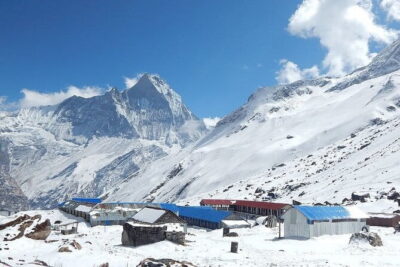
The path then turns away from the Modi River. It widens in places, but the altitude and exposed terrain make the walk demanding. When you reach Annapurna Base Camp, the mountains surround you on all sides, with little to interrupt the view.
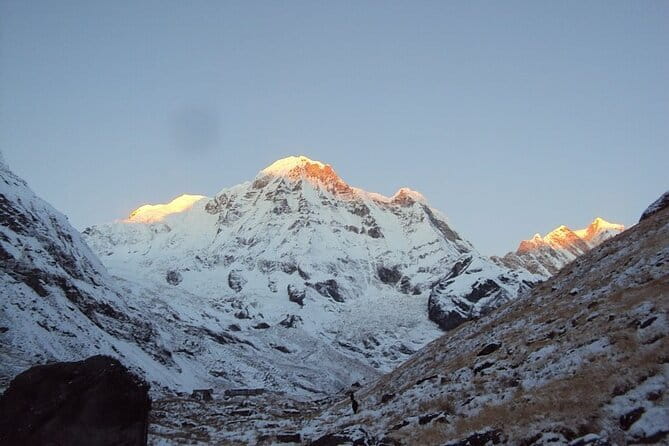
You stay overnight at this high point. That overnight stay is a major strength of the itinerary because you are not rushing in, taking a quick photo, and immediately returning downhill. You have time to take in the setting and, if conditions allow, watch the early light over the peaks.
Still, altitude is the serious concern. The itinerary rises to 4,130 meters in a relatively short number of trekking days. You should take symptoms such as headache, nausea, unusual tiredness, or poor coordination seriously and tell your guide at once. The tour calls for moderate fitness, but fitness alone does not prevent altitude problems.
Day 7: Sunrise and the long return to Bamboo
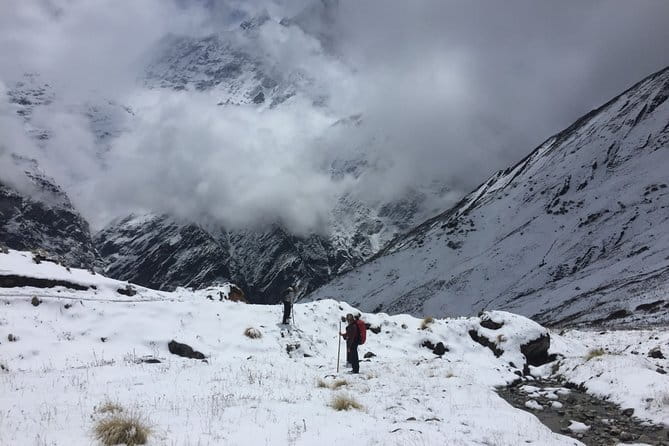
The return begins with what may be the finest view of the trek: sunrise over the Annapurna range. After that, you retrace the route toward Bamboo, mostly losing elevation along the Modi River.
Downhill is not automatically easy. Seven hours of descending can be hard on knees and ankles, particularly after the high-altitude overnight. You pass an avalanche-prone area, Deurali, Dovan, wooden bridges, and the forest zones lower down.
The return route gives you a different view of places you saw on the way up. Forest details become easier to notice when you are no longer focused on gaining height, and the warmer, greener surroundings are a welcome change after the exposed base-camp section.
Bamboo is a practical overnight stop. It breaks up the descent and keeps the next day from becoming an even longer push. If you use the porter service, keep your daypack light with water, layers, sunscreen, and anything you need during the day.
Day 8: Chhomrong steps and a second hot spring
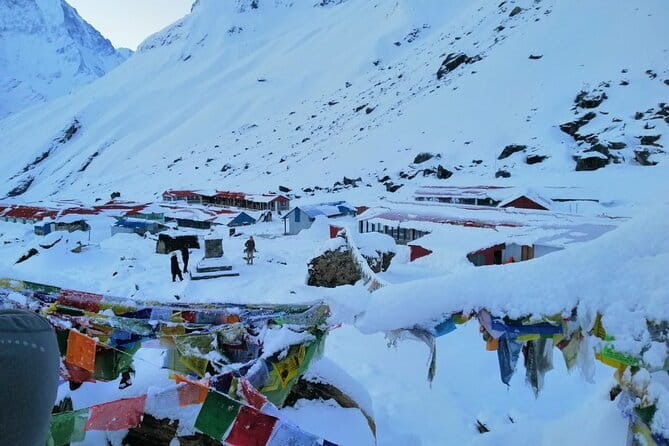
You retrace the trail through Khuldighar and Sinuwa, following a twisting route past Tilche and Chhomrong. The day takes about six hours, but the stone steps and repeated climbs still require steady effort.
The route includes a bridge, steep steps, and Taulung village, where trails branch toward Landruk, Tadapani, and Kot Danda. These junctions show how connected the Annapurna trekking network is, even though your route stays focused on the base camp path.
After about an hour beyond the main section, you reach Jhinu Danda again. This second visit is well timed. The hot springs offer a chance to relax muscles that have taken a beating from the high-altitude climb and long descent.
Do not count on the springs to erase all fatigue. You still have a final trekking day, and soaking is best treated as a pleasant extra rather than a substitute for rest and hydration.
Day 9: Nayapul and back to Pokhara
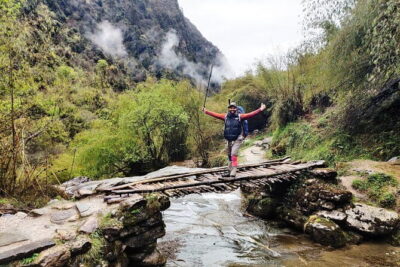
The last trekking day follows the Modi Khola valley from Jhinu Danda toward New Bridge and Nayapul. You descend stone steps and hillside paths, passing farms, fields, wooden bridges, suspension bridges, and traditional houses.
The valley gradually widens as you lose elevation. You also see more cultivation and larger fields, a clear contrast with the rocky high country around Annapurna Base Camp.
Nayapul marks the end of the physical trek. From there, transport takes you back to Pokhara for another night at Lakeside. Food in Pokhara is at your own expense, so budget for dinner and any extra snacks or drinks.
This night is useful even if you are eager to return to Kathmandu. It gives your body a pause after the trail and leaves time for a walk around Lakeside before the final transfer.
Days 10 and 11: Kathmandu and departure
The return to Kathmandu is described as a scenic five- to six-hour drive through hills, terraces, valleys, and river country. After the quiet of the trail, the capital can feel hectic, so the final evening is best kept flexible.
The plan includes time at Kathmandu Durbar Square, with its stone-paved palace area and surrounding streets. You can also shop for souvenirs in Thamel before returning to your hotel.
Your final day includes a transfer to Tribhuvan International Airport at least three hours before your flight. The airport drop-off is included, but your international flight and any extra baggage charges are not.
The schedule leaves little room for major delays. If weather, road conditions, or other changes add a night in Kathmandu, that extra accommodation and food are not covered. Keep your international itinerary flexible enough to avoid a tight same-day connection.
Guides, porters, and group size
The group limit is 15 people, which keeps the trek small enough for a guide to monitor the pace and trail conditions. It is still a shared group, so you should expect to walk at the group’s general speed rather than set your own private schedule.
An English-speaking guide leads the route, with an assistant guide and one porter for every two trekkers. The maximum porter load is listed as 30 kilograms. Pack responsibly and ask how that limit is divided before departure, since lighter bags make the walking day easier for everyone.
The supplied details identify Shiva as a guide and Bishal as a porter, while Suman handles an airport welcome. If you want to know your exact team in advance, ask the operator after booking.
Tips are not included. You should set aside money for the guide and porters, along with personal expenses and drinks outside the included meals.
Who should book this trek?
This trip suits you if you want Annapurna Base Camp without arranging every permit, hotel, transfer, meal, and porter yourself. It is also a good fit if you value the village route, forest scenery, hot springs, and a full overnight stay at base camp rather than a rushed mountain excursion.
You should be comfortable with long walking days, steep stone steps, rough trails, and a high point of 4,130 meters. The word short in the trek’s name refers to the route compared with longer Himalayan journeys, not to an easy holiday.
I would be cautious about booking if you have not prepared for sustained uphill and downhill walking, or if you need a high degree of comfort. Mountain lodges are simpler than the Kathmandu and Pokhara hotels, and weather or road changes can affect the schedule.
Free cancellation is available if you cancel at least 24 hours before the start time. Changes or cancellations inside that window are not accepted for a refund.
Should you book the Annapurna Base Camp trek?
I would book this trip if you want a well-supported route with a clear goal, strong scenery, and useful inclusions at a single price. The best parts are the gradual move from villages and forest into high mountain country, the hot springs at Jhinu Danda, and the dramatic arrival at Annapurna Base Camp.
Before paying, confirm two points: the exact Kathmandu to Pokhara transport and the lodging standard during the trek. If those details suit you, the package offers a practical way to reach one of Nepal’s most memorable mountain viewpoints without managing the entire operation yourself.
FAQ
How long is the Annapurna Base Camp trek?
The full experience lasts about 11 days, including time in Kathmandu and Pokhara, the trek to Annapurna Base Camp, the return walk, and airport transfers.
How high is Annapurna Base Camp?
Annapurna Base Camp is at an altitude of 4,130 meters above sea level.
Is transportation from Kathmandu to Pokhara included?
Transportation costs are included, but the schedule gives different details. The overview describes a roughly 30-minute flight, while the itinerary describes a scenic road journey. Confirm the exact arrangement before booking.
Are meals included?
Breakfast, lunch, and dinner are included during the trekking section. Food in Kathmandu and Pokhara is not included.
Are a guide and porter included?
Yes. The package includes an English-speaking trekking guide, an assistant guide, and one porter for every two trekkers, with a maximum porter load of 30 kilograms.
Is trekking equipment provided?
Sleeping bags and down jackets are available to rent through the tour. Trekking permits, including the TIMS card and Annapurna Conservation Area fees, are also included.
Latest treks added in Kathmandu
- Private Manaslu Circuit Trek at Himalayas★ 5.0 · 3 reviews
- Ghorepani Poonhill Trek★ 5.0 · 5 reviews
- Ghorepani Poon Hill Trek★ 5.0 · 16 reviews
- Amazing 1 Day Trekking Experience in Kathmandu Nepal★ 5.0 · 24 reviews
- Upper Mustang Trekking★ 5.0 · 2 reviews
- Upper Mustang Trekking★ 3.0 · 2 reviews
- Upper Mustang Trek★ 5.0 · 5 reviews
- Upper Mustang Trekking★ 5.0 · 4 reviews
Annapurna Base Camp Treks, compared.
Trekking in Annapurna/Langtang/Everest/Upper Mustang regions
Read our review →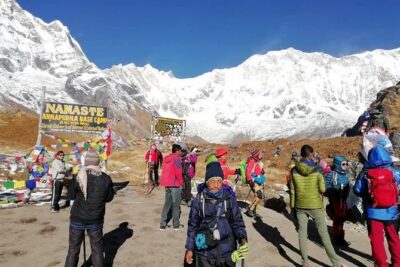
Kathmandu to Annapurna Base Camp (ABC) 5-Day Trek
Read our review →Browse the lists this tour appears in