
REVIEW · KATHMANDU
Annapurna Base Camp Trek
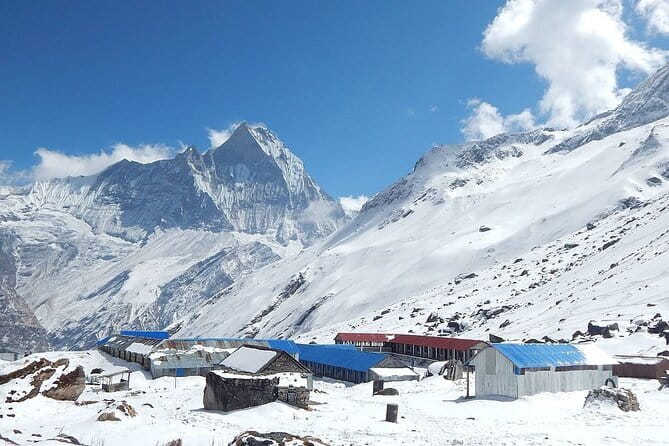
Annapurna Base Camp is the prize here, but the route earns its keep long before you reach 4,130 meters. You walk through rhododendron and bamboo forests, Gurung villages, Buddhist sites, and high mountain country, with Annapurna and Machhapuchhre appearing as the trail climbs. I especially like the full-board trekking meals and the practical support of a guide, porter, permits, duffel bag, and sleeping bag included in the price.
I also like the smart route design: a night in Pokhara breaks up the long road journey, while Jhinu Danda gives you a gentler final trekking day. The main caution is that the $240 price is unusually low for a package described as luxury. The included lodging is a best-available twin-share teahouse room, not a private high-end mountain lodge, and hot showers, drinks, insurance, tips, and several city meals cost extra.
Key points at a glance
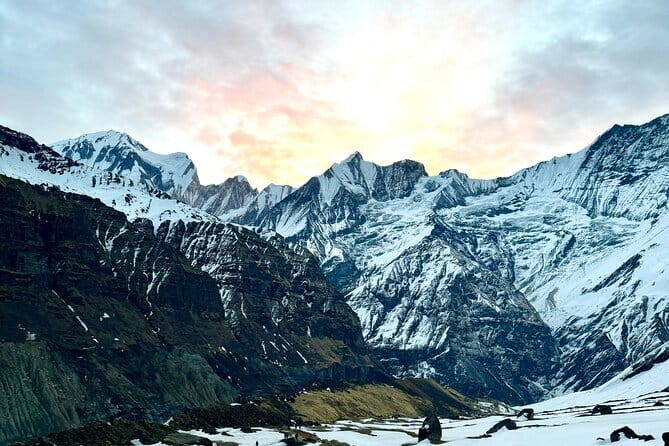
- Annapurna Base Camp at 4,130 meters: The high point comes on Day 6, after a steady climb through Deurali and the upper valley.
- Ghandruk start: Your first trekking night is in a traditional Gurung village at 1,940 meters.
- Porter support included: One porter is provided for every two people, with a duffel bag and sleeping bag supplied for the trek.
- Pokhara breaks up the route: The 200-kilometer road journey from Kathmandu takes about 7 to 8 hours each way.
- Full board in the mountains: Breakfast, lunch, dinner, and tea or coffee are included during the trekking section.
- Jhinu Danda on the way back: The route descends to 1,780 meters before returning to Pokhara.
What this Annapurna Base Camp package really offers
This is an organized mountain trek with a useful amount of support at a very competitive price. The program lasts about 11 days in the detailed schedule, though the overview describes it as 12 days. That small mismatch is worth clearing up before you pay, especially if you are arranging flights around the trip.
The trek is described as luxury, but I would read that word carefully. You receive a 3-star hotel in Kathmandu and Pokhara, an English-speaking government-licensed guide, porter help, meals in the mountains, permits, a sleeping bag, and basic first aid supplies. Those inclusions remove several common hassles.
At the same time, mountain accommodation is listed as best-available twin-sharing teahouse lodging. You should expect practical, simple rooms rather than polished resort comforts. Hot showers are not included, and bottled water, alcohol, and other drinks are extra. The package gives you support and convenience, but not a lavish standard at every stop.
The strongest value comes from the combination of permits, transport, staff, food, and gear. You do not have to arrange the Annapurna Conservation Area Permit or TIMS card yourself. One porter for two people also means you can carry a lighter daypack, although you should still pack carefully because personal laundry and other extras are yours to pay for.
More Annapurna Treks in Kathmandu
- Annapurna Circuit Trek with Tilicho Lake
★ 5.0 · 368 reviews - Annapurna base camp trek 5 Days
★ 5.0 · 252 reviews - 14-Day Private Annapurna Base Camp Trek
★ 5.0 · 180 reviews
Kathmandu arrival and the road to Pokhara
Day 1 is a soft landing. A representative meets you at Tribhuvan International Airport and takes you to your Kathmandu hotel, a transfer listed at roughly 30 to 45 minutes. Breakfast is included, though the schedule gives little detail about sightseeing or a formal trek briefing.
That matters because you may want to use this first day to confirm packing, ask about the walking schedule, and check what your porter will carry. Your hotel in Kathmandu is included, but lunch and dinner there are not.
On Day 2, you leave Kathmandu for Pokhara. The road distance is about 200 kilometers, yet the drive takes 7 to 8 hours. That is a long day on the road, so do not think of this as a quick transfer. The reward is Pokhara, a lower-altitude city at 822 meters, which gives you a change of pace before the trail begins.
The drive is included in a tourist bus, not a private vehicle. That keeps the price down, but it also means the day is less flexible. If you prefer to avoid a full day by road, this package does not list a flight alternative.
Ghandruk gives the trek its character
On Day 3, the group travels from Pokhara toward Nayapul, about 41 kilometers, then walks roughly 5 kilometers to Ghandruk. The drive takes 2 to 3 hours, followed by 3 to 4 hours of trekking. The village sits at about 1,940 meters.
Ghandruk is an excellent first walking stop because it brings you into the cultural side of the route right away. The program highlights traditional Gurung villages, and Ghandruk is the place where the trek begins to feel like more than a mountain transfer. You are no longer simply heading toward a summit point. You are moving through settled hill country, with local villages and daily life along the trail.
Breakfast, lunch, and dinner are included from this day onward. That full-board arrangement is useful because food choices can be limited in mountain villages, and you do not need to keep calculating every meal.
Sinuwa and Deurali build the altitude slowly
Day 4 covers about 12 kilometers from Ghandruk to Sinuwa, taking 6 to 7 hours. The trail descends toward the Kimrong Khola before climbing again. This up-and-down pattern is typical of Himalayan routes: a day can look moderate on paper but still feel demanding because every descent must be climbed again.
Sinuwa sits at 2,340 meters, so the itinerary raises your sleeping altitude in a measured way rather than rushing straight into the high country. You should still treat the schedule seriously. Six or seven hours on foot is a full day, and the combination of uneven trail, stairs, and repeated climbs can test your legs.
On Day 5, you walk about 10 kilometers to Deurali. The route passes through bamboo forest and continues upward to roughly 3,200 meters. Again, the walking time is listed as 6 to 7 hours.
This is where the forest setting begins to change. The earlier section features lush vegetation, while Deurali marks a higher, cooler part of the valley. Your guide is especially important here, not just for route finding but for keeping the pace sensible. The package requires moderate physical fitness, and that description should be taken seriously.
Another trail to compare in Kathmandu:
- Everest Base Camp Trek – 14 Days
★ 5.0 · 1,499 reviews - Everest Base Camp Trek
★ 5.0 · 842 reviews - Everest Base Camp Trekking
★ 5.0 · 485 reviews - Everest Base Camp Trekking – 13 Day
★ 5.0 · 365 reviews
Annapurna Base Camp at 4,130 meters
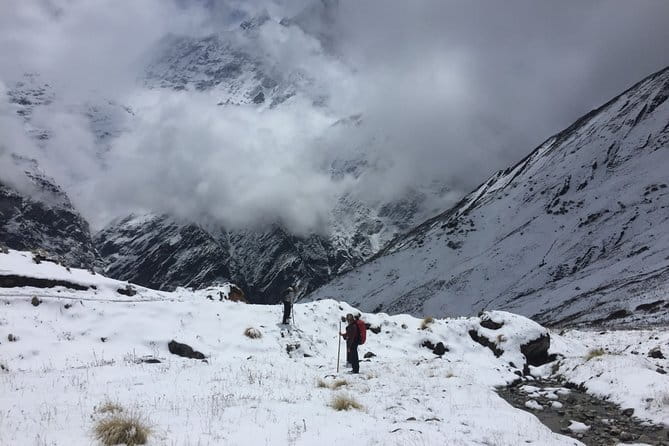
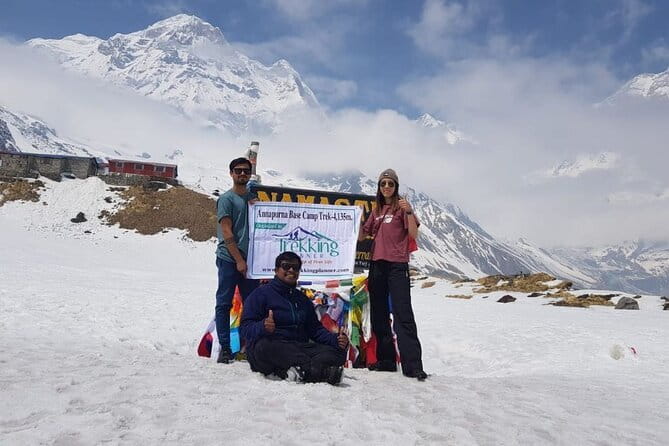
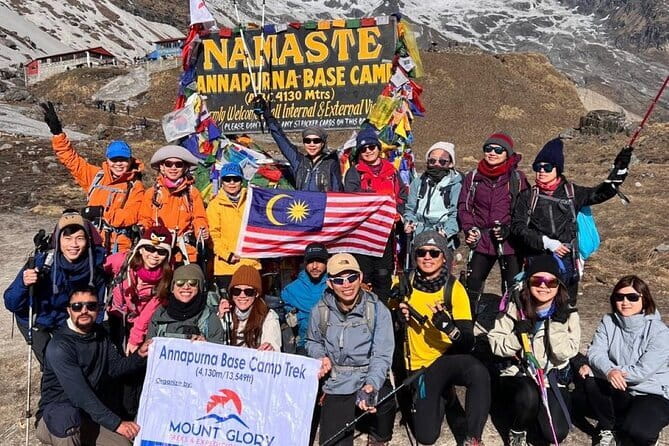
Day 6 is the central event. You walk about 9 kilometers in 6 to 7 hours and reach Annapurna Base Camp at 4,130 meters, or 13,550 feet. The route also passes the Machhapuchhre Base Camp area, one of the named highlights of the trip.
This is not a casual walk with a mountain view at the end. The altitude is high, the air is thinner, and the day can feel much longer than the distance suggests. You will want warm layers, water, sun protection, and a steady pace. The included first aid kit is reassuring, but it does not replace travel and rescue insurance, which you must arrange yourself.
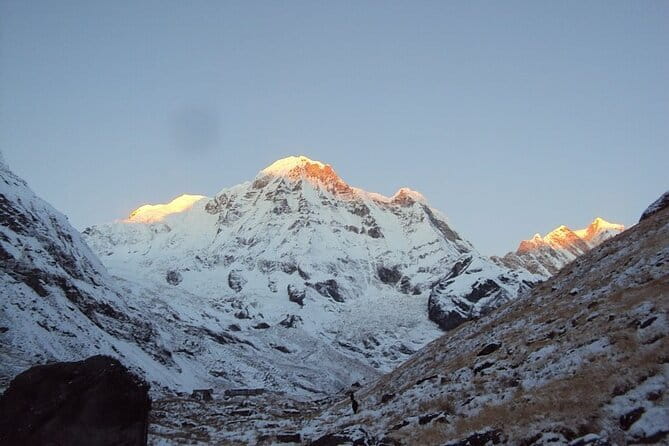
The payoff is the setting around base camp: huge Himalayan peaks, a high open valley, and a close view toward Annapurna and Machhapuchhre. The route is designed so that you reach the main goal after several days of gradual ascent, rather than treating base camp as a rushed out-and-back excursion.
Accommodation at this point remains teahouse-based. That is part of the appeal for some walkers, since it keeps you close to the trail culture and other trekkers, but it also means you should not expect hotel-style facilities. Hot showers are specifically excluded.
The long descent through Bamboo
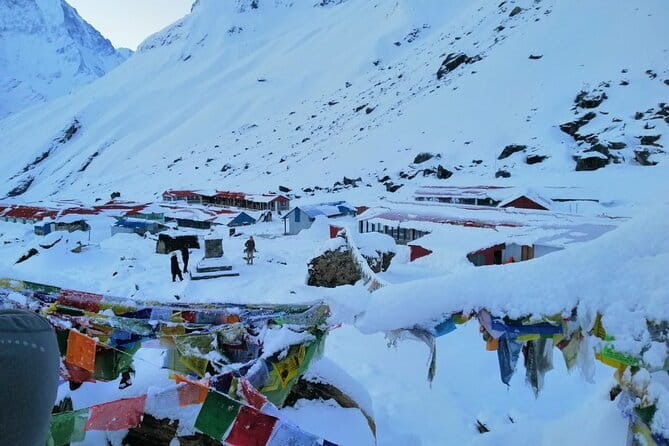
Day 7 begins with time at Annapurna Base Camp, then reverses direction toward Bamboo. The schedule lists about 13 kilometers and 6 to 7 hours of walking, with Bamboo at around 2,310 meters.
This is a demanding descent. Going downhill is not always easier, especially after the high point of the trip. Knees and ankles take plenty of strain, and the trail can feel repetitive as you retrace part of the route. The positive side is that altitude stress usually eases as you lose height, and the return view can look different as the light changes.
You continue to receive breakfast, lunch, dinner, and tea or coffee during the trek. Keeping meals included is a real convenience on this section because you can focus on walking rather than finding and budgeting for food at every stop.
Jhinu Danda makes a good final mountain night
Day 8 covers about 11 kilometers from Bamboo to Jhinu Danda in 5 to 6 hours. Jhinu Danda sits at 1,780 meters, well below the base camp, so this is a substantial drop in altitude.
The route passes through forest again and gives your legs a little relief from the high country. Jhinu Danda is a useful choice for the final mountain stop because you are still on the trail, but the main physical challenge is behind you.
The schedule does not explicitly include a hot-spring visit, so you should not assume that one is part of the package. The location may be associated with that kind of stop, but the supplied details only confirm the overnight destination. Ask the operator if that matters to you.
Returning to Pokhara and Kathmandu
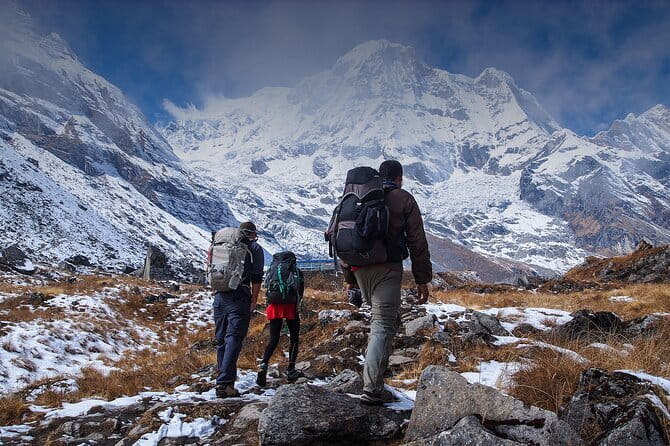
Day 9 is the easiest walking day. You cover about 6 kilometers, then take a 2 to 3-hour drive back to Pokhara from either Siwa or the Ghandruk area. Breakfast and lunch are included, but dinner in Pokhara is not.
This shorter day is well placed. After the long ascent and descent, you get a final walk without another major mountain push. Back in Pokhara, the included 3-star hotel and breakfast offer a more comfortable reset before the return to Kathmandu.
Day 10 repeats the 200-kilometer road journey to Kathmandu, again taking about 7 to 8 hours. Breakfast and dinner are included on this day, while lunch is not listed. Like the outbound trip, this is a full transport day and should be treated as such when planning anything around it.
Day 11 allows time in Kathmandu before an airport transfer of about 30 to 45 minutes. Breakfast is included. The schedule does not promise sightseeing, shopping time, or an extra night after a delayed flight, so check your departure details carefully.
Price and what you still need to budget
At $240 per person, this is a low-cost organized trek, especially with permits, transport, accommodation, meals during the trek, guide service, porter support, a sleeping bag, and airport transfers included. Group discounts may also be available, though no discount amount is given.
The word luxury should not drive your expectations. Your comfort comes mainly from having logistics handled for you. Mountain rooms are twin share, and personal extras are limited.
Plan for these additional costs:
- Nepal entry visa
- Travel and rescue insurance
- Lunch and dinner in Kathmandu and Pokhara, except for the meals specifically included
- Bottled water and other drinks
- Alcohol
- Hot showers during the trek
- Laundry and phone calls
- Tips for the guide, porters, and driver
The insurance point is especially important. A trek reaching 4,130 meters needs proper cover, and insurance is not part of this price.
Organization, support, and service
The strongest praise attached to this experience focuses on smooth organization, warm assistance, and helpful guides and porters. I would give those features real weight because a multi-day trek has many moving parts: airport pickup, road transfers, permits, accommodation, food, gear, and staff coordination.
The trek is private, meaning only your own group participates. That can make the pace and daily routine more personal than a large shared departure, though the exact group size is not provided. You receive an English-speaking, government-licensed guide, and one porter is assigned for every two people.
A useful detail is the supplied duffel bag and sleeping bag. Both must be returned after the trek, so treat them as loaned equipment. The first aid kit is included as well, but your own personal medication and insurance remain your responsibility.
The three strongest pieces of feedback highlight careful planning, professional guidance, and very kind support from the trekking team. One account also described the food positively. Those are the parts I would value most on this route, since good timing and dependable help matter more than decorative touches at high altitude.
Who should book this trek
You should consider this trip if you want a classic Annapurna Base Camp route with the main logistics arranged in advance. It suits someone with moderate fitness who can handle several 6 to 7-hour walking days, a high point of 4,130 meters, and a long road journey between Kathmandu and Pokhara.
It also fits you if you prefer support without paying for a fully private luxury expedition. The guide, porter, permits, meals, and loaned gear take care of much of the hard planning.
You may want another option if you need private rooms, hot showers, flexible transport, or a short and easy walking schedule. The route is physically real, the road transfers are long, and the high-altitude accommodation is basic.
Cancellation is free up to 24 hours before the start time for a full refund. Poor weather or failure to reach the minimum number of participants can lead to a different date, a different experience, or a full refund. Confirm the 11-day versus 12-day timing before booking.
Should you book the Annapurna Base Camp Trek?
I would book this trek if the priority is reaching Annapurna Base Camp with a guide, porter, permits, meals, and transport covered at a very low price. The itinerary has a sensible rise and fall in altitude, includes memorable places such as Ghandruk and Jhinu Danda, and leaves you with time in Pokhara on both sides of the mountain section.
I would not book it expecting five-star comfort. Think of it as a well-supported teahouse trek with hotel nights in the cities. Pack for basic mountain facilities, buy proper insurance, budget for drinks and tips, and confirm the duration before you commit. For a fit walker seeking a classic Himalayan route without arranging every detail alone, the value is strong.
FAQ
How long does the Annapurna Base Camp trek take?
The detailed schedule runs for 11 days, from arrival in Kathmandu through the final airport transfer. The overview describes the experience as 12 days, so confirm the exact duration before booking.
What is the highest point of the trek?
The highest point is Annapurna Base Camp at 4,130 meters, or 13,550 feet.
Is transportation from Kathmandu to Pokhara included?
Yes. The package includes tourist-bus transport from Kathmandu to Pokhara and back. Each road journey covers about 200 kilometers and takes roughly 7 to 8 hours.
Are trekking permits included?
Yes. The Annapurna Conservation Area Permit and TIMS card are included.
What meals are included?
Breakfast is included at the Kathmandu and Pokhara hotels. During the trek, breakfast, lunch, dinner, and tea or coffee are included. Lunch and dinner in Kathmandu and Pokhara are not included unless specifically listed for that day.
Is a guide provided?
Yes. The package includes an experienced, English-speaking, government-licensed trekking guide.
Is porter service included?
Yes. One porter is provided for every two people. A duffel bag and sleeping bag are also supplied and must be returned after the trek.
What is not included in the price?
International airfare, the Nepal entry visa, travel and rescue insurance, personal expenses, bottled water and other drinks, alcohol, hot showers during the trek, city lunches and dinners, and tips are not included.
Can I cancel for a full refund?
Yes, if you cancel at least 24 hours before the experience start time. Cancellations or changes made less than 24 hours in advance are not accepted for a refund.
Latest treks added in Kathmandu
- Private Manaslu Circuit Trek at Himalayas★ 5.0 · 3 reviews
- Ghorepani Poonhill Trek★ 5.0 · 5 reviews
- Ghorepani Poon Hill Trek★ 5.0 · 16 reviews
- Upper Mustang Trekking★ 3.0 · 2 reviews
- Amazing 1 Day Trekking Experience in Kathmandu Nepal★ 5.0 · 24 reviews
- Upper Mustang Trekking★ 5.0 · 2 reviews
- Upper Mustang Trekking★ 5.0 · 4 reviews
- Upper Mustang Trek★ 5.0 · 5 reviews
Annapurna Base Camp Treks, compared.




Trekking in Annapurna/Langtang/Everest/Upper Mustang regions
Read our review →


Kathmandu to Annapurna Base Camp (ABC) 5-Day Trek
Read our review →Browse the lists this tour appears in