
REVIEW · KATHMANDU
Annapurna Base Camp Trek
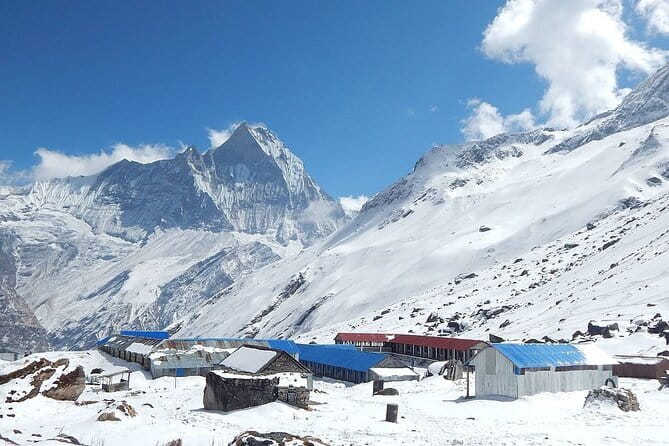
Annapurna Base Camp is reached through a dramatic glacier-ringed amphitheater, not by a road or quick viewpoint. You walk from the lower Modi Khola valley into the Annapurna Sanctuary, with Machhapuchhare, Annapurna South, Hiunchuli, and other high peaks closing in around you.
I like the way this trip combines Poon Hill sunrise with the main base camp trek, and I like that a private group can set its own date and pace within the planned route. The reported care from guide Krishna Pokhrel is also worth noting. The main drawback is the steady physical demand: several walking days run six hours or more, and the overnight stay at 4,090 meters requires sensible pacing.
Key points to know before booking
- The highest night is at 4,090 meters: Annapurna Base Camp is the physical and scenic high point of the trip.
- Poon Hill is included: You get a sunrise viewpoint before entering the narrower Modi Khola valley.
- It is a private trip: Only your own group participates, with dates arranged around your schedule.
- Pokhara breaks up the journey: You travel there by tourist bus, then return for free time before heading back to Kathmandu.
- Meals and permits are included: Accommodation, ACAP and TIMS permits, breakfast, lunch, and dinner are covered as stated.
- The package costs $850 per person: That is useful value if you want transport, guide service, permits, hotels, and guesthouse meals arranged together.
Why the Annapurna Sanctuary route is special
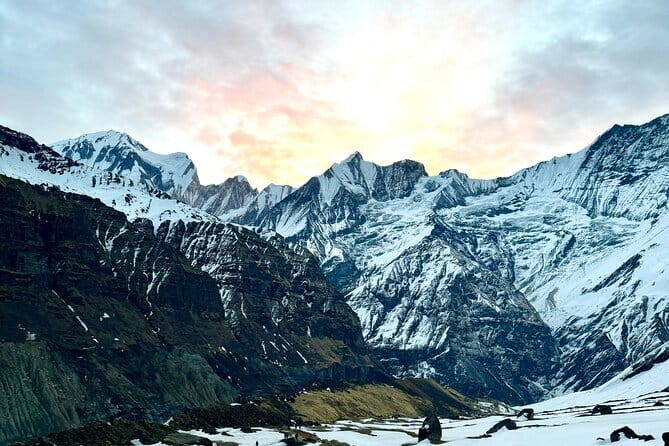
The Annapurna range forms an unusual ring of peaks around a glacier-covered basin. The route takes you toward that basin along the Modi Khola, a river that cuts south through a gorge described as roughly 12,000 feet deep.
You do not simply walk toward one mountain. The setting changes by the day. Lower valleys are associated with the Gurung people and fertile farmland, while the upper route becomes colder, steeper, and more enclosed by rock and snow.
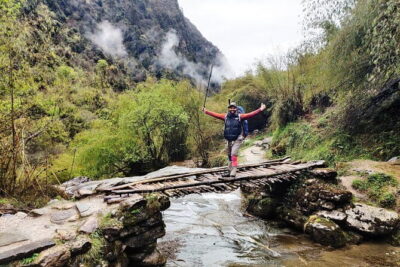
The route is popular for good reason, but popularity does not make it effortless. You should expect stone steps, uneven paths, long uphill sections, and guesthouse nights rather than city-hotel comfort. The reward is a clear sense of moving from a warm valley into a high Himalayan sanctuary.
More Annapurna Treks in Kathmandu
- Annapurna Circuit Trek with Tilicho Lake
★ 5.0 · 368 reviews - Annapurna base camp trek 5 Days
★ 5.0 · 252 reviews - 14-Day Private Annapurna Base Camp Trek
★ 5.0 · 180 reviews
Days 1 and 2: Kathmandu temples and practical preparation
Your first day begins at Kathmandu airport at about 1,345 meters. An airport representative meets you and transfers you by private tourist vehicle to the hotel. Accommodation is on a bed-and-breakfast basis.
Day 2 is a guided city tour after breakfast, beginning at 9 a.m. The stops include Pashupatinath, a major Hindu temple complex; Boudhanath, one of the world’s largest Buddhist stupas; Patan, with its 16th-century royal palace area; and Swayambhunath, the hilltop Buddhist site often called the Monkey Temple.
This day gives you useful cultural context before the mountains take over. It also leaves you with a simpler job on the morning of the trek: get up, eat, and go. The city tour is full, so do not expect a slow morning.
The package provides hotel pickup and drop-off, and the trip is private. That matters in Kathmandu, where having someone handle the first airport transfer can save time and confusion after a long flight.
Day 3: The long road from Kathmandu to Pokhara
The drive to Pokhara takes about six hours by tourist bus, with an overnight stay at a hotel and breakfast included. Road time in Nepal is part of the experience, but it is also one of the less comfortable parts of this trip.
Pokhara, at about 910 meters, is much lower than Kathmandu and acts as the gateway to the Annapurna region. You get one night there before the walking begins. The schedule is efficient, though not leisurely. If you prefer to break up long road transfers, this package gives you only the planned overnight stop.
Days 4 and 5: From Naya Pul to Ghorepani
On Day 4, a one-hour drive takes you from Pokhara to Naya Pul, also called New Bridge. From there, you walk to Tikhe Dhunga at 1,495 meters. The walking time is about three and a half hours, with a guesthouse night and meals included.
This is a sensible opening day because it gets you onto the trail without demanding a full day on foot. Still, it is not a city stroll. You should arrive with comfortable footwear and enough fitness for repeated climbs.
Day 5 takes you from Tikhe Dhunga to Ghorepani at 2,850 meters. The walk lasts about five and a half hours. Ghorepani is important less as a final destination than as the base for the next morning’s Poon Hill climb.
The rise in altitude is noticeable here. You do not need to treat the day as a race. A private guide can help your group keep a steady rhythm, which is one of the practical advantages of booking privately.
Another trail to compare in Kathmandu:
- Everest Base Camp Trek – 14 Days
★ 5.0 · 1,499 reviews - Everest Base Camp Trek
★ 5.0 · 842 reviews - Everest Base Camp Trekking
★ 5.0 · 485 reviews - Everest Base Camp Trekking – 13 Day
★ 5.0 · 365 reviews
Day 6: Poon Hill sunrise and the forest route to Tadapani
Day 6 is one of the strongest parts of the trip. You go from Ghorepani to Poon Hill, then continue to Tadapani at about 2,520 meters. Total walking time is around six and a half hours.
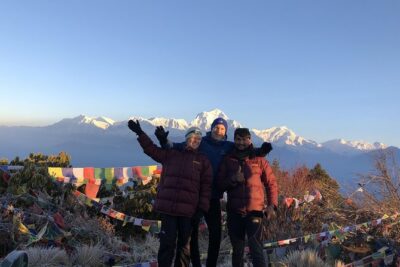
Poon Hill is included as an early-morning viewpoint, so you should be ready for a pre-breakfast start. The attraction is the broad mountain view, with the Annapurna range providing the main spectacle. Weather controls how much you see, but the viewpoint gives the trek a memorable opening high point before the trail moves deeper into the valley.
The rest of the day continues to Tadapani. That makes this more than a short sunrise outing. You need to be comfortable walking again after the viewpoint, with enough energy for a long day.
Days 7 and 8: Entering the Modi Khola valley
From Tadapani, Day 7 leads to Sinuwa at 2,310 meters. The walking time is about six hours. Day 8 continues from Sinuwa to Deurali at 3,150 meters, another six-hour day.
This section shifts the character of the trek. You leave the Poon Hill approach and move toward the Annapurna Sanctuary. The route follows the upper Modi Khola area, with the valley tightening as the mountains become more dominant.
Sinuwa and Deurali are functional overnight stops. Guesthouses on this part of the route are there to provide shelter, meals, and a place to sleep, not luxury. The included breakfast, lunch, and dinner are valuable because food options at high trail stops are limited compared with Pokhara or Kathmandu.
The two six-hour days also show why the moderate fitness requirement should be taken seriously. You do not need to be an elite climber, but you should be prepared to walk for much of the day and manage changing altitude.
Day 9: Reaching Annapurna Base Camp at 4,090 meters
Day 9 takes you from Deurali to Annapurna Base Camp, at 4,090 meters. The listed walking time is about four and a half hours, followed by an overnight stay at a guesthouse.
The distance is not the only issue. At this height, the air is thinner, and a shorter walking day can still feel demanding. Move slowly, drink what you need, and tell your guide if you feel unwell. Rescue costs are not included, so emergency planning matters.
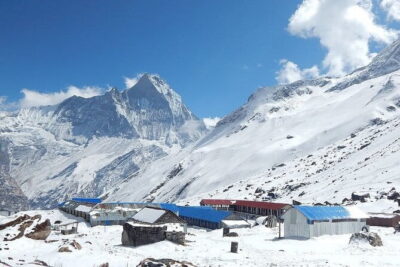
The setting is the payoff. Annapurna Base Camp sits within the Annapurna Sanctuary, the glacier-covered basin ringed by major peaks. You are surrounded by a concentrated wall of Himalayan mountains rather than looking at a single distant summit.
This is also the coldest and most exposed-feeling night of the route. The package includes the guesthouse and meals, but it does not promise hotel-style facilities. Keep expectations practical and focus on the rare location.
Days 10 and 11: Descending through Dovan and Chhomrong
Day 10 reverses the route from Annapurna Base Camp to Dovan at about 2,600 meters. Walking time is approximately five and a half hours.
The descent is welcome after the high night, but downhill walking can be hard on knees. Trekking poles are worth considering, although the package details do not state that they are provided.
Day 11 continues from Dovan to Chhomrong, listed at 2,310 meters, with another five and a half hours of walking. Chhomrong is one of the better-known settlement points on the route and gives you a change of pace after the more remote upper valley.
The return journey can feel different from the ascent. You know the route, but the lower altitude may make walking easier. Your guide remains important here, especially for keeping the group together and managing the day’s timing.
Days 12 and 13: Leaving the trail and returning to Pokhara
Day 12 runs from Chhomrong to Syauli at about 1,040 meters and takes roughly six and a half hours. This is a long descent, so do not assume the lower altitude makes it easy.
On Day 13, you trek to Naya Pul, then drive back to Pokhara. The schedule gives you free, unguided time in the city and an overnight hotel stay with breakfast.
That free time is a useful feature. After more than a week of walking, you may prefer your own plan rather than another formal tour. The description does not specify activities or admissions in Pokhara, so treat this as open time, not a built-in sightseeing program.
Day 14 and 15: Back to Kathmandu and home
Day 14 is another long tourist-bus journey, this time from Pokhara to Kathmandu. The stated travel time is about seven hours, followed by a hotel night with breakfast.
Day 15 is the farewell and airport drop-off. The trip therefore includes a final night in Kathmandu rather than sending you straight from Pokhara to your flight.
Build some flexibility into your wider Nepal plans if possible. The package gives an approximate duration, and road travel is a major part of the schedule. The airport transfer is included, but your flight details still need to be supplied to the operator.
What the $850 price covers
At $850 per person, the value depends on how much of the planning you want handled for you. This is not only a guided walk. The price includes Kathmandu and Pokhara hotel stays, trail guesthouses, ACAP and TIMS permits, local taxes, transport described in the schedule, an English-speaking local trekking guide, and meals listed as breakfast, lunch, and dinner.
The private format adds value for couples, families with suitable fitness, or a small group of friends. You are not assigned to a large mixed party, and dates can be arranged around your preferred timing.
The exclusions matter. Drinks must be purchased separately, emergency rescue costs are not included, and gratuities are optional. Ask for clear details on insurance and emergency arrangements before departure, since rescue is a significant financial concern on any high-altitude trek.
Two names connected with the service are useful to know. Krishna Pokhrel is identified as a guide who took special care with comfort and support, while Ravi handled arrangements and was willing to accommodate changes. Ask the company whether either person is available for your dates, since guide assignment is not guaranteed by the basic package description.
Food, lodging, guides, and group style
Accommodation is a mix of hotels in Kathmandu and Pokhara and guesthouses along the trail. Breakfast is included at the hotels, while the trekking portion includes the stated meals. Vegetarian food is available if you request it when booking.
The English-speaking local guide is a central part of the experience. You are not simply buying a bed and a permit. You are paying for route support, local coordination, and help moving through a demanding mountain schedule.
The trip is private, with only your own group participating. That can make the journey more relaxed, but it also means your group must be ready for the physical demands. A private guide cannot remove the climbs, altitude, or long walking days.
Who should book this trek
I would suggest this trip to someone who wants a classic Nepal trek with a clear beginning and end, but does not want to organize every transfer and permit independently. It suits people with moderate fitness who are comfortable walking for five to six hours on repeated days.
It is also a good match for a group of friends or family members who want their own schedule. Children must be accompanied by an adult, and the physical demands mean you should judge each child’s ability carefully.
I would hesitate to recommend it to anyone seeking luxury lodging, short daily walks, or a soft adventure. The route reaches 4,090 meters and includes long descents. You should also reconsider if you have no room in your schedule for possible changes around road travel or mountain conditions.
Booking confirmation is provided at the time of reservation. You must supply each participant’s passport name, passport number, expiry date, country, and a digital photo before the trip. Cancellation is most flexible six full days before the local start time, with a 50 percent refund available for cancellations two to six full days beforehand. Less than two full days brings no refund.
Should you book the Annapurna Base Camp Trek?
Book it if you want the full route in a manageable package: Kathmandu culture, Pokhara, Poon Hill, Gurung-region trails, the Annapurna Sanctuary, and a private guide. The combination gives you more variety than a base camp walk alone.
The strongest reasons to choose it are the private format, included permits and meals, and the chance to reach Annapurna Base Camp without arranging each part yourself. The main caution is that $850 does not cover drinks or emergency rescue, and the walking schedule is serious.
Before paying, confirm the exact guide, hotel and guesthouse standards, transport details, insurance expectations, and whether Krishna Pokhrel or another named guide will lead your group. If those points suit you and you are ready for long mountain days, this is a strong-value route to one of Nepal’s most dramatic high-altitude settings.
FAQ
How long does the Annapurna Base Camp Trek take?
The trip lasts approximately 15 days, including arrival and departure days, Kathmandu sightseeing, transport between Kathmandu and Pokhara, and the trekking route.
Where does the tour start?
The tour starts in Kathmandu, in Nepal’s Kathmandu Valley. Airport pickup and hotel transfer are included.
Is this a private tour?
Yes. Only your group participates, and the trip can be organized around your suitable time and date.
What is the highest point of the trek?
Annapurna Base Camp is the highest point listed, at 4,090 meters or about 13,418 feet.
Are meals included?
Yes. Breakfast, lunch, and dinner are included according to the schedule. Drinks are not included and can be purchased separately.
Are trekking permits included?
Yes. The package includes ACAP and TIMS permits, along with taxes, fees, and handling charges.
Is vegetarian food available?
Yes. A vegetarian option is available, but you should request it when booking.
Can I cancel the trek for a refund?
You can receive a full refund if you cancel at least six full days before the local start time. Cancellation two to six full days ahead allows a 50 percent refund. Less than two full days receives no refund.
Latest treks added in Kathmandu
- Private Manaslu Circuit Trek at Himalayas★ 5.0 · 3 reviews
- Ghorepani Poonhill Trek★ 5.0 · 5 reviews
- Ghorepani Poon Hill Trek★ 5.0 · 16 reviews
- Upper Mustang Trekking★ 3.0 · 2 reviews
- Amazing 1 Day Trekking Experience in Kathmandu Nepal★ 5.0 · 24 reviews
- Upper Mustang Trekking★ 5.0 · 2 reviews
- Upper Mustang Trek★ 5.0 · 5 reviews
- Upper Mustang Trekking★ 5.0 · 4 reviews
Annapurna Base Camp Treks, compared.

Trekking in Annapurna/Langtang/Everest/Upper Mustang regions
Read our review →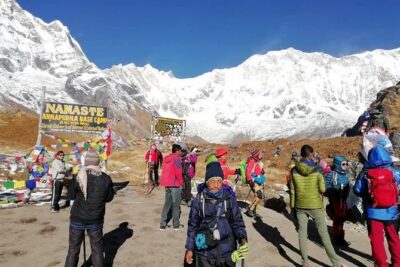
Kathmandu to Annapurna Base Camp (ABC) 5-Day Trek
Read our review →Browse the lists this tour appears in