
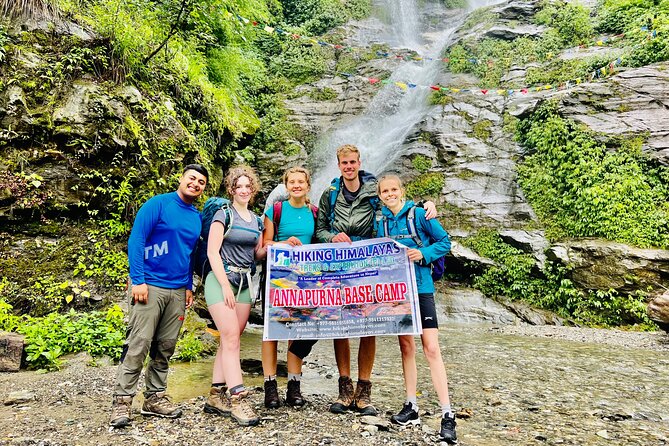
REVIEW · KATHMANDU
Annapurna Base Camp Private Short Trek
The finest part of this Annapurna Base Camp trek is the way the scenery changes hour by hour. You begin with Kathmandu streets and a long road to Pokhara, then move through terraced fields, rhododendron and bamboo forests, steep stone paths, and finally a high mountain bowl surrounded by Annapurna peaks. I like the close contact with village life, and I like that this private trip can adjust its pace to your ability. The main caution is the schedule: some walking days are very long, with the push to base camp listed at up to 16 hours.
I also like the practical package. Permits, meals, guides, buses, and hotels are included, so you are not piecing together every transfer yourself. The private format gives your group more control than a large fixed departure. Still, ask for a clear day-by-day walking estimate before paying, since the supplied route descriptions contain a few place-name and timing inconsistencies.
Key points at a glance
- A private route to 4,130-meter Annapurna Base Camp: The high point is reached after stopping at Machhapuchhre Base Camp, with views of Annapurna I, Annapurna South, Gangapurna, Annapurna III, Hiunchuli, Gandharvachuli, and Machhapuchhre.
- A strong mix of scenery: Expect terraced hills, forest, river crossings, traditional villages, and wide Himalayan views rather than one unchanging trail.
- Pace support from a private guide: The guide can adjust the trek to your capacity, a useful feature on steep climbs and long descent days.
- Most major costs are bundled: Permits, guide expenses, meals listed in the package, Kathmandu and Pokhara hotels, buses, local transfers, a map, and a certificate are included.
- Long transport and hiking days: Kathmandu to Pokhara takes about nine hours by road, and the base camp day is especially demanding.
- A 4.9 rating from eight posted reviews: The strongest praise focuses on smooth planning, supportive guiding, food, lodging, and quick solutions when problems arise.
Why the Annapurna route is worth your time
Annapurna Base Camp gives you a big Himalayan payoff without requiring the long approach associated with some other famous Nepal treks. The route climbs through lived-in villages and working farmland before reaching a dramatic mountain amphitheater. You are not simply walking toward a distant peak. The mountains gradually close around you.
The cultural side matters too. The route passes through places such as Chhomrong, Sinuwa, Jhinu, and Deurali, where the village setting is part of the experience. You will see terraced fields, forest trails, lodges, bridges, and local communities linked by the trekking route.
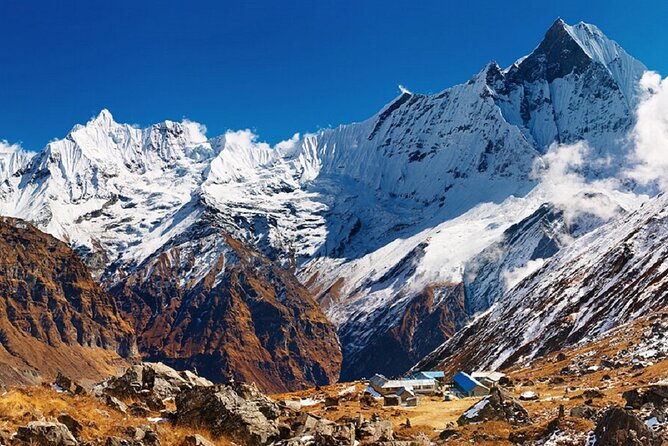
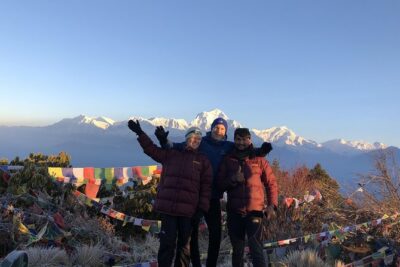
I especially like the contrast between the lower route and the high country. Near Jhinu and Chhomrong, the trail feels green and settled. Higher up, the trees thin out and the views become more severe. At base camp, the reward is not just one mountain but a circle of peaks, including Annapurna I, Annapurna South, Gangapurna, Annapurna III, Hiunchuli, Gandharvachuli, and Machhapuchhre, also called Fishtail.
This is a private activity, so only your group participates. That can make a real difference. If you need a slower morning, more rest, or a pace matched to your fitness, you have a better chance of getting it than on a large group departure. The company’s guide Kapil is specifically praised for adjusting the trek to walking ability and solving problems quickly. Other posted comments name guides or staff called Raj, but your booking confirmation should state who will lead your departure.
More Annapurna Treks in Kathmandu
- Annapurna Circuit Trek with Tilicho Lake
★ 5.0 · 368 reviews - Annapurna base camp trek 5 Days
★ 5.0 · 252 reviews - 14-Day Private Annapurna Base Camp Trek
★ 5.0 · 180 reviews
Kathmandu to Pokhara: the long road into the mountains
Your trip begins with airport pickup and a meeting in the Thamel area of Kathmandu. The meeting point is generally arranged at Tribhuvan International Airport, often in the arrival hall or outside the terminal with a sign. Two nights in Kathmandu are included on a bed-and-breakfast basis, though the day-by-day schedule places the first arrival and final departure around the trekking plan.
On the second day, you leave early for Pokhara by tourist bus. The distance is about 200 kilometers, but the road journey takes roughly nine hours. That is a full day, so you should not think of this as a quick transfer. The value is that the transport is organized and included, but road conditions and traffic can make the journey tiring.
Pokhara gives you a useful pause before the trail begins. The package includes two nights there with breakfast. After the trek, you return to Pokhara, rest at the hotel, and have time around Phewa Lake for food and a relaxed evening. That recovery night is welcome after the long descent from the high route.
Jhinu, Chhomrong, and Sinuwa: the first serious climb
From Pokhara, a vehicle takes you toward Jhinu Danda. The route passes through Hemja, Naudanda, Lumle, Kade, Nayapul, and along the Modi Khola area. Once you reach Jhinu, the walking begins.
The first uphill section takes about an hour to Chhomrong, where lunch is planned. This village is a fine early viewpoint, with close views toward Annapurna South and Hiunchuli. It also gives you a first taste of the route’s rhythm: climb, stop, eat, and climb again.
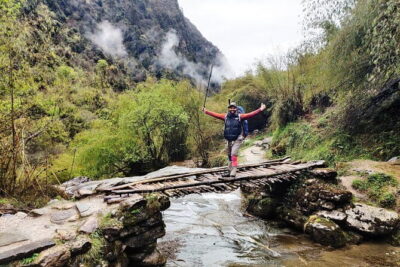
After lunch, you descend to a river, cross a bridge, and climb back toward Sinuwa. That up-and-down pattern is important to understand. Mountain trekking is not a steady staircase upward. You can lose height only to gain it again minutes later.
The day is listed at about 12 hours, which is demanding for a first walking day. The description also refers to Sinuwa as the overnight destination, while the final line mentions Chhomrong and resting there. Confirm the actual overnight stop before departure. The difference affects your walking time, sleeping arrangements, and what you need to carry that evening.
Bamboo, Dovan, Himalaya, and Deurali
The next major section rises through bamboo and rhododendron forest. You pass places identified as Bamboo, Dovan, and Himalaya Hotel before stopping for lunch. After lunch, the route continues for about two hours to Deurali.
The itinerary labels this stop Ghorepani, but the detailed description says Deurali is the destination. Ghorepani is normally associated with a different section of the Annapurna trekking network, so this is another point worth checking with the operator. The important practical fact is that you should expect a forested climb toward the high route, not assume you are spending the night in the famous Poon Hill village.
The forest is one of the pleasures of this trek. Rhododendron and bamboo provide a greener, more enclosed walk than the exposed upper sections. You may also catch views of Fishtail and the surrounding hills as the trail opens.
This is another long day, listed at roughly 12 hours. You will want sturdy footwear, a light daypack, water, rain protection, and enough patience for the slow uphill stretches. The package includes seasonal fruit during the trek, which is a small but useful touch on a hard walking day.
Another trail to compare in Kathmandu:
- Everest Base Camp Trek – 14 Days
★ 5.0 · 1,499 reviews - Everest Base Camp Trek
★ 5.0 · 842 reviews - Everest Base Camp Trekking
★ 5.0 · 485 reviews - Everest Base Camp Trekking – 13 Day
★ 5.0 · 365 reviews
Machhapuchhre Base Camp and the push to ABC
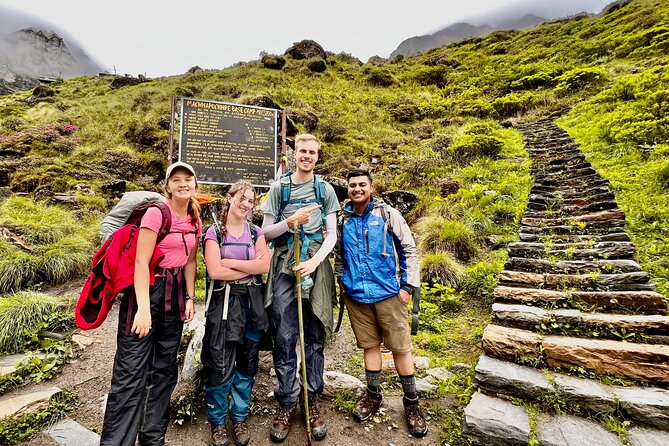
The base camp day is the trip’s central challenge. From the overnight area, you walk about three hours to Machhapuchhre Base Camp, usually called MBC, and stop for lunch. After that, the route continues for about two hours to Annapurna Base Camp.
The schedule lists the full day at approximately 16 hours, so you should treat this as a serious physical effort. The exact timing may vary with weather, pace, trail conditions, and rest stops, but the published estimate is enough reason to prepare carefully. A private guide can help match the pace to your condition, yet no guide can remove the altitude, steepness, or distance.
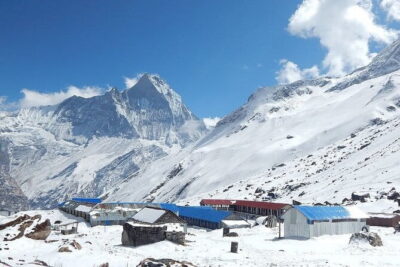
At ABC, the reward is immediate. The site sits among high Himalayan walls, with evening views toward Annapurna I, Gangapurna, Annapurna South, Hiunchuli, Annapurna III, Gandharvachuli, and Machhapuchhre. The itinerary highlights sunset, but weather can change quickly in the mountains. Go for the view, while keeping realistic expectations about cloud cover.
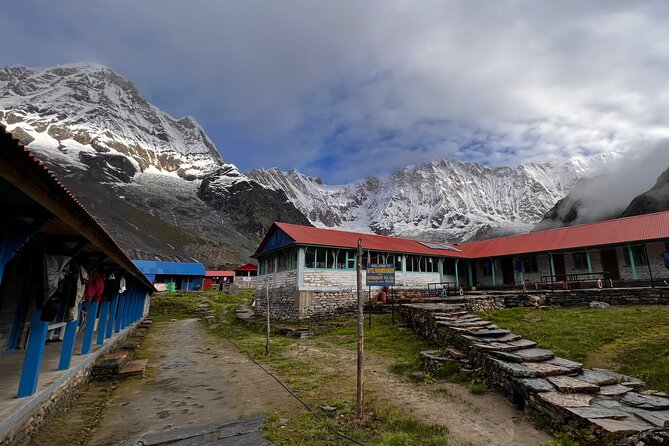
You sleep at base camp, which is valuable because you do not need to rush back down the same day. Accommodation on the route is simple rather than luxurious. The package covers trekking meals and lodging arrangements, but personal items such as hot showers, Wi-Fi, drinks, and bar bills cost extra.
Sunrise at base camp and the long descent
The morning at ABC begins early for sunrise over the peaks. This is one of the best reasons to spend the night there. The light changes across the mountain walls, and you have a quiet window before the descent begins.
After breakfast, you walk down toward Bamboo. The schedule gives five to six hours for this section and labels the full day at about 12 hours. Descending is often harder on tired knees than climbing, especially after the previous day’s effort. Trekking poles can be useful, though they are not listed as included equipment.
The return route offers a different view of familiar ground. You notice the river valleys, forest cover, and steep trail angles more clearly when walking downhill. Do not judge the day by distance alone. A long descent after sleeping at altitude can leave you more tired than expected.
Jhinu, Pokhara, and the ride back to Kathmandu
The following day takes you back toward Jhinu Danda. Lunch is planned there, after which a vehicle collects the group for the drive to Pokhara, listed at around two hours. You then return to the hotel and have time at Phewa Lake.
This is a sensible recovery evening. You can eat well, rest, and enjoy a less demanding setting before the final road journey. The farewell dinner after the trek is included, along with the listed meals across the trip.
The next morning, a taxi takes you to the bus station for the tourist bus to Kathmandu. The journey takes about six to eight hours, with lunch on the way. Two-way Kathmandu to Pokhara bus transport is included, so you are not paying separately for the main intercity rides.
The final day is for departure to your home destination. Airport arrangements should be confirmed directly, since the schedule describes the activity as ending back at the meeting point and gives a six-hour final-day duration.
What the $700 price really covers
At $700 per person, the price looks reasonable for a private nine-day Nepal trekking package, mainly because many costly basics are bundled. The inclusions cover trekking permits, a professional guide and guide expenses, tourist buses between Kathmandu and Pokhara, transport between Pokhara and Jhinu, two Kathmandu nights, two Pokhara nights, trekking meals, government charges, a map, an achievement certificate, seasonal fruit, and a farewell dinner.
Meals are listed as nine breakfasts, seven lunches, and six dinners. That gives you useful coverage, but you should still budget for drinks, Wi-Fi, hot and cold beverages, bar bills, and hot showers. Emergency evacuation is not included, so travel insurance with trekking and evacuation coverage is important.
International flights and the Nepal entry visa are also outside the price. The stated visa cost is USD 40 for 30 days, available on arrival at the airport. Tips for guides, trekking staff, and drivers are not included, so plan for those separately.
The main value is convenience rather than luxury. You pay for a coordinated route, a private guide, transport, permits, and meals. You should not book it expecting high-end hotels or a soft adventure. The walking is real, the lodges are basic, and the road journeys are long.
Who should book this private trek?
I would choose this trip if you want Annapurna Base Camp with a guide and prefer not to manage permits, buses, hotel nights, and local transfers yourself. It also suits a couple, family group, or small circle of friends that wants a private pace.
You need moderate physical fitness. The steep climbs, repeated descents, long walking days, and high altitude are not minor details. If you are unsure about the 16-hour base camp schedule, ask whether the company can split or adjust the day. The private format may make that conversation easier, but you should get the plan confirmed before arrival.
The trip is also a good fit if you value supportive guiding. The strongest praise attached to this operator focuses on smooth organization, comfortable enough lodging, food, encouragement, and a guide who adjusts to the group’s condition. That is exactly the kind of help that matters on a route where weather, fatigue, and pace can change the day.
Final verdict: a strong value with details to confirm
I would book this Annapurna Base Camp trek if the operator clarifies the overnight stops, walking times, and assigned guide in writing. The mountain route is excellent, the private format is useful, and the $700 package includes a lot of the expenses that can otherwise pile up.
I would hesitate only if you want short walking days, polished accommodation, or a fully fixed schedule with no inconsistencies. Confirm the Sinuwa versus Chhomrong stop, the Deurali versus Ghorepani reference, and the realistic timing for the ABC day. If those points are settled, this is a practical way to reach one of Nepal’s most rewarding mountain viewpoints.
FAQ
How long does the Annapurna Base Camp private trek take?
The experience lasts approximately nine days, including Kathmandu, Pokhara, the trek, return transport, and final departure.
Where does the activity start?
The meeting point is in Thamel, Kathmandu. Airport redemption information is provided for Tribhuvan International Airport.
What time does the activity start?
The listed start time is 7:00 am.
Is airport pickup offered?
Yes. Pickup is offered, with the representative expected to identify a meeting point in the airport arrival hall or outside the terminal.
Is this a private tour?
Yes. Only your group participates in the activity.
What level of fitness is needed?
A moderate level of physical fitness is required. The route includes steep ascents, long descents, and very long walking days.
How long is the Kathmandu to Pokhara journey?
The tourist bus journey covers about 200 kilometers and takes approximately nine hours.
Are trekking permits included?
Yes. The required trekking permits are included in the package.
Are meals included?
Yes. The package lists nine breakfasts, seven lunches, and six dinners, along with seasonal fruit during the trek.
What costs are not included?
Personal expenses such as Wi-Fi, hot and cold drinks, bar bills, and hot showers are not included. Emergency evacuation, Nepal’s entry visa, international airfares, and tips for guides, trekking staff, and drivers are also excluded.
Latest treks added in Kathmandu
- Private Manaslu Circuit Trek at Himalayas★ 5.0 · 3 reviews
- Ghorepani Poonhill Trek★ 5.0 · 5 reviews
- Ghorepani Poon Hill Trek★ 5.0 · 16 reviews
- Upper Mustang Trekking★ 3.0 · 2 reviews
- Amazing 1 Day Trekking Experience in Kathmandu Nepal★ 5.0 · 24 reviews
- Upper Mustang Trekking★ 5.0 · 2 reviews
- Upper Mustang Trek★ 5.0 · 5 reviews
- Upper Mustang Trekking★ 5.0 · 4 reviews
Annapurna Base Camp Treks, compared.

Trekking in Annapurna/Langtang/Everest/Upper Mustang regions
Read our review →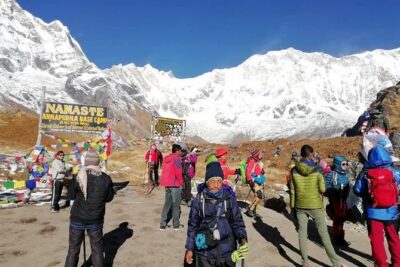
Kathmandu to Annapurna Base Camp (ABC) 5-Day Trek
Read our review →Browse the lists this tour appears in