REVIEW · KATHMANDU
Tiji Festival Trek ( Upper Mustang) : The Festival of Lo Manthang
In Lo Manthang, the Tiji Festival turns a remote walled town into a stage for ancient Tibetan Buddhist ritual. Over three days, masked dancers, music, prayer, and ceremony retell the story of a son who saves the Mustang kingdom from destruction. You reach the festival on foot, crossing the high country from Jomsom rather than simply arriving for an afternoon show.
I like the way this trip pairs the festival with a proper Upper Mustang trek, and I like that permits, domestic flights, meals, accommodation, and a licensed guide are included. The main caution is effort: this is a moderate trek with long walking days, thin air, and a maximum elevation of 4,353 meters. Also confirm the advertised duration before booking, since the schedule is an 18-day journey even though the summary lists 18 hours.
Key points at a glance
- Three full days of Tiji ceremony: The 2025 festival runs from May 24 to May 26 in Lo Manthang.
- A real approach on foot: You walk from Jomsom through Kagbeni, Chele, Syangbochen, Dhakmar, and other Mustang villages.
- High-altitude trekking: The route reaches 4,353 meters and includes several five-to-eight-hour walking days.
- Private two-person format: Only your group participates, with transport arranged by private vehicle, bus, and aircraft.
- Useful inclusions: Restricted-area permits, monument fees, domestic flights, meals, tea-house lodging, a duffel bag, map, and first-aid kit are covered.
- A culture-first trip: The purpose is not only scenery. It is a chance to witness Tibetan Buddhist ritual in its home setting.
Why the Tiji Festival makes this trek special
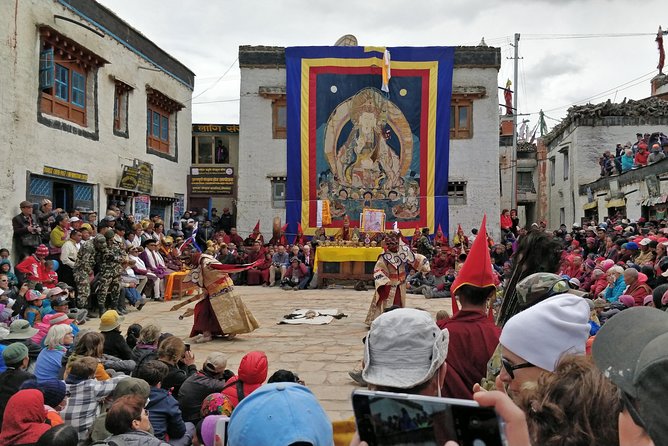
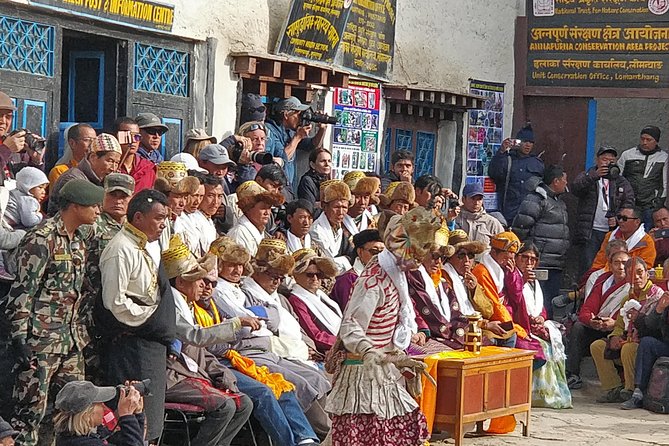
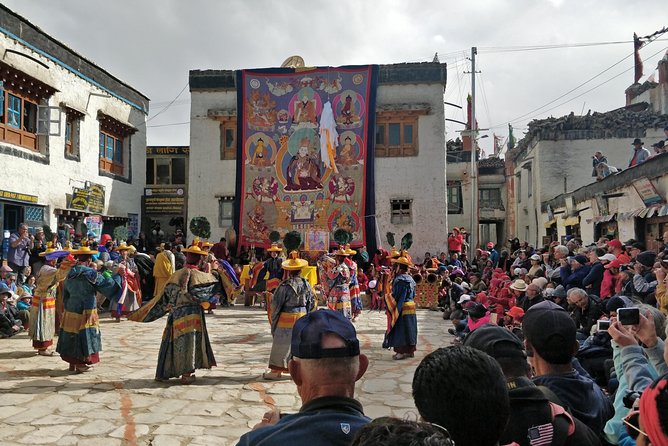
The Tiji Festival is the heart of the journey. Its three days of ritual are linked to a local Buddhist story about a son who protects Mustang from ruin. The ceremonies use masked dance, music, and religious symbols, with performers acting out the struggle between destructive forces and renewal.
The effect can be powerful because the festival is not presented as a short cultural show for passing visitors. You arrive after days of walking through Upper Mustang, so the ceremony becomes part of a larger experience of place, religion, and community.
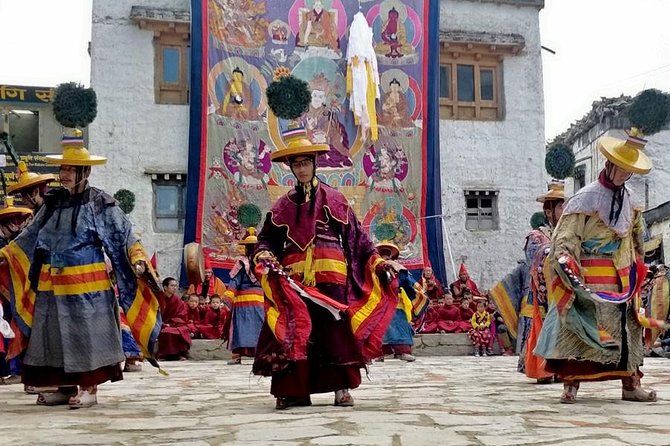
The mask dance is likely to make the strongest visual impression. The preparations and ceremonies can feel strange at first, especially if you are unfamiliar with Tibetan Buddhist practice. Give yourself time to watch quietly and follow the rhythm of the event rather than trying to understand every symbol at once.
The festival dates for 2025 are May 24, 25, and 26. You should plan around those dates carefully. Missing even one day would mean losing part of the story, and the itinerary wisely places three complete festival days in Lo Manthang.
More Trekking Tours in Kathmandu
- Everest Base Camp Trek – 14 Days
★ 5.0 · 1,499 reviews - Everest Base Camp Trek
★ 5.0 · 842 reviews - Everest Base Camp Trekking
★ 5.0 · 485 reviews
Day 1 and Day 2: Kathmandu, permits, and preparation
Your trip begins with arrival at Tribhuvan International Airport in Kathmandu. Pickup is offered, and the listed meeting point is the airport. The itinerary gives a start time of 12:15 am, which is unusually precise and may reflect an overnight arrival or a system entry rather than a normal group departure time. Confirm the exact pickup plan before flying.
The second day is set aside for preparation in Kathmandu. That is useful on a route where equipment, permits, and flight plans matter. You will need a current valid passport on the day of travel, and the restricted-area permit is included in the package.
This is also the point to ask your guide about the walking schedule, luggage arrangements, weather, and the flight to Jomsom. The operator provides a company T-shirt, duffel bag, trekking map, and appreciation letter. The duffel is especially practical if the main luggage arrangement limits what you carry each day.
The tour is designed for a private group of two. That gives you more control than a large departure, but it also means the pace and atmosphere depend closely on your own partnership and on the guide. An English-speaking, government-licensed trekking guide is included. One guide associated with the operator is Jeeban, though you should confirm your assigned guide when booking.
Day 3: The long road from Kathmandu to Pokhara
The drive to Pokhara covers about 220 kilometers and is scheduled to take eight hours. The distance may look modest on a map, but this is a full travel day. You will use a private vehicle or bus, depending on the operating plan.
Pokhara sits at about 860 meters, far lower than the coming Mustang route. It is a sensible overnight point before the morning flight to Jomsom. I appreciate this gradual change because it avoids launching straight from Kathmandu into a high-altitude walking program.
The drawback is simple: eight hours on the road can be tiring before the trek even starts. Keep essential items close, including water, medication, documents, and a warm layer.
Day 4: Flying to Jomsom and walking to Kagbeni
The flight to Jomsom takes you to 2,715 meters, where the walking portion begins. From there, you trek to Kagbeni at about 2,858 meters, with roughly four hours on foot.
Kagbeni is an important early stop because it marks the transition from the lower part of the route into the more remote Mustang region. You will already feel the change in altitude, so this shorter first walking day has value. It gives your body a chance to adjust before the route climbs higher.
Domestic mountain flights can be affected by operating conditions, so keep some flexibility in your expectations. The package includes the flight to Jomsom and the return flight to Pokhara, which removes a major planning burden, but flight timing is still something to confirm locally.
Another trail to compare in Kathmandu:
- Annapurna Circuit Trek with Tilicho Lake
★ 5.0 · 368 reviews - Everest Base Camp Trekking – 13 Day
★ 5.0 · 365 reviews - Everest Base Camp Trek
★ 5.0 · 350 reviews - Everest Base Camp Trek -14 Days
★ 5.0 · 321 reviews
Days 5 to 7: Climbing through Chele, Syangbochen, and Dhakmar
Day 5 takes you to Chele, also written as Tsele, at about 3,050 meters. The walk is scheduled for six hours. This is the first clear jump in altitude, and you will notice that the route now demands steady pacing rather than speed.
On Day 6, you continue to Syangbochen at 3,475 meters for around five hours. By now, the trip feels like a genuine high-country trek. Your guide can help set a sensible pace, but you still need to pay attention to how your body responds.
Day 7 leads to Dhakmar at about 3,810 meters, again in roughly five hours. The route is moderate by the operator’s rating, but moderate does not mean easy. You are walking several hours at increasing altitude, staying in tea-houses rather than full-service hotels, and carrying at least a daypack.
These days are where fitness matters most. You do not need to be an elite trekker, but you should be comfortable walking for five or six hours and managing basic accommodation. Food during the trek includes breakfast, lunch, and dinner, which helps keep the daily routine simple.
Day 8: Reaching Lo Manthang at 3,700 meters
The walk to Lo Manthang takes about five hours. At approximately 3,700 meters, the town becomes your base for the main reason this trip exists: the Tiji Festival.
Lo Manthang is known here as the destination rather than a quick stop. You arrive with time to settle in before the ceremonies begin, and the accommodation plan uses hotels and tea-houses during the overall route. Do not expect a resort-style stay. The value is being close to the festival and living within the rhythm of a remote trekking town.
The route’s highest point is listed as 4,353 meters, even though Lo Manthang itself is lower. Ask your guide exactly where that maximum elevation occurs and how the walking day is arranged. Knowing this in advance makes the altitude profile easier to judge.
Days 9 to 11: Three days inside the festival
The first day introduces the ritual program, with preparations, ceremonies, and masked performance. The second day continues the religious story, while the third completes it. The program is not simply three repeats of the same event. Each day forms part of the larger account of danger, protection, and renewal.
The masked dance is the feature most likely to stay with you. It can make a colossal impression, but the event asks for patience and respect. This is a religious celebration for followers of Tibetan Buddhism, not a performance arranged only for tourists.
Take care with photography and follow local guidance. The supplied information does not set out specific photography rules, so your guide is the right person to ask. You will get more from the festival if you watch the ceremony itself rather than spending the whole time trying to capture every movement.
Three full days also provide breathing room. If weather, fatigue, or a late arrival affects one session, you still have other opportunities to see the ritual. That extra time is one of the strongest reasons to choose the full trek instead of trying to visit Lo Manthang briefly.
Days 12 to 15: The return route through Yara and Muktinath
After the festival, Day 12 takes you toward Yara in about five hours. This keeps the trip moving rather than sending you straight back along the same route.
Day 13 continues to Tengbe, with around six hours of walking. These post-festival days may feel quieter, but they are important. You get to see more of Mustang instead of treating Lo Manthang as the entire destination.
Day 14 is the toughest day on paper: around 12 hours to Chuksang, also written as Tsusang. That is a very long walking day, and it deserves serious attention before booking. Ask how the route is divided, what time you leave, and what alternatives exist if the pace becomes too much. A moderate rating does not erase the strain of a 12-hour day.
Day 15 takes you to Muktinath in about eight hours. This is another demanding stretch, coming after nearly two weeks of trekking. By this point, fatigue may be as important as altitude. Good footwear, sensible pacing, and communication with your guide will matter.
Days 16 to 18: Flights, road travel, and departure
From Muktinath, you fly to Pokhara and transfer to a hotel. The return flight is included, as is the onward ground transport.
Day 17 is a six-hour drive back to Kathmandu. It is another long road day, but it gives you a final night in the capital before international departure on Day 18.
The itinerary is therefore an 18-day trip, not an 18-hour activity. Since the tour summary lists approximately 18 hours, ask Nepal Adventure Team to clarify the booking record, meeting time, and total duration before paying. This is a small administrative detail with a large practical effect.
What the $2,895 price covers
At $2,895 per person, the package is not a budget stroll. It does, however, include several costly and important elements:
- Licensed English-speaking trekking guide
- Hotel and tea-house accommodation
- Breakfast, lunch, and dinner during the trek
- Restricted-area permit
- Other trekking permits and monument fees
- Ground transportation
- Domestic flight to Jomsom
- Return flight to Pokhara
- Nepal government VAT at 13 percent
- First-aid medical kit
- Duffel bag, map, T-shirt, and appreciation letter
That list gives the price real value, particularly because Upper Mustang requires restricted-area paperwork and because domestic flights and ground transfers are arranged for you. You are paying for access, logistics, and a guide as much as for the walking itself.
You still need to budget for alcoholic and non-alcoholic drinks, travel and rescue insurance, and tips for the guide and porters. Insurance is not a minor extra on a high-altitude trek. The package does not include it, so arrange suitable cover before departure.
Who should book this Upper Mustang trip?
I would recommend this to someone who wants a cultural journey with serious walking attached. You should have a moderate level of physical fitness, be at least 18, and be ready for several long days at altitude.
It suits a couple or two friends who value a private format and want time at the Tiji Festival rather than a quick photo stop. It also suits you if Tibetan Buddhist ceremony, local ritual, and a remote route interest you as much as mountain scenery.
I would hesitate if you dislike tea-house accommodation, long road transfers, domestic flights, or changing conditions. The 12-hour walking day from Tengbe to Chuksang is the clearest warning sign. Families should note that children must be accompanied by an adult, while the stated minimum age is 18.
The operator offers free cancellation if you cancel at least 24 hours before the experience start time. Within 24 hours, the payment is not refunded, and changes are not accepted. Since the date is tied to the festival, check every detail before making nonrefundable travel arrangements.
Should you book it?
Book this trek if the Tiji Festival is your main goal and you want to reach it through Upper Mustang rather than arrive only for the ceremony. The three festival days, included permits, meals, flights, and private guide make the $2,895 cost easier to justify.
Do not book it casually. The route is long, high, and sometimes strenuous, with a demanding 12-hour day near the end. Confirm the apparent 18-hour versus 18-day discrepancy, ask who your guide will be, and arrange travel and rescue insurance.
For the right person, this is a rare combination: a demanding Himalayan walk followed by three days of living religious tradition in Lo Manthang. The festival is the prize, but the road to it is what gives the experience its meaning.
FAQ
When is the 2025 Tiji Festival?
The 2025 Tiji Festival takes place from May 24 to May 26, with three days of ceremonies in Lo Manthang.
How long is the trek?
The detailed schedule runs for 18 days, from arrival in Kathmandu through international departure. The tour summary also lists a duration of approximately 18 hours, so confirm the correct duration with the provider before booking.
What is the highest elevation on the route?
The maximum elevation is listed as 4,353 meters. Lo Manthang itself is listed at approximately 3,700 meters.
What meals are included?
Breakfast, lunch, and dinner are included during the trek. Extra alcoholic and non-alcoholic drinks are not included.
Is the tour private?
Yes. It is a private activity, and only your group participates. The stated group size is two.
What documents and fitness level are required?
You need a current valid passport on the day of travel and a moderate level of physical fitness. The minimum age is 18, and children must be accompanied by an adult.
Latest treks added in Kathmandu
- Private Manaslu Circuit Trek at Himalayas★ 5.0 · 3 reviews
- Ghorepani Poonhill Trek★ 5.0 · 5 reviews
- Ghorepani Poon Hill Trek★ 5.0 · 16 reviews
- Amazing 1 Day Trekking Experience in Kathmandu Nepal★ 5.0 · 24 reviews
- Upper Mustang Trekking★ 5.0 · 2 reviews
- Upper Mustang Trekking★ 3.0 · 2 reviews
- Upper Mustang Trek★ 5.0 · 5 reviews
- Upper Mustang Trekking★ 5.0 · 4 reviews
Kathmandu Trekking Tours, compared.