
REVIEW · KATHMANDU
Annapurna Base Camp Trek
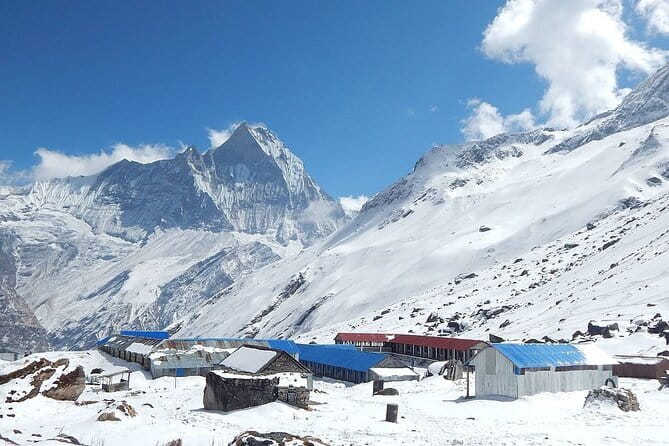
Annapurna Base Camp gives you a lot in 15 days: Kathmandu temples, Pokhara’s lakeside pause, a Poon Hill sunrise, village trails, suspension bridges, and a high mountain bowl ringed by snow peaks. The main prize is Annapurna Base Camp, reached after days of walking through forests and narrow valleys.
I like the smart route design, which adds Poon Hill before the main trek, and I like the strong guide support. Names attached to this program include Pradeep, Bikas, Santosh, Birendra, Aashman, and Lal. The possible drawback is simple: this is a demanding walking trip, not a sightseeing tour with a little hiking added.
I also like that the price includes permits, entrance fees, and many meals. Still, you should confirm exactly what lodging and ground transport cover before paying, since the inclusions list does not spell out every hotel, lodge, or transfer cost.
Key points to know before booking
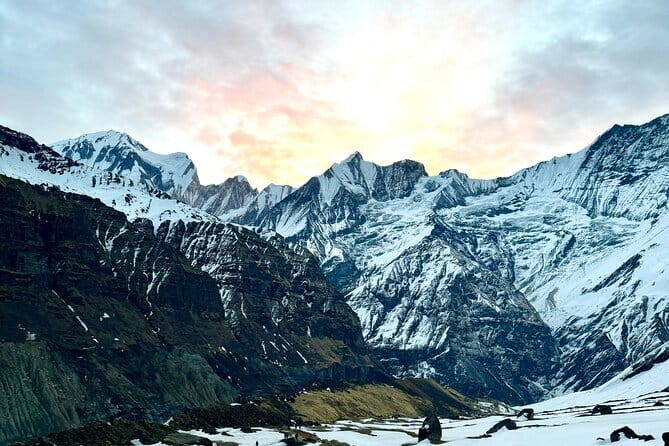
- Poon Hill adds a sunrise classic: You climb early for close views of the Annapurna and Dhaulagiri ranges, with coffee waiting at the viewpoint.
- The route mixes culture and mountains: Kathmandu’s major religious sites come before village trails, forests, waterfalls, and high Himalayan scenery.
- The final approach is enclosed and dramatic: From Deurali, the path follows a rocky valley to Machapuchare Base Camp and then Annapurna Base Camp.
- Guide care is a major part of the experience: Pradeep, Bikas, Santosh, Birendra, Aashman, and Lal are among the guides associated with groups on this route.
- You need steady fitness: Walking days run about five to eight hours, with steep stone steps, uphill sections, cold forest paths, and rough ground.
- The $995 price includes useful basics: Permits, listed entrance fees, 14 breakfasts, 10 lunches, and 10 dinners are included, while insurance, drinks, tips, and personal spending are not.
Kathmandu gives you a useful two-day start
Your first day is gentle. An airport representative meets you with a sign, takes you to your hotel by private car, and brings you to a welcome dinner. The meal comes with traditional Nepali food and a dance show, followed by a detailed talk about the days ahead.
That first evening matters more than it may seem. You can ask questions before the walking begins, check the pace with your guide, and get used to the fact that this trip has both city touring and mountain trekking.
Day two is a full Kathmandu Valley circuit. You visit Pashupatinath, Boudhanath, Swayambhunath, and Kathmandu Durbar Square. These are not filler stops. Pashupatinath is a major Hindu temple near the airport, Boudhanath brings you to one of the city’s best-known Buddhist stupas, Swayambhunath adds the famous hilltop temple and monkeys, and Durbar Square gives you a close look at Kathmandu’s historic center.
The day ends with a trek briefing, an introduction to the guide, and an equipment check. That is a sensible point in the schedule to raise concerns about footwear, bags, clothing, or any physical problem that could affect the walk.
More Annapurna Treks in Kathmandu
- Annapurna Circuit Trek with Tilicho Lake
★ 5.0 · 368 reviews - Annapurna base camp trek 5 Days
★ 5.0 · 252 reviews - 14-Day Private Annapurna Base Camp Trek
★ 5.0 · 180 reviews
The long ride to Pokhara is part of the trip
On day three, you take a tourist bus toward Pokhara. The ride takes about seven to eight hours, with hills and the Trishuli River beside the road and meal stops near Malekhu and Ghansikuwa.
This is not a quick transfer, so set your expectations properly. You lose most of a day to the road, but you also get a broad look at rural Nepal before reaching Pokhara. The overnight hotel is near Fewa Lake, giving you time for a meal, a café stop, or a walk before the serious hiking begins.
Pokhara is the gateway for the Annapurna route and a calmer counterpoint to Kathmandu. The contrast is useful: Kathmandu is dense with temples and traffic, while Pokhara gives you a slower evening before the trail.
Ulleri begins with a serious staircase
Day four takes you from Pokhara to Nayapul, where the walking starts. You follow a valley forest, cross the Bhurungdi Khola River, pass through Tikhedhunga, and then face about 3,400 steps and boulders before reaching Ulleri.
That staircase is the day’s test. The itinerary gives about six hours of walking, but the effort depends on your pace and how often you stop. This is a good reason to carry water and keep your first trekking day controlled rather than racing ahead.
Ulleri is the first overnight village on the route. The reward is not a grand viewpoint so much as the feeling that city life is now behind you. From here, the trail becomes a daily rhythm of stone paths, forests, farm terraces, lodges, and mountain weather.
Poon Hill earns the early alarm
The next stage leads toward Ghorepani. You pass waterfalls and small villages, with views toward Annapurna South. The path climbs through mountain country rather than simply following an easy valley, and the day is listed at about five hours.
The following morning starts before dawn with the climb to Poon Hill. This is one of the strongest parts of the program. From the viewpoint, the Annapurna and Dhaulagiri ranges catch the first light, and you can take in close views with a hot coffee before descending to Ghorepani for breakfast.
After breakfast, you continue through rhododendron forest and past waterfalls to Tadapani. The day runs about seven hours, so the sunrise comes with a cost: an early start followed by a full trekking day. I think that trade is worth it, but you should be ready for a long morning.
Poon Hill also gives you an early sense of the scale of the mountains. The route is not yet at base camp, but the views of Annapurna South and Nilgiri make the later goal feel real.
Another trail to compare in Kathmandu:
- Everest Base Camp Trek – 14 Days
★ 5.0 · 1,499 reviews - Everest Base Camp Trek
★ 5.0 · 842 reviews - Everest Base Camp Trekking
★ 5.0 · 485 reviews - Everest Base Camp Trekking – 13 Day
★ 5.0 · 365 reviews
Chhomrong brings mountain villages and more steps
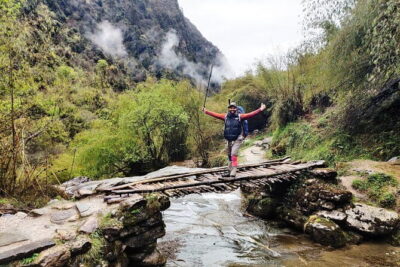
From Tadapani, the trail passes through a large rhododendron forest and opens onto terraced fields. You cross a suspension bridge and climb toward Chhomrong, a village below Mt. Annapurna.
The day takes about six hours. The description includes waterfalls, varied ground, and a roughly five-kilometer uphill stretch, so do not treat it as a relaxed village walk. Chhomrong is an important point on the route because the trail begins to feel more focused on the Annapurna Sanctuary.
You will see the familiar pattern of this trek here: a descent that costs energy, followed by another climb. The stone steps are part of the route, not an occasional nuisance. If your knees are sensitive, mention it early. One guide, Bikas, is specifically praised for encouraging a person who had knee pain, but support from a guide is not a substitute for preparing your body.
Bamboo and Deurali narrow the route
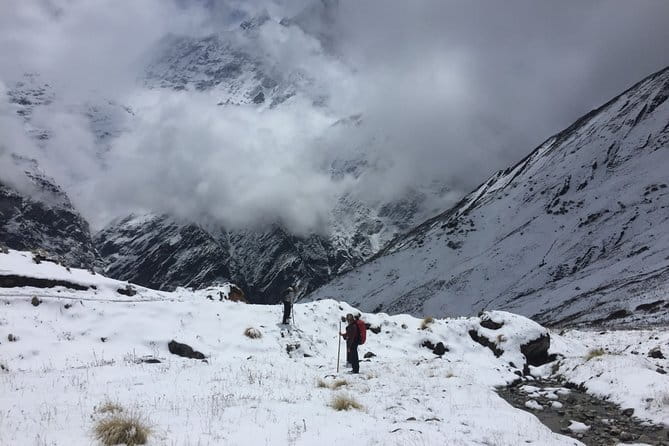
Day eight descends from Chhomrong by many stone steps to the Chhomrong Khola River. After a swinging bridge, the route climbs to Sinuwa, passes through forest near Kuldihar, and then drops toward Bamboo.
This six-hour day can feel harder than its distance suggests because of the repeated up-and-down movement. The forest provides shade, but the path remains physical.
The next day brings a colder bamboo forest and a steep climb to Himalaya Hotel. After the forest opens, you get views of the glacial river below. The trail becomes drier and more exposed as you reach Hinku Cave, then drops to a river before climbing again to Deurali.
This five-hour section is where the scenery changes sharply. Green forest gives way to cliffs, waterfalls, river views, and larger mountain horizons. You may find the change more memorable than any single viewpoint because the route gradually shows you that the base camp is close.
Annapurna Base Camp is the natural high point
The walk from Deurali to Annapurna Base Camp takes about six hours. The trail follows the valley over rocky ground and occasional steep sections, with flatter stretches breaking up the climb.
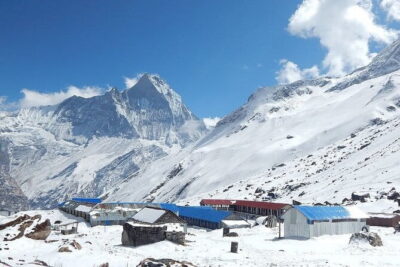
You pass Machapuchare Base Camp first. From there, the views include Hiunchuli, Annapurna South, Annapurna I, Annapurna III, Gandharvachuli, and Gangapurna. The final approach continues through the gorge, which is the only access described for this area.
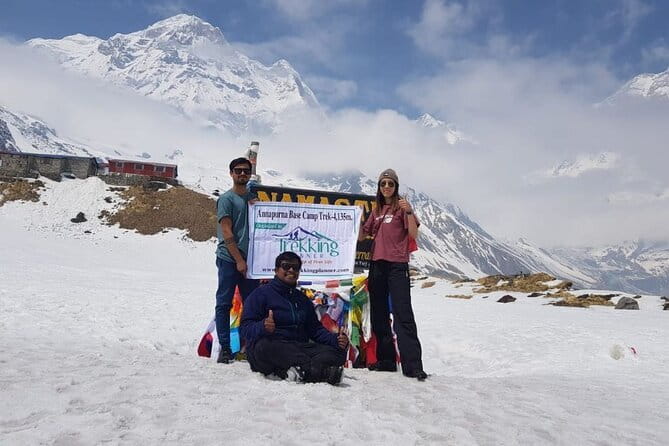
At Annapurna Base Camp, the mountains surround you rather than simply appearing across a distant valley. That enclosed setting is the reason this trek feels different from a standard viewpoint hike. You have spent several days walking toward the peaks, and now the route places you among them.
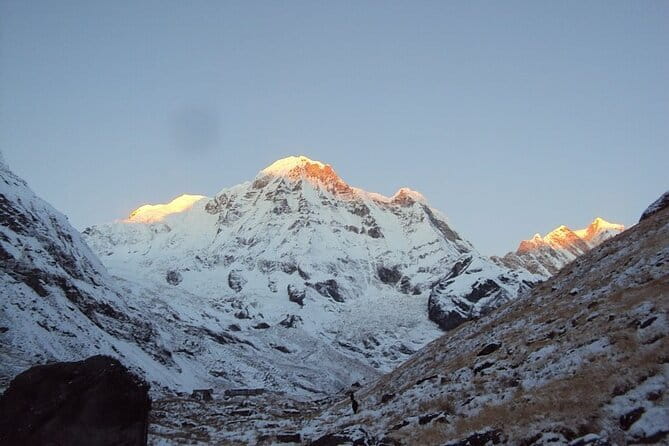
The overnight stay at base camp is valuable. You do not need to rush back down on the same day, and the next morning offers a chance to see sunrise in the high mountain setting. The supplied schedule does not give a separate acclimatization day, so you should discuss pace, symptoms, and the plan with your guide as you climb.
The return is easier on paper, but not effortless
Day 11 starts with sunrise at base camp, then drops through Machapuchare Base Camp, Deurali, Himalayan Hotel, and the lower settlements. The itinerary labels the overnight stop Bamboo, while the route description also names Doban, so confirm the exact night’s lodge with the operator before departure.
The downhill direction usually makes the day feel less demanding than the climb to base camp, but six hours of descending can still be hard on knees and ankles. This is another reason to use trekking poles if you already own them and to keep your pace steady.
Day 12 retraces the route to Chhomrong, where you stop for lunch, then descends to Jhinu Danda. The path moves through farmland and rainforest. This change from high mountain terrain back to warmer forest makes the day feel like a real transition out of the sanctuary.
Jhinu Danda and Pokhara close the trail
After breakfast at Jhinu Danda, you walk toward Nayapul through western Nepal’s hill country. Lunch comes along the way, and the walking portion of the Annapurna Sanctuary route ends at Nayapul.
From there, you drive back to Pokhara for the night. The full day is listed at about eight hours, combining trail time, lunch, and the road transfer. That is a long finish, so do not plan an ambitious evening in Pokhara.
Day 14 takes you back to Kathmandu by flight or road. The schedule allows a free day after arrival for shopping or independent exploring, followed by a farewell dinner. Because the return method is presented as either a flight or a drive, ask which option is included and how any difference in cost is handled.
The final morning is straightforward. A representative takes you to the airport three hours before departure. The 15-day schedule gives you a buffer after the trek, which is useful if road travel or mountain weather causes a change in plans.
What the $995 price really offers
At $995 per person, this is a substantial trip rather than a cheap day excursion, but the price includes several costly and useful basics:
- Required permits and listed entrance fees
- 14 breakfasts
- 10 lunches
- 10 dinners
- Airport pickup
- A private group format
- Kathmandu and Pokhara hotel stays as described in the schedule
- Lodge nights on the trekking route as described in the schedule
The last two points deserve confirmation because accommodation and all transport are not clearly itemized in the formal inclusion list. Ask for a written breakdown covering hotels, mountain lodges, the Pokhara bus, airport transfers, and the return flight or drive.
You pay extra for drinks, bar bills, personal expenses, travel insurance, and tips. Group discounts are offered, which may improve the value for families or friends booking together.
Guide support is one of the strongest features
The guide team is central to the experience. Names connected with this program include Pradeep, Bikas, Santosh, Birendra, Aashman, and Lal. The strongest pattern in the feedback is not about luxury. It is about guides who stay attentive, explain the area, motivate tired walkers, and adjust when someone struggles.
That matters on a trek with children or mixed fitness levels. One family described bringing an eight-year-old boy and receiving a flexible change of plan when snow made the route harder. Another participant with knee pain specifically credited Bikas with encouragement and care.
Porters are also part of the support system. One group traveled with eight porters, and several comments point to the porter team as an important reason the walk felt manageable. Ask how much of your luggage the porters carry and what daypack weight you should expect to handle yourself.
Who should book this trek
I would recommend this trip to you if you want a structured Himalayan walk with a private group, local guide support, and a clear start and finish in Kathmandu. It suits people who want more than mountain views, since the program includes temples, villages, forests, farms, rivers, and a major Nepalese city.
It also suits families and friends who want help with logistics. The guide team has experience supporting children and adjusting plans when conditions change, though the route is still physically demanding and parents should discuss the child’s readiness before booking.
I would hesitate if you want a soft adventure, flexible rest days, or comfortable transport every day. Five to eight hours of walking is common, and the trail includes 3,400 steps, steep climbs, rocky sections, swinging bridges, and repeated descents.
The cancellation terms are fairly strict close to departure. You receive a full refund if you cancel at least three full days before the start time, while later cancellations and late changes are not accepted. Travel insurance is not included, so arrange that separately.
Should you book the Annapurna Base Camp Trek?
Book it if the idea of earning your mountain views appeals to you. The route gives you a satisfying progression from Kathmandu’s temples to Pokhara, Poon Hill, forest trails, high valleys, and the ring of peaks at Annapurna Base Camp.
The best reasons to choose it are the varied route, the Poon Hill sunrise, the private group format, and the repeated signs of careful guide support. Before booking, confirm lodging, transport, porter arrangements, the exact Day 11 overnight stop, and the return from Pokhara to Kathmandu.
If you are moderately fit, willing to walk hard for several days, and comfortable with simple mountain accommodation, this is a strong way to see the Annapurna region without arranging every permit, meal, transfer, and lodge yourself.
FAQ
How long is the Annapurna Base Camp Trek?
The experience lasts approximately 15 days, including arrival and departure days, Kathmandu sightseeing, travel between Kathmandu and Pokhara, the trek, and the return to Kathmandu.
What is included in the price?
The $995 price includes all listed fees and taxes, required permits, entrance fees on the itinerary, 14 breakfasts, 10 lunches, and 10 dinners. Group discounts and pickup are offered.
Are drinks and travel insurance included?
No. Bar bills, beverages, travel insurance, tipping, personal expenses, and anything not listed in the program are excluded.
Is this a private tour?
Yes. Only your group participates in the activity. The program also includes guide support and porters for the trekking sections.
How fit do I need to be?
You should have a moderate level of physical fitness. Walking days generally last about five to eight hours and include steep sections, stone steps, rocky ground, forest paths, bridges, and long descents.
What is the cancellation policy?
You can receive a full refund if you cancel at least three full days before the experience start time. Cancellations or changes made less than three full days before the start are not accepted or refunded.
Latest treks added in Kathmandu
- Private Manaslu Circuit Trek at Himalayas★ 5.0 · 3 reviews
- Ghorepani Poonhill Trek★ 5.0 · 5 reviews
- Ghorepani Poon Hill Trek★ 5.0 · 16 reviews
- Upper Mustang Trekking★ 3.0 · 2 reviews
- Amazing 1 Day Trekking Experience in Kathmandu Nepal★ 5.0 · 24 reviews
- Upper Mustang Trekking★ 5.0 · 2 reviews
- Upper Mustang Trek★ 5.0 · 5 reviews
- Upper Mustang Trekking★ 5.0 · 4 reviews
Annapurna Base Camp Treks, compared.

Trekking in Annapurna/Langtang/Everest/Upper Mustang regions
Read our review →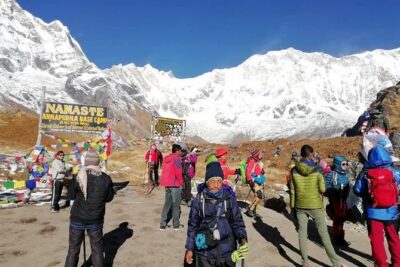
Kathmandu to Annapurna Base Camp (ABC) 5-Day Trek
Read our review →Browse the lists this tour appears in