
REVIEW · KATHMANDU
10 Days Annapurna Circuit Trek
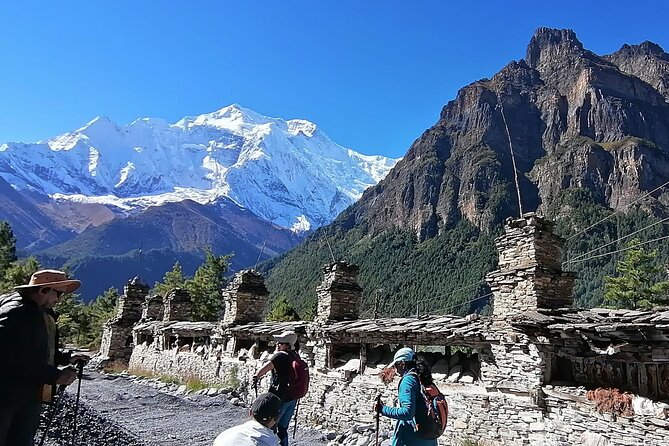
The high point here is literal: Thorong La Pass at 5,416 meters, reached after days of walking from the Marshyangdi Valley into the stark Mustang region. You get snowy peaks, pine forest, Tibetan-style villages, a sacred temple, and a dramatic flight above the Kali Gandaki Gorge in one compact trip.
I like the useful all-in structure, with guides, porters, meals, a sleeping bag, private ground transport, and the Jomsom to Pokhara flight included. I also like the small maximum group size of 15, plus the personal touch of guides such as Babu and Resham and porters such as Rojit.
The main consideration is the pace. Ten days leaves little spare time for altitude problems, slow walking, or weather delays, and the crossing at 5,416 meters is a serious physical test. You need moderate fitness and a sensible attitude toward altitude.
Key points to know before booking
- Thorong La is the make-or-break day: The pass reaches 5,416 meters and involves a long, rocky climb from Thorung Phedi.
- The trip includes practical support: A guide and one porter for every two people accompany the trek, with meals, a sleeping bag, and basic transport covered.
- Manang offers a valuable pause: Day five focuses on Manang village and Gangapurna Lake before the route climbs higher.
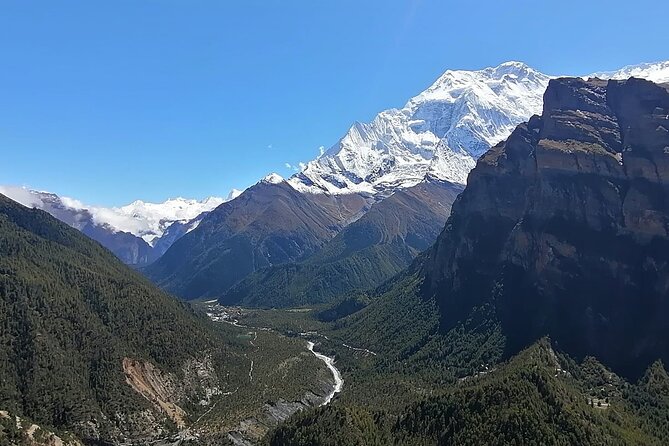
- The scenery changes sharply: Expect forest and river valleys near Chame, dry high country around Manang, and arid Mustang near Muktinath.
- The finish saves time: A domestic flight from Jomsom to Pokhara replaces a long return overland journey.
- A small group is a real advantage: The maximum of 15 makes it easier for a guide to monitor pace and respond when altitude becomes a problem.
Why this Annapurna route is so rewarding
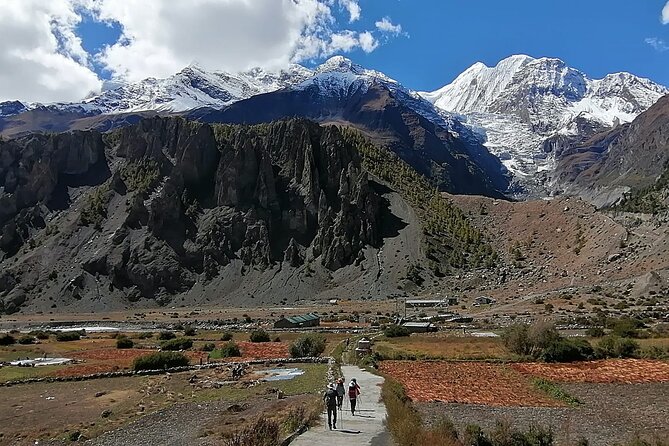
The Annapurna Circuit works because the scenery keeps changing. You begin with a long road journey from Kathmandu toward Besisahar, then move through river valleys and forest before entering the high country around Manang. After Thorong La, the world feels drier, more Tibetan, and more open.
This is not simply a walk from one mountain view to the next. The route gives you a sense of Nepal’s changing climate and culture. You pass villages tied to mountain farming, Buddhist and Hindu religious traditions, and old trade routes across the Himalayas. The views are the headline, but the village life gives the trip its shape.
At $1,430 per person, the price looks reasonable for what is included. Ten lunches, 10 dinners, 11 breakfasts, a guide, porters, a sleeping bag, private transportation, taxes, and the Jomsom to Pokhara flight cover many of the expenses that can quietly add up on a mountain trip.
You still pay separately for bottled water, alcoholic drinks, and the listed admission charges at Thorong La and Muktinath. You should also note that the vehicle is not air-conditioned, though that matters less once you are on foot. The value is strongest if you want one company to coordinate the moving parts instead of arranging each meal, porter, transfer, and flight yourself.
More Annapurna Treks in Kathmandu
- Annapurna Circuit Trek with Tilicho Lake
★ 5.0 · 368 reviews - Annapurna base camp trek 5 Days
★ 5.0 · 252 reviews - 14-Day Private Annapurna Base Camp Trek
★ 5.0 · 180 reviews
Day 1: Kathmandu to Besisahar with a stop at Manakamana
Your staff pickup is scheduled for 7:15 a.m. from the Himalayan Trekking and Tours office on Yapikhya Marg in Kathmandu. The first day is largely a transport day, with a drive of about seven hours over roughly 185 kilometers to Besisahar.
The route includes Manakamana Temple. This gives the day a cultural stop rather than making it a straight ride into the mountains. By the time you reach Besisahar, you begin to see the snow-covered peaks that set the tone for the trek.
Be realistic about this day. Seven hours in a vehicle is tiring, and mountain roads can make the journey feel longer than the distance suggests. Still, reaching Besisahar on the first day lets you save your legs for the walking ahead.
Day 2: Forest, river valleys, and Chame
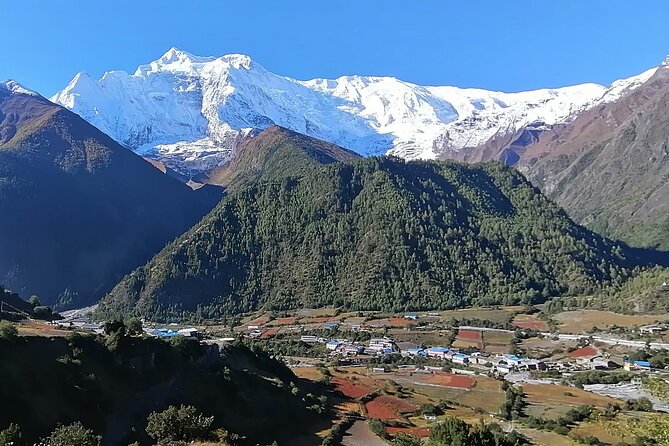
The trail climbs toward Tyanja at about 2,360 meters, then continues through forest near the river to Kopar at about 2,590 meters. The route finishes at Chame, headquarters of Manang District.
This is where the trek begins to feel like a trek rather than a tour with a long walk added on. The path follows the river and passes through forest, while the mountains begin to dominate the view. Chame rewards you with views of Annapurna II.
The steady rise is useful preparation for the much higher sections ahead, but it is also your first reminder that altitude changes the effort. Walk at a pace you can maintain. There is no prize for rushing the early days.
Day 3: Narrow valleys and the Paungda Danda rock face
The third day starts in a deep forest along a steep, narrow valley. You cross a river on a long bridge at about 2,910 meters, then another bridge at around 3,040 meters.
The major visual moment is Paungda Danda, a huge rock face that comes into view as the route continues. This kind of scenery is one reason to choose the full circuit. The trail does not offer just distant peaks. It brings you through enclosed valleys, beside rivers, and under towering rock walls.
The terrain can feel demanding because of the narrow valley and constant climbing. Your guide matters here, particularly when the group has mixed walking speeds. A maximum of 15 people is manageable, but you should still expect the day to have a shared pace rather than a private one.
Another trail to compare in Kathmandu:
- Everest Base Camp Trek – 14 Days
★ 5.0 · 1,499 reviews - Everest Base Camp Trek
★ 5.0 · 842 reviews - Everest Base Camp Trekking
★ 5.0 · 485 reviews - Everest Base Camp Trekking – 13 Day
★ 5.0 · 365 reviews
Day 4: Pine forest and the approach to Manang
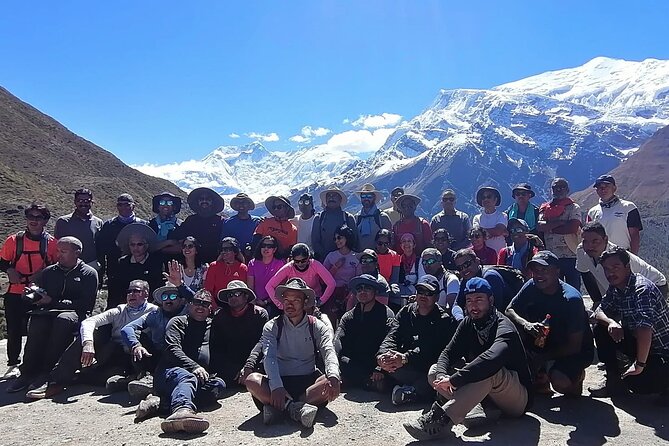
The route passes through aromatic pine forest before reaching the Manang area. Along the way, you can expect close views of Gangapurna, Annapurna II and III, Tilicho, Chulu East, and Pisang Peak.
This is one of the most scenic transitions on the trip. The trees begin to thin, the mountains feel nearer, and the valley opens into a high mountain setting. The change is gradual enough that you can notice it step by step.
The attraction is not only the number of peaks. Manang is important because it places you in the high country before the pass crossing. You have time to look around, adjust to the altitude, and get a feel for mountain life before the route becomes tougher.
Day 5: Manang village and Gangapurna Lake
Day five is devoted to exploring Manang village and visiting Gangapurna Lake. This is one of the smartest parts of the schedule because it gives you more than another long push uphill.
Manang offers a closer look at daily life in the mountain region. You can interact with local people, walk through the village, and see how the setting changes from the lower valleys. Gangapurna Lake adds a striking natural stop and brings you close to one of the area’s best-known mountain features.
The schedule information describes this as a full day, so check the exact timing with your operator before departure. That detail matters because a proper pause in Manang can make the next high-altitude days more manageable. If you are feeling tired, use the time to rest rather than treating every hour as a sightseeing obligation.
Day 6: Manang to Yak Kharka and Ledar
Leaving Manang, the trail climbs into the Marshyangdi Valley. The ascent becomes strenuous as you pass Gunsang and continue toward Yak Kharka, with Ledar reached before sunset.
This is a shorter-feeling world than the lower route. Forest gives way to open high country, and the air is thinner. The walk may not have the dramatic pass crossing yet, but it is an important test of how your body is handling the altitude.
You should pay attention to headache, nausea, unusual fatigue, or other signs that you are not adjusting well. One past Annapurna trekker had altitude trouble and credited the guide team with responding when symptoms appeared. That is a useful reminder to speak up early. A guide cannot help with a problem you try to hide.
Day 7: Thorung Phedi and the final preparation
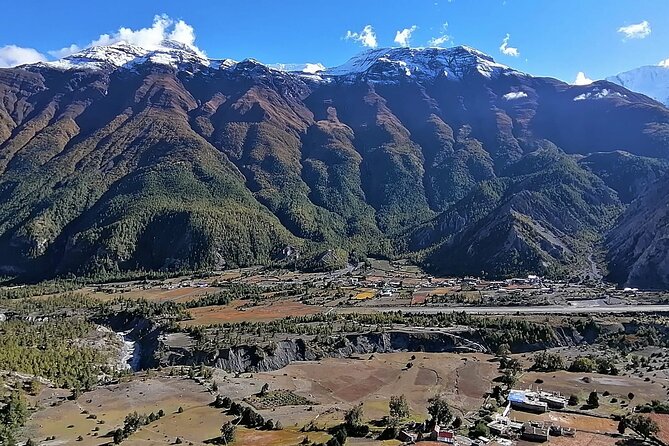
The path follows the east bank of the Jorsang Khola toward Thorung Phedi. The trail becomes narrow in places, with unstable slopes and difficult sections underfoot.
Thorung Phedi is the overnight point before the pass. It is not just another stop on the route. Your arrival here sets up the biggest day of the entire trek.
Expect this day to feel tough even though it is mainly preparation for the crossing. Keep your pack light, protect your energy, and organize clothing and essentials before sleeping. The next morning starts early and demands your best effort.
Day 8: Thorong La at 5,416 meters and Muktinath
This is the trip’s main challenge. You climb rocky ridges to Thorong La, the highest point of the trek at 5,416 meters.
From the pass, the view includes the Dhaulagiri range. The setting is broad, exposed, and very different from the forested approach. Reaching the top is a physical achievement, but the descent that follows also requires care. Rocky ground and tired legs are a poor combination, so take your time.
The route continues to Muktinath, one of the important religious sites in Nepal’s Mustang region. The temple has significance for Hindu and Buddhist pilgrims, and it adds a cultural dimension after the demanding mountain crossing.
Admission fees for Thorong La and Muktinath are not included, according to the supplied tour details. Carry some local money for these charges and any small purchases, since bottled water is also not covered.
Day 9: Down the Kali Gandaki Valley to Jomsom
After the pass, the character of the trip changes again. You descend through the dramatic Kali Gandaki Valley, where the surroundings become dry and more Tibetan in appearance.
The route passes Jharkot and Khingar, described as typical Tibetan villages, then follows the valley floor toward Jomsom. The descent gives your legs a different kind of work after the uphill days. It can feel easier because you are losing altitude, but long downhill walking still takes a toll.
Jomsom is an important practical stop because it connects the trek to the next morning’s flight. It also marks the end of the walking route for this itinerary. Take the evening to rest and keep your belongings organized for an early departure.
Day 10: Jomsom to Pokhara by air
After breakfast, you take a morning flight to Pokhara. The flight passes above the Kali Gandaki Gorge and offers views toward Dhaulagiri and the Annapurna ranges.
This is a strong ending because it replaces a long return journey by road with a short, scenic connection. It also gives you a final look at the terrain you have crossed from a completely different angle.
The Pokhara portion is described as free time, with the option to visit the city and go boating on Fewa Lake. Do not treat this as a full guided Pokhara sightseeing day. It is better understood as a chance to relax after the trek and enjoy the lakeside setting.
Guides, porters, meals, and comfort
The support package is practical rather than luxurious. One porter is assigned to every two people, which helps keep your personal load down while still giving the porter a workable arrangement.
Guides named in past trips include Babu and Resham. Babu is also described as especially helpful on local matters, while porter Rojit is singled out for being friendly and accommodating. Staff quality can shape a high-altitude trek, so these details are worth noting, though you should confirm your own guide assignment before booking.
The package includes breakfast, lunch, and dinner for the stated 10 days, along with coffee or tea and a sleeping bag. Accommodation is described positively, but the specific hotels and teahouses are not listed. Expect basic mountain accommodation rather than city-hotel standards, and ask the company for the current lodging plan if room arrangements matter to you.
You are responsible for bottled water and alcoholic drinks. Since the route reaches high altitude, water is not a minor expense. Budget for it and ask your guide about the safest way to manage hydration along the route.
How difficult is this 10-day trek?
The official guidance calls for moderate physical fitness, but the pass makes this more demanding than an ordinary walking holiday. You need to manage long days, repeated climbs, uneven paths, narrow trails, and a high point above 5,000 meters.
The biggest concern is not only leg strength. It is how your body reacts to altitude. The schedule includes a day in Manang, which helps, but 10 days is still a brisk time frame for the circuit. If you develop symptoms, tell your guide at once and follow the team’s advice.
This trip suits you if you want a supported mountain trek and are comfortable with basic accommodation, shared group timing, and hard walking. It is less suitable if you want a relaxed schedule, private pacing, or a trip with extensive spare days for weather and rest.
Group size, timing, and cancellation terms
The group maximum is 15 people. That is small enough for a guide to keep the party together without creating the feel of a large expedition.
The stated start time is 7:15 a.m., with the first hotel pickup at 7 a.m. on day one. Confirm the exact pickup point and time before leaving Kathmandu, since the listed meeting point is the Himalayan Trekking and Tours office.
Free cancellation is available up to 24 hours before the experience start time for a full refund. Changes or cancellations inside that period are not accepted for a refund under the stated terms.
Should you book the Annapurna Circuit Trek?
Book it if you want a compact, well-supported route with major mountain scenery, a serious pass crossing, local villages, included meals, porter support, and a scenic flight into Pokhara. The strongest features are the changing scenery, the Manang pause, and the practical package at $1,430.
Think twice if you need a slow altitude schedule or dislike long vehicle transfers and basic mountain lodging. Before paying, confirm the exact accommodation, the day five timing, your guide assignment, and how the company handles altitude symptoms and flight disruption.
For a fit walker who wants the classic Annapurna experience without arranging every detail alone, this is a strong choice. Just respect Thorong La. The mountains do not care how neatly the itinerary is printed.
FAQ
Where does the Annapurna Circuit Trek begin?
The activity begins in Kathmandu, with the listed meeting point at Himalayan Trekking and Tours on Yapikhya Marg 17.
What time does the tour start?
The stated start time is 7:15 a.m. The first day’s hotel pickup is scheduled for 7 a.m.
How long is the trek?
The tour lasts approximately 10 days.
What is the highest point of the trek?
The highest point is Thorong La Pass at 5,416 meters.
Is a guide included?
Yes. A guide is included in the tour price.
Are porters included?
Yes. One porter is assigned for every two people.
Are meals included?
Breakfast, lunch, and dinner are included. The package lists 11 breakfasts, 10 lunches, and 10 dinners.
Is the Jomsom to Pokhara flight included?
Yes. The domestic flight from Jomsom to Pokhara is included.
Are bottled water and alcoholic drinks included?
No. Bottled water and alcoholic beverages are not included.
What is the cancellation policy?
You can cancel at least 24 hours before the start time for a full refund. Cancellations or changes made less than 24 hours before the start time are not accepted for a refund.
Latest treks added in Kathmandu
- Private Manaslu Circuit Trek at Himalayas★ 5.0 · 3 reviews
- Ghorepani Poonhill Trek★ 5.0 · 5 reviews
- Ghorepani Poon Hill Trek★ 5.0 · 16 reviews
- Amazing 1 Day Trekking Experience in Kathmandu Nepal★ 5.0 · 24 reviews
- Upper Mustang Trekking★ 5.0 · 2 reviews
- Upper Mustang Trekking★ 3.0 · 2 reviews
- Upper Mustang Trek★ 5.0 · 5 reviews
- Upper Mustang Trekking★ 5.0 · 4 reviews
Annapurna Base Camp Treks, compared.

Trekking in Annapurna/Langtang/Everest/Upper Mustang regions
Read our review →
Kathmandu to Annapurna Base Camp (ABC) 5-Day Trek
Read our review →Browse the lists this tour appears in