REVIEW · YULARA
Uluru: Guided Trek of Uluru’s Base in a Small Group
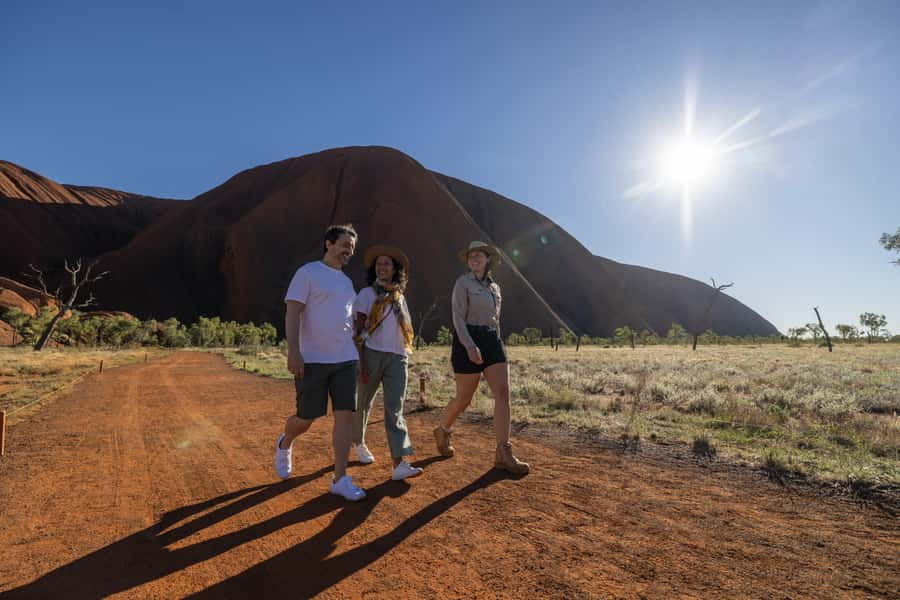
Uluru changes by the minute at sunrise, and this tour puts you beside the rock for that transformation rather than viewing it from a distant lookout. You walk the entire base, about 10.5 kilometres, with stops for rock art, waterholes, cultural stories, and breakfast.
I like the small vehicle and group size, which gives the guide room to adjust the pace and answer questions. I also like the way the route connects the sights to Anangu culture, especially at Mutitjulu Waterhole and Kantju Gorge. The catch is simple: this is a long walk in a hot, exposed part of Australia, and the very early pickup takes commitment.
Key points
- Sunrise on foot: Begin before dawn and watch Uluru catch its first light from close range.
- The full base walk: See changing rock faces, caves, markings, waterholes, and shaded sections over roughly 10.5 kilometres.
- Cultural storytelling: Learn Tjukurpa stories connected with Kuniya, Liru, and the Mala people.
- Small-group format: Transport holds a maximum of 11 participants, making the outing feel personal.
- Breakfast on the trail: Carry a picnic breakfast, with tea and coffee, and stop along the way.
- Useful language support: Optional audio guides are available in Spanish, Chinese, French, German, Italian, and Russian.
Why walking Uluru’s full base matters
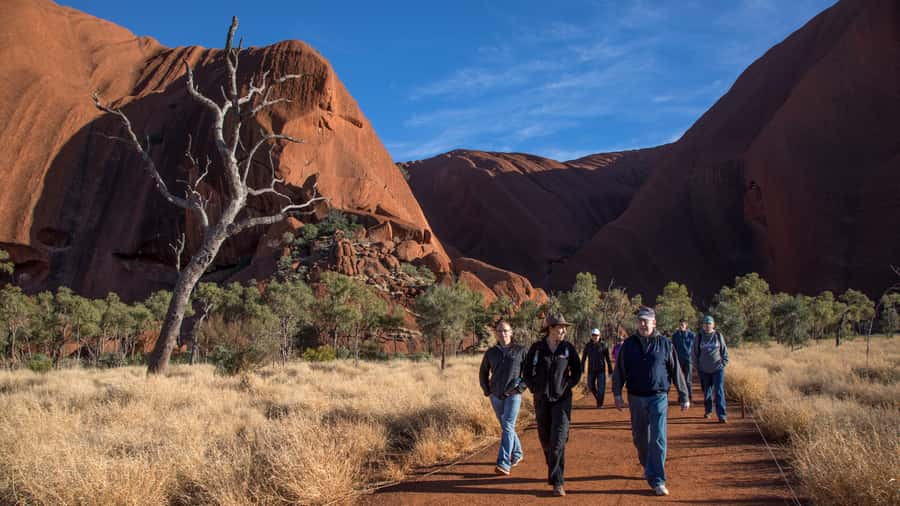
Uluru is not a monument you understand from one photograph. Its sides change constantly. One stretch is sheer and red, another is marked by caves and overhangs, and another opens toward a waterhole or a quiet gorge.
The full base walk gives you time to notice those shifts. You are not simply circling a rock to collect a photograph. Your guide explains how the formations, water, plants, animals, and stories connect. That context makes the walk far more meaningful than a self-guided loop with no background.
The route is generally flat and follows gravel tracks, so the main challenge is distance rather than climbing. One participant recorded more than 14 kilometres, while the advertised distance is about 10.5 kilometres. Your total will depend on the exact route, stops, and walking around points of interest, so plan for a serious morning rather than a quick stroll.
I would rate this as manageable for anyone reasonably fit, but not effortless. You need comfortable walking shoes, a hat, sunscreen, water, and clothing suited to the season. In cooler months, the morning can feel cold. By the later part of the walk, especially in warmer months, sun and heat become the larger concern.
More guided trips in the world
- Bali: Mount Batur Sunrise Trek With Guide and Breakfast
★ 4.8 · 3,461 reviews - From Chania: Full-Day Samaria Gorge Trek Excursion & Guide
★ 4.6 · 3,191 reviews - La Palma: Tajogaite Volcano Guided Trek
★ 4.8 · 1,810 reviews
Before sunrise: pickup from Ayers Rock Resort
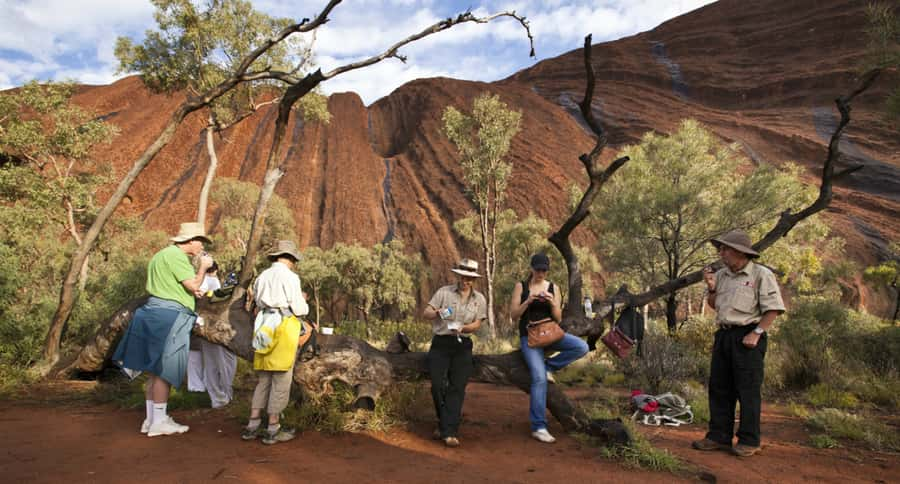
Pickup takes place about an hour before sunrise from the front of your hotel reception at Ayers Rock Resort. The vehicle carries no more than 11 participants, which is a useful middle ground: smaller and more personal than a large coach, but not so intimate that you feel trapped in a private tour.
There are a few pickup details worth knowing. If you stay at Emu Walk Apartments, pickup is from Desert Gardens Hotel next door. If you stay at The Lost Camel, meet at Sails in the Desert next door. Everyone else should wait outside the front of the relevant hotel reception.
The transport is air-conditioned, an important comfort in Central Australia. Guides such as Michael, Lily, Dimitri, Rachel, and Lucia have been praised for keeping the early start upbeat and making people feel looked after. Your guide may differ, but the small group gives you a better chance to speak with that person than you would have on a full-size coach outing.
The early departure is not a minor detail. You will be dressing and packing while it is still dark, and breakfast comes later on the walk. That said, starting before the heat arrives is one of the smartest features of the tour. By late morning, even a flat path can feel demanding.
Sunrise beside Uluru
The group begins walking before sunrise and stops at a suitable point to watch the first light reach Uluru. This is the visual high point of the outing, but the setting is not just about color.
In the half-light, the rock first appears as a dark mass. As the sun rises, its walls shift through soft browns, reds, and stronger orange tones. You can watch the surrounding country brighten at the same time, which helps explain Uluru’s commanding presence.
Bring a camera if you like, but do not spend the entire moment looking at a screen. The best part is seeing the light move across the surface in real time. Your guide also helps with timing and positioning, so you are not left guessing where to stop.
The sunrise section can be chilly, particularly between May and September. A warm layer is practical, even if the afternoon forecast promises heat. Once the sun is up, you can remove it and carry it in your day pack.
Kuniya Walk and Mutitjulu Waterhole
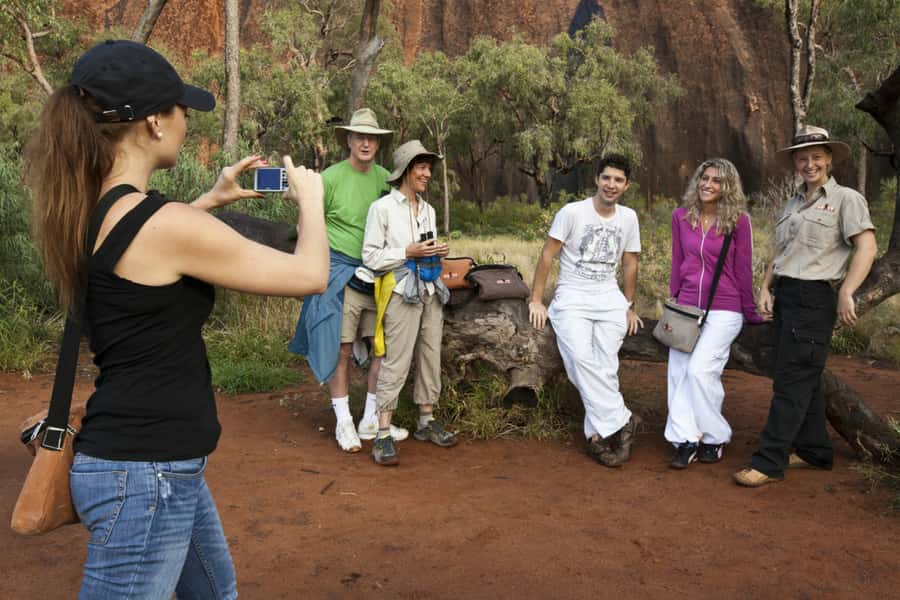
One of the most important sections follows the Kuniya Walk toward Mutitjulu Waterhole. This is where the walk shifts from broad views to a more focused cultural and natural setting.
Your guide introduces the Tjukurpa story associated with Kuniya and Liru. These are not decorative myths added to a sightseeing route. They help explain the cultural meaning of places around Uluru and the responsibilities attached to them for the Anangu, the traditional owners.
Mutitjulu Waterhole also shows why water is so important in this dry country. The rock, plants, animals, and human stories come together here. Your guide discusses survival, local flora and fauna, and the way waterholes shaped life in the area.
The waterhole is a good place to slow down. The tour is not built around rushing from one photo stop to the next, and guides have allowed regular pauses for water and rest. That matters on a route of this length.
Please keep in mind that Uluru is a culturally significant place. Your guide will explain where attention and respect are needed. Listening carefully is part of the experience, not an interruption to it.
More Trekking Tours in the world
- Mount Etna: Trek to 3000m with cable car and 4×4
★ 4.6 · 3,823 reviews - Mount Etna: Summit Crater Trek with Cable Car
★ 4.8 · 1,875 reviews - Etna: summit craters trekking with volcano guide 3350mt
★ 4.7 · 1,712 reviews - From Rethymno: Samaria Gorge Full-Day Trek, Pickup & Guide
★ 4.5 · 1,610 reviews
Rock art and the changing face of Uluru
The base walk includes ancient rock art sites and markings on the rock. These can be easy to miss if you pass without explanation. A guide points out what you are seeing and explains why particular sections matter.
The rock face does not look the same all the way around. You will see towering walls, caves, grooves, overhangs, and areas shaped by water. The variety makes the full circuit worthwhile. If you only visit one side of Uluru, you miss much of this change.
Your guide also covers geology. You learn how to read the shape of the rock and how weather and water have affected it. The geology is useful because it gives a physical explanation for what you are seeing, while the cultural stories give the place its human meaning.
This combination is one of the strongest parts of the outing. You are not asked to choose between science and culture. Both help you understand Uluru more fully.
Mala Walk and Kantju Gorge
Later, the route reaches the Mala Walk and Kantju Gorge. Here, your guide tells the Tjukurpa story of the Mala people and explains the cultural importance of the area.
Kantju Gorge brings you close to another dramatic section of Uluru. The walls and enclosed form feel different from the open views earlier in the walk. It is a good reminder that the base circuit is not repetitive. The rock keeps presenting new angles and spaces.
This section may also feel more demanding simply because it comes later. Even on a level track, your legs know that you have been walking for several hours. Guides have been praised for keeping a steady pace, offering rest stops, and allowing time for photographs.
The direction of travel can affect your comfort. One guide took a group counterclockwise so the second half of the walk had more shade as the day warmed. The exact route direction may vary, but it is worth asking your guide about shade, water, and the expected pace at the start.
Breakfast on the trail
An outback picnic breakfast comes in a carry pack, with tea and coffee supplied. You carry the food yourself, so keep your day pack light and pack only what you need.
The breakfast is intended as a practical meal during a long walk, not a restaurant-style spread. Most people find it sufficient, but one person wanted something more filling. If you normally eat a large breakfast, bring an extra permitted snack or check what is included before departure.
There are water points along the route, but you should not rely on them as your only supply. Carry a water bottle and start well hydrated. One participant carried four litres and used it all, while another advised carrying about two litres and refilling along the way. Your needs depend on the season, your pace, and your own body, but this is not the place to travel with a tiny bottle.
Some walkers have found the refill water earthy or metallic in taste. A reusable bottle or hydration bladder is more useful than a small disposable bottle. In hot weather, frozen water or an insulated bottle can make a real difference.
What the small group changes
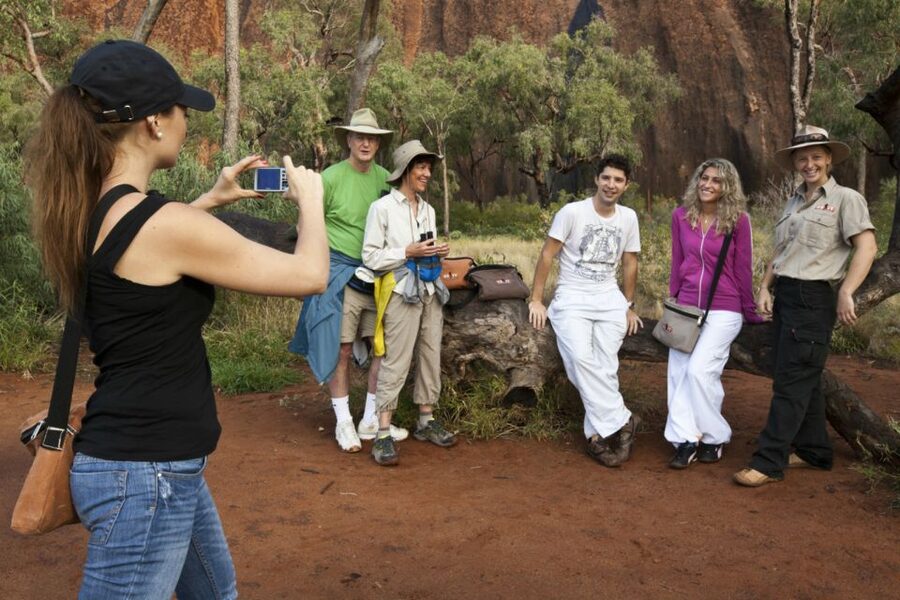
The maximum group size is 11, and that limit matters here. A base walk has many natural pauses, and a large group can turn each stop into a slow shuffle. With fewer people, the guide can speak without shouting and keep the group together more easily.
The format also lets you ask direct questions about plants, animals, geology, or Anangu culture. Guides including Andy, Max, Tim, Gareth, Luca, and Sebastian have been singled out for warmth, care, and strong storytelling. Your guide will vary, but the structure gives that person time to shape the morning around the group.
Do not expect a private tour. You will still share the vehicle, walking pace, and stops with other people. The small-group promise is best understood as a more personal experience, not total flexibility.
Audio guides are available in Spanish, Chinese, French, German, Italian, and Russian. The live guide speaks English. If you use an audio guide, you may receive information in your preferred language while still moving with the English-speaking group.
Price, park entry, and practical value
The listed price is $169 per person. That includes hotel pickup and return within Ayers Rock Resort, air-conditioned transport, a professional driver-guide, the picnic breakfast, tea, and coffee.
You must pay separately for entry to Uluru-Kata Tjuta National Park. The park ticket is valid for three consecutive days from the date of issue, so it can also cover another visit during that period. You can buy it at the park entry station.
For the price, the main value is not transport alone. You receive roughly six hours in the park, a full guided base walk, cultural interpretation, sunrise timing, breakfast, and a very small group. If you already have a rental car and feel confident walking the route alone, a self-guided visit will cost less apart from park entry. But you will need to supply your own transport, planning, food, and interpretation.
I think the tour earns its price for a first visit to Uluru, especially if you want cultural context rather than just a scenic walk. It is less attractive if you dislike early starts, long walks, or fixed group pacing.
Cancellation is free up to three days in advance for a full refund. The infant price includes touring and car-seat hire.
Heat, footwear, and what to carry
The most important preparation is physical and practical. Wear sensible walking shoes with a secure sole. This is not a technical hike, but the distance is long enough for poor footwear to become painful.
Carry:
- A refillable water bottle or hydration bladder
- A hat and sunscreen
- Warm layers in cooler months
- Comfortable walking clothes
- Sunglasses
- A small day pack
- A fly net if insects bother you in warmer weather
The route is mostly flat and gravel-surfaced, but flat does not mean easy in desert heat. Take every rest stop, drink before you feel thirsty, and tell your guide if you need to slow down.
Families and older walkers can manage it if they are reasonably fit, but anyone with limited walking ability should think carefully about 10.5 kilometres or more. The infant option includes a car seat, yet the activity itself remains a long walk for the adults in the group.
Who should book this Uluru walk?
I would choose this tour if you want to see every side of Uluru and understand why the place matters to the Anangu. It suits first-time visitors, couples, solo walkers, and families with older children who can handle a long morning on foot.
It is also a good choice if you prefer a guide who can explain what you are seeing. The stories of Kuniya, Liru, and the Mala people give the route a stronger sense of place than a simple loop with a map.
I would choose something shorter if you are not comfortable walking for several hours, if hot weather affects you badly, or if you want a slow breakfast and a relaxed morning. The tour is rewarding, but it asks for effort.
Should you book it?
Book this tour if a close look at Uluru matters more to you than a quick photo stop. The sunrise, full base circuit, Mutitjulu Waterhole, rock art, Kantju Gorge, and cultural storytelling make a strong single morning.
Skip it if the 5 a.m. style pickup and long distance sound miserable. For everyone else, the small group, capable guides, breakfast, and well-timed start make $169 a fair price for a structured introduction to Uluru. Pack water, wear good shoes, and keep your first morning free of other plans.
FAQ
How long does the Uluru base tour last?
The tour lasts six hours, including hotel pickup, transport, the guided walk, stops, breakfast, and the return journey to your Ayers Rock Resort accommodation.
How far do you walk?
You walk approximately 10.5 kilometres around Uluru. Some participants have recorded a longer distance, depending on the exact route and stops.
What time does pickup take place?
Pickup is approximately one hour before sunrise. The exact starting time changes with the season, so check availability for the date you want.
Where does hotel pickup happen?
Pickup is outside hotel reception at Ayers Rock Resort. Guests at Emu Walk Apartments meet at Desert Gardens Hotel, and guests at The Lost Camel meet at Sails in the Desert.
Is breakfast included?
Yes. An outback picnic breakfast is provided in a carry pack, along with tea and coffee. You carry the breakfast during the walk.
Is the national park entry fee included?
No. Entry to Uluru-Kata Tjuta National Park is separate. Tickets can be purchased at the park entry station and remain valid for three consecutive days from the issue date.
What languages are available?
The live guide speaks English. Optional audio guides are available in Spanish, Chinese, French, German, Italian, and Russian.
How many people are in the group?
Transport and the tour are limited to 11 participants, including the guide.
What should I bring?
Bring sensible walking shoes, a water bottle, a hat, sunscreen, suitable walking clothes, and warm layers during cooler months. A fly net may also help in warmer conditions.
Latest treks added in the world
- 5 Days Desert Trekking from Marrakech★ 5.0 · 16 reviews
- 3 days Toubkal Trek from Marrakech★ 5.0 · 4 reviews
- Elite Experience Atlas Mountains Day Trekking★ 5.0 · 7 reviews
- Morocco Desert Trek 4 Days: 2 days on foot in Morocco★ 5.0 · 2 reviews
- Atlas Mauntains and 3 Valleys Trek★ 5.0 · 6 reviews
- 3 Days Berber Villages Trek – Authentic Atlas Mountain Experience★ 5.0 · 4 reviews
- Atlas Mountains Valley Trek – 3 Days★ 5.0 · 29 reviews
- 5-day Jebel M’goun trek★ 5.0 · 2 reviews
Guided, compared.
Mount Batur Sunrise Trek With Guide and Breakfast
Read our review →
From Chania: Full-Day Samaria Gorge Trek Excursion & Guide
Read our review →
Etna: summit craters trekking with volcano guide 3350mt
Read our review →
From Rethymno: Samaria Gorge Full-Day Trek, Pickup & Guide
Read our review →
Mount Etna: Guided Trek 3,000 Meters to the Summit
Read our review →