
REVIEW · KATHMANDU
12-Day Nepal Adventure Trek with Jungle Safari
This 12-day Nepal circuit packs a lot into less than two weeks: Kathmandu’s great religious sites, a scenic drive to Pokhara, a five-day trek through the Annapurna foothills, and a jungle stay in Chitwan National Park. The route gives you mountain views and village life without requiring a long Himalayan expedition.
I like two things here. First, the Poon Hill trek offers a real taste of Nepalese mountain walking, including sunrise above 3,000 meters and a demanding climb of roughly 3,000 stairs. Second, the tour includes Chitwan, so you get forests, bird watching, a jungle safari, and Tharu culture instead of spending the whole trip on trails.
The main caution is the pace. Several days involve six or seven hours of walking, and the steep section to Ghorepani is not a casual stroll. Accommodation is described as basic but clean, meals are included only on selected days, and the $25 sightseeing fee in Kathmandu is extra.
Key points to know before booking
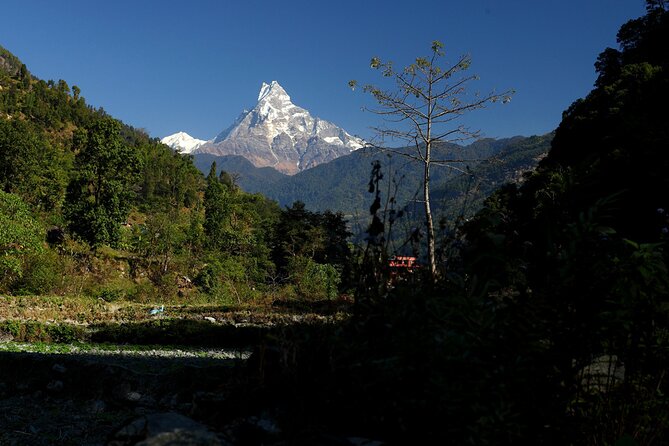
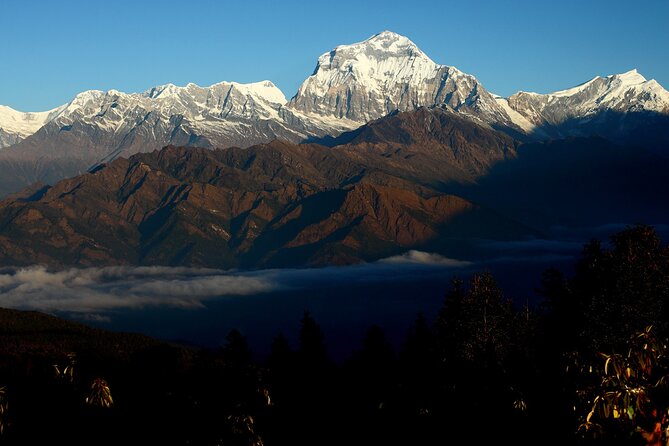
- Poon Hill sunrise at 3,232 meters: Your reward is a mountain panorama including Dhaulagiri, Annapurna I, Annapurna South, Nilgiri, and Tukuche Peak.
- A serious stair climb: The Ulleri section can involve about 3,000 steps at once, so train your legs before arrival.
- A useful Nepal sampler: You see Kathmandu, Pokhara, the Annapurna region, and Chitwan in one carefully connected trip.
- Small group size: The maximum is 14 people, which should make walking support and daily coordination easier.
- Guides who help on the trail: Past departures have been led by guides including Raj, Amrit, Ami, and Saroj, with porters assigned when extra help was needed.
- A $950 package with limits: Accommodation, transport, permits, and many meals are included, but visas, insurance, drinks, tips, porters, and sightseeing admissions are not.
Why this route works for a first Nepal trip
Nepal can be difficult to plan as an independent first visit. Kathmandu traffic, mountain transport, trekking permits, lodge reservations, and the long road connections all take time to sort out. This tour handles the main structure for you, giving you a guide from airport arrival through the final transfer.
The route also has a sensible variety. Kathmandu supplies temples and sacred sites. Pokhara gives you a gentler lakeside base before the trek. The Annapurna foothills provide the physical challenge and mountain scenery. Chitwan changes the mood with jungle activities and village culture.
You should not think of this as a luxury holiday or a relaxed sightseeing trip. It is an active group journey with long road transfers and several walking days. The reward is range. In 12 days, you get a strong first look at Nepal without committing to a high-altitude expedition.
The maximum group size is 14, a useful middle ground. You are not joining a huge coach party, but you also have the social ease and shared support of a group. The guide can help with pacing, and porters may be arranged if you need one, though porter service is not included in the advertised price.
More Jungle Treks in Kathmandu
- Chiang Mai: 2-Day Jungle Trek with Elephant Farm & Raft Ride
★ 4.7 · 881 reviews - 3-Day Ethical Orangutan Jungle Trek | Bukit Lawang, Sumatra
★ 5.0 · 401 reviews - Monkey Business 3 days – 2 nights Jungle trekking (including rafting)
★ 5.0 · 294 reviews
Kathmandu’s temples set the tone
After airport pickup and hotel transfer on Day 1, your first full day visits four major Kathmandu sights. This is an ambitious sightseeing day, but it gives you a good introduction to Nepal’s religious and cultural life.
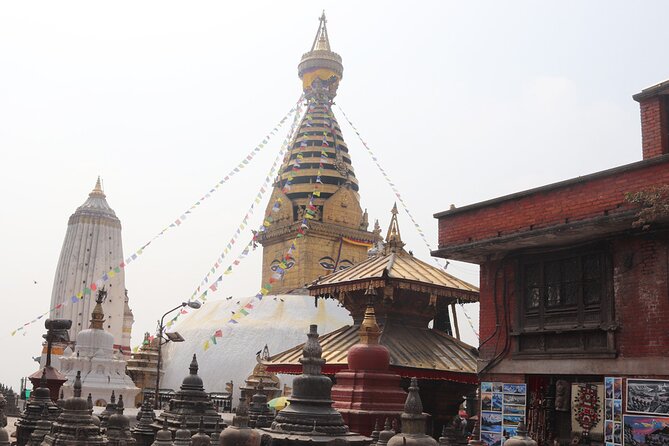
At Swayambhunath, also called the Monkey Temple, you spend about an hour. The site is one of Kathmandu’s best-known hilltop religious complexes. The name hints at the resident monkeys, but the important point is the setting and the mix of Buddhist and Hindu features.
Kathmandu Durbar Square receives about two hours. This is the place to slow down and look at the squares, courtyards, temples, and traditional architecture. The visit is not just a quick photo stop, and the extra time helps you take in the details.
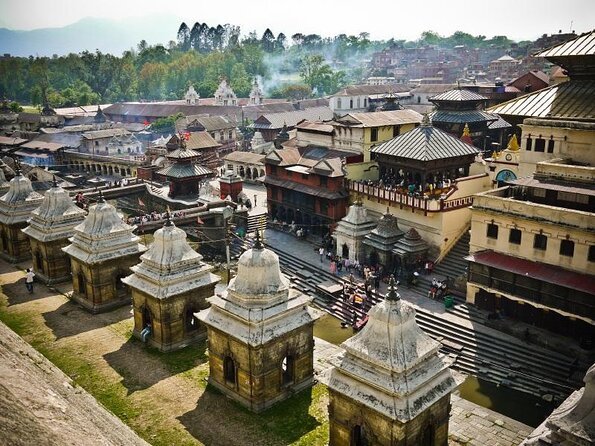
Boudhanath Stupa gets another two hours. Its large Buddhist structure and surrounding religious atmosphere provide a contrast to the older royal square. Pashupatinath Temple completes the day with about an hour at one of Nepal’s most important Hindu sites.
Admission tickets for these Kathmandu sights are not included. The stated extra cost is $25 per person for Swayambhunath Temple and all sightseeing places on Day 2. Bring this into your budget from the start, along with money for drinks and other personal purchases.
The road to Pokhara takes six hours
Day 3 is a long drive from Kathmandu to Pokhara, taking about six hours. The route follows the Trisuli and Marsyangdi rivers, so the journey itself offers changing views of river valleys and rural Nepal.
The drive is included in the tour, as is the tourist-bus transport used for the Kathmandu, Pokhara, Chitwan, and Kathmandu connections. A six-hour road day can feel tiring, especially after a full sightseeing day, but it avoids the need for you to arrange separate transport.
Pokhara is an important reset point before the trek. The city is a base for the Annapurna region and gives you a break from Kathmandu’s dense urban setting. Do not expect a long stay here on the way in. The program moves quickly toward Nayapul and the trail.
Five trail days through the Annapurna foothills
The trek begins on Day 4. After breakfast, you drive about an hour and a half from Pokhara to Nayapul. From there, you walk through Birethanti at 1,065 meters toward Tikhedhunga at 1,577 meters.
This first day covers about six hours. It is your introduction to the rhythm of the trek: breakfast, several hours on foot, a lodge at the end of the day, and simple meals along the route. The walking is not at extreme Himalayan altitude, but you still need sturdy footwear and enough fitness for repeated uphill and downhill sections.
Day 5 is the hard one for many people. You climb steeply for roughly two hours, then continue more gently through Ulleri and Banthanti toward Ghorepani. The route passes villages and offers views toward Machhapuchhre and the Annapurna area.
The stair section deserves respect. One person described the climb as about 3,000 stairs at one shot, and that is the kind of detail you need before signing up. You can be reasonably fit without being an elite hiker, but you should prepare with stairs, hills, or long walks. Your guide may help with pace, and a porter can be assigned if you need extra support, but do not expect the trail to become easy.
Day 5 takes about seven hours. Lodges are basic but clean, according to the available trip feedback. Food is described as plentiful and good, though you should keep expectations practical. This is a mountain trek, not a hotel-based walking holiday.
More safari trips in Kathmandu
- 15 Days Relaxing Nepal Explore Trip with Easy Trek, Tour, National Park Safari
★ 5.0 · 2 reviews - Rovaniemi: Lapland Ski Trekking Safari
★ 4.7 · 224 reviews - Khao Sok: Private Day Trekking, Jungle Dinner & Night Safari
★ 4.7 · 206 reviews - El Calafate: Safari Azul Los Glaciares Trekking Tour
★ 4.8 · 123 reviews
Poon Hill is the trip’s big payoff
Day 6 begins early with the climb to Poon Hill at 3,232 meters. The goal is sunrise, when the mountain peaks may catch the first light. The view includes Dhaulagiri at 8,167 meters, Tukuche Peak, Nilgiri, Varaha Shikhar, Annapurna I at 8,091 meters, and Annapurna South.
Weather controls the show. Clear conditions can produce the dramatic view you came for, while cloud can hide the peaks. The tour can take you to the viewpoint, but no operator can guarantee sunshine.
After Poon Hill, you continue toward Tadapani. This is another roughly seven-hour day, so the sunrise comes with a physical cost. You need to be comfortable walking before breakfast and continuing for hours afterward.
I see this as the right kind of trek for someone who wants a strong Himalayan impression without a long remote expedition. You reach a high viewpoint, pass through mountain villages, and sleep in lodges, but the route remains short enough to fit into a broader Nepal holiday.
Forest trails lead to Ghandruk and Pokhara
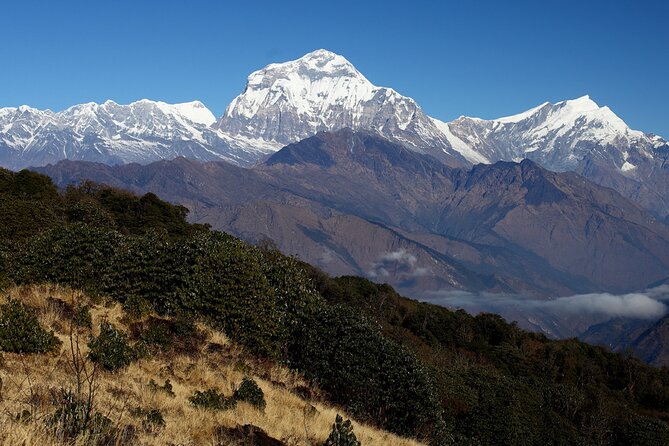
Day 7 takes you toward Ghandruk. The trail descends gently through rhododendron, oak, and other forest, with bird sounds along the way. At around four hours, this is one of the easier walking days and gives your legs some relief after Poon Hill and Tadapani.
Ghandruk is one of the most appealing village stops on the route because the walk is as important as the destination. The forest changes the mood from exposed mountain paths to shaded trails, and the gradual descent feels less punishing than the earlier climb.
Day 8 is your final trek day. You continue downhill through rice fields and local villages to Syauli Bazaar, then return to Pokhara. The walking is described as easy for much of the route, but it still takes about six hours.
That distinction matters. Downhill walking can be gentler on your lungs but harder on knees and ankles. Trekking poles are worth considering, though they are not listed as included. At the end of the day, Pokhara feels like a welcome return to a city base.
Chitwan adds a completely different Nepal
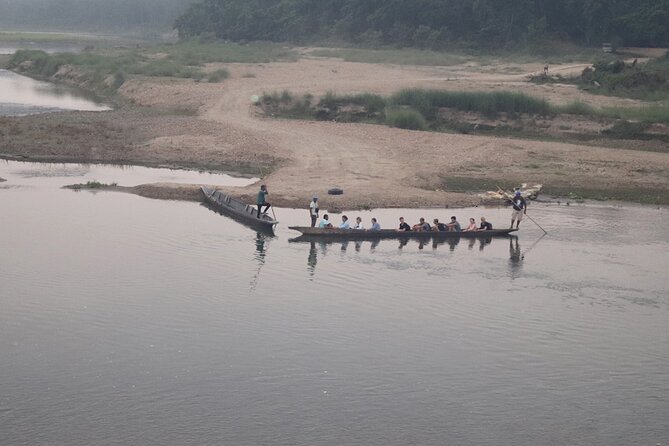
Day 9 brings another long drive, about six hours, from Pokhara to Chitwan National Park. After checking into the jungle lodge, you take part in a Tharu village tour.
This change from mountain trails to lowland jungle is one of the strongest reasons to choose this itinerary. You are not only collecting viewpoints. You are seeing a different part of Nepal, with village life, wildlife activities, and cultural performance.
Day 10 is a full day of jungle activities. The program includes jungle walking, a safari across streams and through the forest, bird watching, and a Tharu cultural stick dance. The day sounds active but varied, so it does not rely on one single wildlife sighting to feel worthwhile.
Wildlife is never guaranteed. The value is in spending time outdoors with a guide, learning the rhythm of the forest, and seeing a part of Nepal that has little connection to the mountain trek. Bird watching is also scheduled again on Day 11 before the drive back to Kathmandu.
The final return to Kathmandu
Day 11 begins with breakfast and a morning bird-watching tour. You then drive back to Kathmandu and check into the hotel. It is another long road day, so do not plan a packed independent schedule for the evening.
Day 12 is the departure day, with the tour arranging airport transfers. The listed starting point is Tribhuvan International Airport in Kathmandu, with a stated start time of 6:15 am. Confirm the exact pickup details with the operator because airport timing is important, especially for an early flight.
The package includes 11 nights of accommodation, airport transfers, a local guide throughout, trekking permits, and the TIMS permit. It also includes 11 breakfasts, seven lunches, and six dinners. The meal plan is not all-inclusive, so check each day’s schedule before assuming lunch or dinner is covered.
Is $950 good value?
At $950 per person, this is a strong value if you want a guided overview rather than a fully independent trip. The price covers nearly two weeks, accommodation, internal road transport, guiding, trekking permits, and a substantial number of meals.
The value becomes clearer when you consider the range of services. You would otherwise need to arrange airport pickup, Kathmandu sightseeing, the bus connections, trek permits, lodge bookings, trail support, and Chitwan transport. Having one company coordinate those moving parts can save time and reduce stress.
Still, $950 is not your final trip cost. Add the Nepal entry visa, travel insurance, the $25 Kathmandu sightseeing charge, drinks, chocolate and other snacks, tips for the guide, porter, and driver, and a trekking porter if you need one. International airfare is also separate.
The accommodation is basic but clean rather than upscale. If you want boutique hotels, private transport, or a quiet custom itinerary, this is not the right package. If you want a practical, active route with a guide and shared transport, the price makes good sense.
Who should choose this Nepal adventure?
I would choose this tour if you have about two weeks and want several sides of Nepal in one trip. It suits you if you like walking, can handle long road transfers, and prefer having a guide manage the daily details.
It is also a good fit if you are not an experienced trekker but are willing to train. Past guides including Raj, Amrit, Ami, and Saroj have helped less confident hikers complete the route, and one slow walker had a porter stay with them throughout the trek. That support is useful, but it does not remove the need for moderate fitness.
You should think twice if you dislike early starts, basic lodges, group schedules, or steep stairways. The trek is often described as manageable, but the route includes long days and real elevation gain.
The tour has a maximum of 14 people, and group discounts are offered. Confirmation is normally provided when you book, subject to availability for bookings made within one day of departure. Cancellation is fully refundable only if made at least three full days before the local start time.
Should you book it?
Book this Nepal adventure if you want Kathmandu culture, a genuine Poon Hill trek, and Chitwan wildlife in one organized package. It delivers variety, useful guide support, and solid value at $950.
Skip it if your idea of a holiday means luxury lodging, private vehicles, or no demanding walks. For the right person, this is a well-balanced first taste of Nepal: active, sometimes tiring, and full of memorable contrasts.
FAQ
How long is the Nepal Adventure Trek with Jungle Safari?
The tour lasts approximately 12 days and includes 11 nights of accommodation.
Where does the tour begin?
The listed meeting point is Tribhuvan Airport in Kathmandu, Nepal. The stated start time is 6:15 am.
What places are included?
The route includes Kathmandu, Pokhara, the Annapurna region, Tikhedhunga, Ghorepani, Poon Hill, Tadapani, Ghandruk, and Chitwan National Park.
How difficult is the trek?
You should have a moderate level of physical fitness. Several walking days last six or seven hours, and the climb near Ulleri can involve about 3,000 stairs.
Is a porter included?
A trekking porter is not included in the price. You can request one if needed, with the additional cost handled separately.
What meals are included?
The package includes 11 breakfasts, seven lunches, and six dinners. Meals not stated in the schedule are not included.
Are Kathmandu sightseeing entrance fees included?
No. The stated additional charge is $25 per person for Swayambhunath Temple and the sightseeing places visited on Day 2.
How many people can join the group?
The maximum group size is 14 people.
What is the cancellation policy?
You can receive a full refund if you cancel at least three full days before the experience start time. Cancellations or changes made less than three full days before the start are not accepted for a refund.
Latest treks added in Kathmandu
- Ghorepani Poonhill Trek★ 5.0 · 5 reviews
- Ghorepani Poon Hill Trek★ 5.0 · 16 reviews
- Private Manaslu Circuit Trek at Himalayas★ 5.0 · 3 reviews
- Upper Mustang Trekking★ 3.0 · 2 reviews
- Amazing 1 Day Trekking Experience in Kathmandu Nepal★ 5.0 · 24 reviews
- Upper Mustang Trekking★ 5.0 · 2 reviews
- Upper Mustang Trek★ 5.0 · 5 reviews
- Upper Mustang Trekking★ 5.0 · 4 reviews
Jungle Treks, compared.
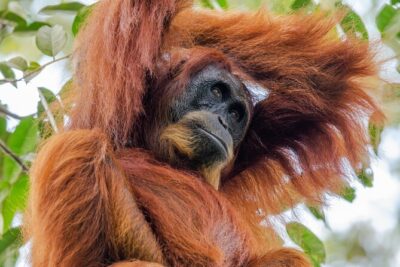
3-Day Ethical Orangutan Jungle Trek | Bukit Lawang, Sumatra
Read our review →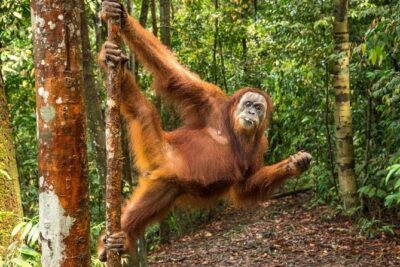
Monkey Business 3 days – 2 nights Jungle trekking (including rafting)
Read our review →
Khao Sok: Private Day Trekking, Jungle Dinner & Night Safari
Read our review →
Big Buddha Jungle Trekking and Temple tour with Lunch
Read our review →
Jungle Adventure-Group Trekking & Bamboo Cooking
Read our review →
ORANGUTAN TREK (2D/1N) by EcoTravel Bukit Lawang
Read our review →Browse the lists this tour appears in