
REVIEW · NEPAL
Private 7 – Day Annapurna Base Camp Trekking
Annapurna Base Camp is the prize here, but the real pleasure is the steady change in scenery: village terraces, bamboo forest, the rushing Modi River, icy mountain country, and finally a great bowl of peaks. I like that this is a private trek, so your guide can adjust the pace and respond to your group rather than march everyone to a fixed rhythm. I also like the practical package: guide, porter, meals, tea-house lodging, permits, transport, and safety equipment are included.
The catch is that seven days makes this a fairly brisk walk. You’ll handle long climbs, steep stone stairs, and several hours on your feet each day. The package suits anyone with moderate fitness, but it is not a gentle mountain holiday, and travel insurance is your responsibility.
Key points to know before you book
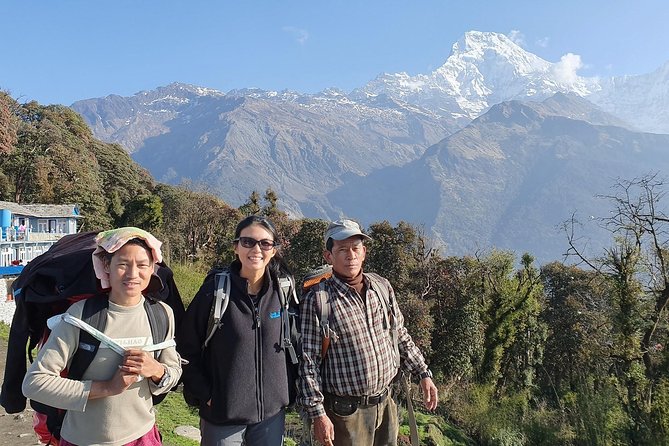
- Private group format: Only your party takes part, with a government-registered guide and porters included.
- Seven days from Pokhara: The trip begins and ends in Lakeside, with road transfers at the start and finish.
- Tea-house trekking: Lodge accommodation, breakfast, lunch, and dinner are provided during the trek.
- A demanding middle section: Expect a 2,500-step descent, steep uphill trails, and walking days of up to eight hours.
- Useful safety support: The package includes oxygen saturation checks, water purification, a trekking map, and emergency evacuation assistance.
- A strong price for an organized trek: At $625 per person, the main costs on the trail are covered, but Pokhara and Kathmandu hotels, insurance, and tips are extra.
Why this seven-day route works
This route follows a direct path from Pokhara toward Annapurna Base Camp, rather than adding side trips or a long acclimatization circuit. That keeps the price and duration manageable, but it also means you need to respect the pace.
You’ll sleep in tea houses along the way. These are simple mountain lodges, and the value is practical rather than luxurious. Your meals and bed are arranged, so you can concentrate on walking, resting, and taking in the mountains instead of sorting out each night’s logistics.
The private setup matters most when your group has different walking speeds or wants to make small changes. The operator has adjusted plans for some groups, and the supplied experiences include trips led by guides named Sanjay, Amar, Laxman, Ram, Kumar, Min, and others. Your own guide may be different, but the repeated strength of this arrangement is personal support and flexibility.
You meet at 8:15 a.m. in Pokhara Lakeside at 6X84+3JQ, Lakeside Road. The experience ends back at the same meeting point. Pickup is offered, and the initial and final road transfers are part of the organized transport.
More Annapurna Treks in Pokhara
- Trekking in Annapurna/Langtang/Everest/Upper Mustang regions
★ 5.0 · 161 reviews - Kathmandu/Pokhara: 5-Day Annapurna Base Camp (ABC) Trek
★ 4.9 · 72 reviews - Annapurna Panorama trek
★ 5.0 · 71 reviews
Day 1: Breakfast views and the road to Chhomrong
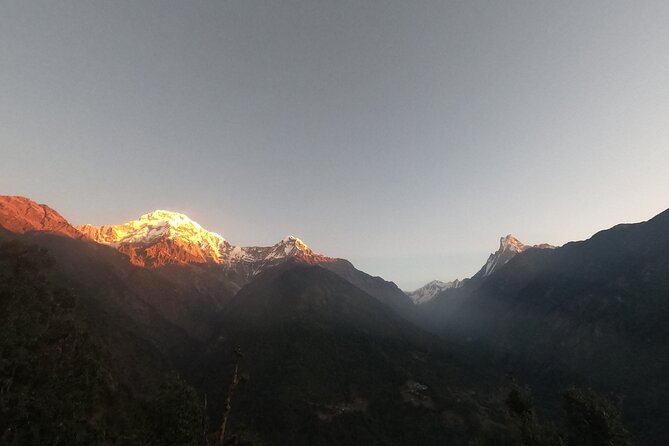
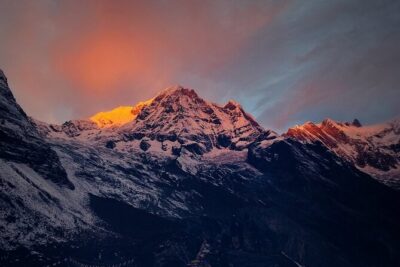
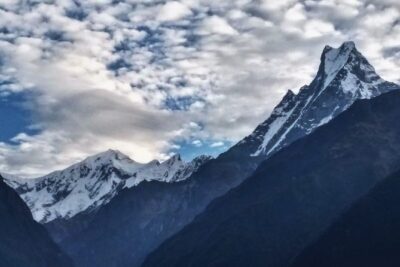
The first day begins with breakfast overlooking Annapurna I, at 8,091 meters, and Machhapuchhre, at 6,997 meters. That is a fine way to start, especially if the summits are clear. You then pack up and take a jeep for roughly two and a half hours toward Chhomrong.
The listed walking time is about three hours, so this opening day is shorter than the days ahead. That is useful because it gives you time to settle into the group, meet your guide, and make sure your gear is arranged properly.
Chhomrong is an important gateway village for the Annapurna Base Camp route. The day is not mainly about covering huge distances. It is about getting from Pokhara into the mountain corridor and beginning the trek without using up all your energy at once.
Your road transfer also deserves a practical note. Mountain roads can take time, and a two-and-a-half-hour jeep journey may feel longer depending on conditions. Keep water and a few personal items close at hand rather than buried in your duffle bag.
Day 2: Stone stairs, Sinuwa, and Bamboo
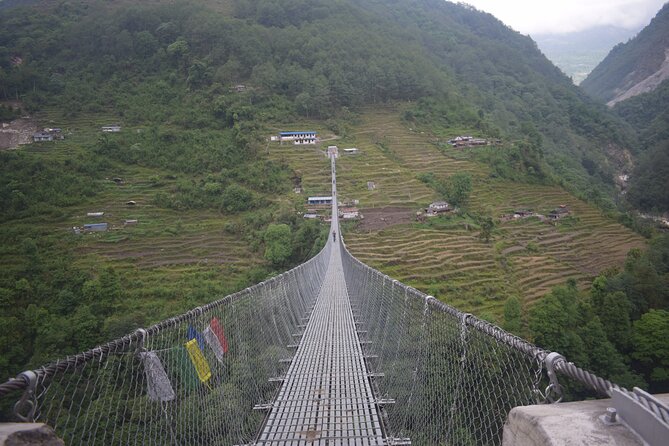
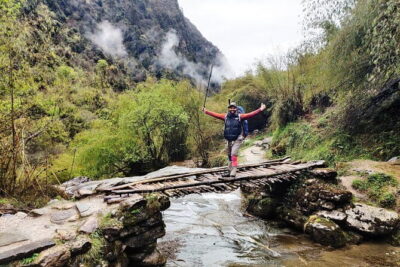
Day two is where the route begins to show its teeth. You descend 2,500 stone steps from Chhomrong and cross the bridge over Chhomrong Khola. After that, the trail climbs toward Sinuwa, where you stop for lunch, then continues to Bamboo for the night.
The pattern is classic Annapurna trekking: down first, up later. It can feel counterintuitive when you know you are heading higher overall, but the valley route requires repeated climbs and descents.
The six-hour walking time is manageable for a fit walker, but the stairs can be tiring on knees and thighs. Use the downhill section to settle into a steady rhythm. Trekking poles could be useful, though they are not listed as part of the included equipment.
Bamboo gives you a forested stop after a demanding day. The route is not yet all snow and open peaks. You’ll spend much of this section among trees, with the trail’s changing grade providing the main challenge.
Day 3: From Bamboo to Deurali through the Weeping Wall
After breakfast, you leave Bamboo and climb toward Himalaya Hotel, passing Dovan on the way. The route follows the upper Modi River corridor and includes the Weeping Wall, a local shrine, and a trail that continues toward Deurali.
The walking time is about five hours. That may look easier than day two, but altitude and uphill travel can make a shorter day feel serious. You are moving into higher country, so a slow, regular pace is more useful than trying to finish quickly.
The Weeping Wall is one of the memorable route features because it gives the day a clear character. You also pass a local shrine, a reminder that this is not simply a mountain workout. The route links villages, religious places, forests, and working trails used by the local community.
Deurali is the final overnight stop before Base Camp. The practical goal is to arrive with enough energy for the next morning. Your guide should help you judge the pace, and the included oxygen saturation checks provide an extra way to monitor how your body is responding.
Another trail to compare in Pokhara:
- Poon hill Trek 3 days
★ 5.0 · 176 reviews - Pokhara: 4-Day Ghorepani, Poonhill & Ghandruk Mountain Trek
★ 5.0 · 132 reviews - Ghorepani – Poon Hill Trek 3N-4D
★ 5.0 · 125 reviews - From Pokhara: 3-Day Ghorepani Poon Hill Trek with Guide
★ 4.9 · 68 reviews
Day 4: Following the Modi River to Annapurna Base Camp
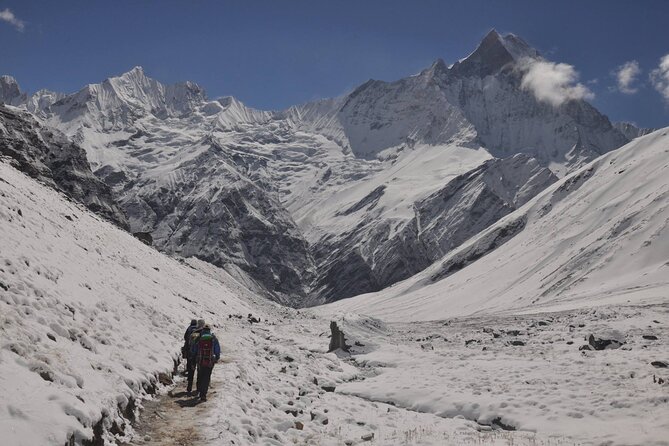
From Deurali, the trail climbs alongside the Modi River and passes through alpine forest. You’ll see neatly stacked rocks, an icy cave, and the mountain surroundings becoming more open and severe as you approach Machhapuchhre Base Camp and then Annapurna Base Camp.
The listed walking time is about five hours. The distance may not sound extreme, but this is the day when altitude and uphill effort matter most. The description calls the climb arduous, and you should take that seriously.
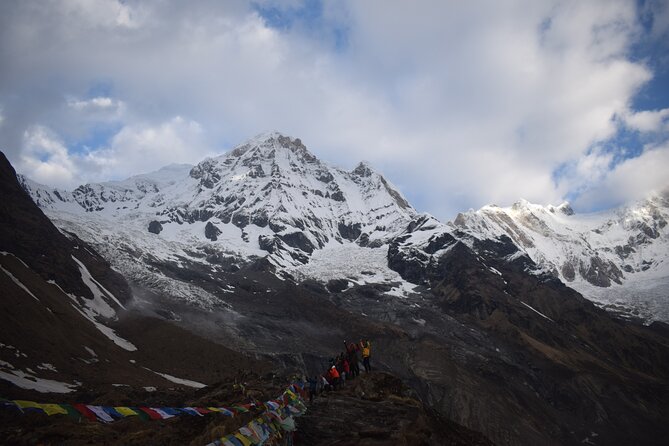
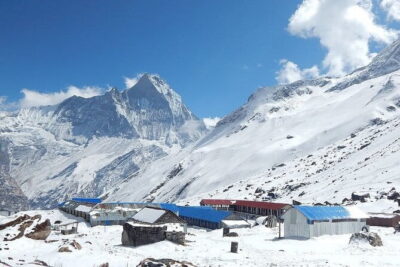
Arriving at Annapurna Base Camp is the central moment of the trip. The setting is surrounded by the Annapurna massif, with the high walls and summits giving the stop its dramatic scale. If conditions are clear, you can expect broad mountain views rather than the village-and-forest scenes of the lower route.
This is also the point where good preparation pays off. Keep warm layers accessible, drink regularly, and let your guide know if you feel unwell. The package includes emergency rescue assistance, but that is support for a serious situation, not a substitute for travel insurance. You should arrange insurance before leaving home and check that it covers trekking and emergency evacuation.
Day 5: The big Base Camp day
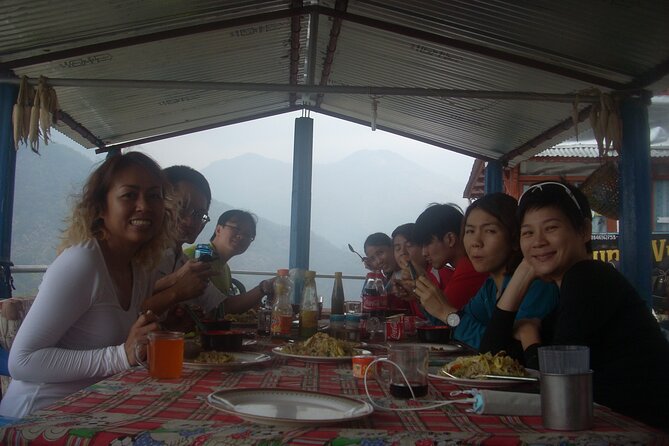
Day five begins with time to explore Annapurna Base Camp. The high-altitude setting offers a 360-degree view of the surrounding mountains, making this the most visual day of the trek.
The total walking time is listed as eight hours, so you should not think of Base Camp as a quick photo stop. You’ll have time to take in the views, but you also need to descend and continue through the route. The long day combines sightseeing with a serious amount of walking.
I like this structure because the goal is not treated as a rushed finish. You get a proper morning in the mountain amphitheater, then begin the return journey. The tradeoff is fatigue. By this stage, your legs have already handled several steep sections, and the return can feel just as demanding as the ascent.
Keep your camera and small personal items handy, but do not overload yourself. Porters carry the main duffle bags, while you’ll want a light daypack for water, warm clothing, snacks, and essentials.
Day 6: Forest trails and the Jhinu Danda hot spring
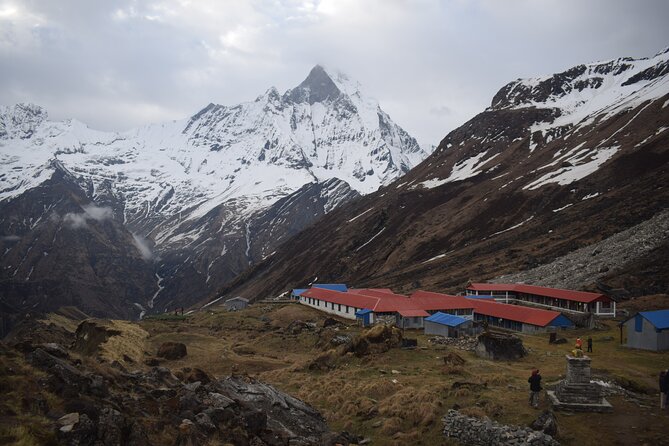
The route continues back through the Annapurna region, with the day ending at Jhinu Danda and its hot spring. The trail passes through lush bamboo forest, follows a narrow ridge toward Sinuwa, and then descends toward Chhomrong River.
The walking time is about six hours. After the long Base Camp day, this is still a full day on foot, but the hot spring gives it a welcome reward. It is a good example of how the route mixes mountain scenery with ordinary pleasures. You are not only chasing a high-altitude viewpoint; you also get a chance to relax in warm water after several days of walking.
The narrow ridge and repeated up-and-down movement require attention. Do not let the promise of the hot spring tempt you into rushing. A private group can usually find a comfortable pace, and that is one of the strongest reasons to choose this format.
Day 7: Breakfast, Samrung, and the return to Pokhara
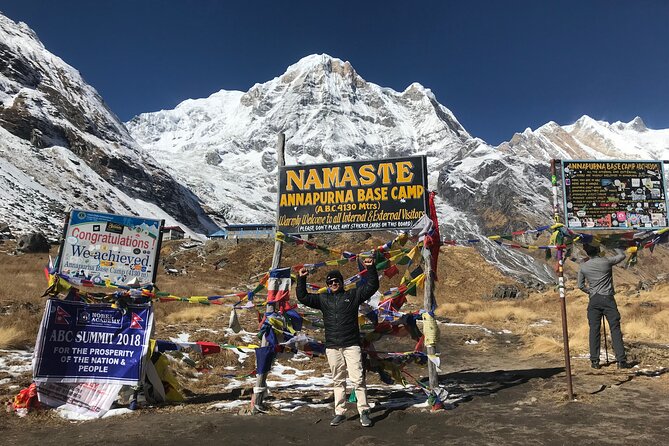
The final day starts with breakfast and another chance to look toward Annapurna I and Machhapuchhre. You then walk a short section to Samrung before taking a private jeep along the Baglung route back to Pokhara.
The listed walking time is about three hours, making this a gentle finish compared with the previous days. The road journey is the main transfer of the day, and the experience ends back at the Lakeside meeting point.
This final morning is useful because it gives you one last mountain view before returning to city comforts. Do not plan an important flight immediately after arrival unless you allow plenty of extra time. The provided details do not promise a fixed return hour, and mountain road transport can be slower than expected.
What the $625 price really covers
At $625 per person, this is a strong value if you want an organized private trek and do not want to arrange every trail detail yourself. The price includes a government-registered trekking guide, porters and their expenses, lodge accommodation, necessary permits, ACAP fees, transport described in the schedule, and government tax and service charges.
Food is also covered on the trail: seven breakfasts, six lunches, and six dinners. That removes one of the regular costs and decisions of a multi-day trek.
The package includes a trekking map, oxygen saturation checks, a duffle bag, and water purification. Emergency rescue evacuation assistance and public liability insurance are also included. Those details add practical value, particularly for a route where altitude and changing conditions deserve respect.
You still need to budget for hotel accommodation in Kathmandu and Pokhara, travel insurance, and tips for your guide and porter. The package does not include every personal expense, so the headline price should not be treated as your complete Nepal budget.
The guide and porter make the difference
A private trek is only as good as the people managing it. The operator has used guides including Sanjay, Amar, Laxman, Ram, Kumar, Min, and female guides such as Ritika and Andrea on different trips. That gives you a sense of the available team, but you should confirm your assigned guide before departure.
The strongest pattern in the service is attention to individual needs. Guides have helped groups change plans, supported walkers through difficult sections, and arranged assistance when needed. One group specifically completed a custom seven-day version after first considering six days, which shows that the basic plan may not be rigid.
Your porter is not just extra muscle. Porters carry the larger load, allowing you to walk with a lighter daypack. You should still pack thoughtfully and keep important personal items with you.
Who should book this trek?
I would choose this trek if you want Annapurna Base Camp in a compact seven-day package, prefer a private group, and value having meals, beds, permits, transport, and staff arranged together.
It is especially suitable for:
- Couples or friends who want to set their own walking rhythm
- First-time Nepal trekkers who want local support
- People with moderate fitness who can manage several hours of walking daily
- Visitors who want mountain scenery and village life without organizing each lodge and transfer
- Groups that may need small changes to the plan
I would think twice if you want a relaxed holiday with short walks, private rooms, or hotel-style comfort. Tea houses are practical mountain lodging, and the route includes steep stairs, long uphill sections, and an eight-hour day.
Booking details and cancellation
Confirmation is provided at booking, and the activity is near public transportation. The start time is 8:15 a.m., and pickup is offered from the Pokhara area.
You can cancel up to 24 hours before the local start time for a full refund. Changes made less than 24 hours before departure are not accepted, and cancellations inside that window are not refunded. Poor weather can also affect the trip. If the operator cancels for that reason, you are offered another date or a full refund.
Should you book the Annapurna Base Camp trek?
Book it if your main goal is to reach Annapurna Base Camp with a private guide, a porter, and most trail costs handled for you. The $625 price is attractive because it includes the parts that are easy to underestimate: food, lodging, permits, transport, staff expenses, and basic safety support.
Go in with clear expectations. This is a demanding mountain walk, not a sightseeing tour with occasional strolls. If you train for long uphill days, arrange proper insurance, keep your pack light, and accept simple lodging, you get a focused route with excellent variety and a well-supported finish at one of Nepal’s great mountain destinations.
FAQ
Where does the Annapurna Base Camp trek start?
The trek starts at the Pokhara Lakeside meeting point at 6X84+3JQ, Lakeside Road, Pokhara 33700, Nepal. The scheduled start time is 8:15 a.m.
Where does the trek end?
The activity ends back at the Pokhara Lakeside meeting point after the return from Samrung by private jeep.
Is this a private trek?
Yes. Only your group takes part in the activity, and the guide can work with your party rather than combining you with a larger public group.
Are a guide and porter included?
Yes. The package includes one government-registered trekking guide and porters, along with their expenses.
Are meals and accommodation included?
Yes. Lodge accommodation is included during the trek, along with seven breakfasts, six lunches, and six dinners. Hotels in Kathmandu and Pokhara are not included.
What permits are included?
The package includes ACAP and necessary permits, as well as government tax and service charges.
How fit do I need to be?
You should have a moderate level of physical fitness. The route includes 2,500 stone steps, steep uphill and downhill sections, and walking days ranging from about three to eight hours.
Is travel insurance included?
No. You must arrange your own travel insurance before the trek. The package includes assistance for emergency rescue evacuation, but that does not replace personal travel insurance.
What happens if bad weather cancels the trek?
If poor weather causes the operator to cancel the experience, you can choose a different date or receive a full refund.
Can I cancel for a full refund?
Yes. You must cancel at least 24 hours before the local start time to receive a full refund. Cancellations or changes made less than 24 hours before departure are not accepted.
Latest treks added in Pokhara
- Pokhara: Majestic Mardi Base Camp Guided Trek with HotSpring★ 5.0 · 6 reviews
- Pokhara: 9-Day Annapurna Base Camp Trek with Poon Hill★ 5.0 · 6 reviews
- Pokhara: 5-Day Ghorepani and Poon Hill Private Trek★ 5.0 · 4 reviews
- Pokhara: 5-Day Trek to Annapurna Base Camp and Hot Springs★ 5.0 · 4 reviews
- Pokhara: 7-Day Annapurna Base Camp Trek & Hot Spring★ 4.0 · 3 reviews
- Pokhara:4-Day Ghorepani Poon Hill Guided Trek via Ghandruk★ 5.0 · 3 reviews
- Pokhara: 4-Day Poon Hill and Ghandruk Guided Trek★ 5.0 · 14 reviews
- Pokhara: 4-Day Beautiful Ghorepani Poon Hill & Ghandruk Trek★ 4.8 · 21 reviews
Annapurna Base Camp Treks, compared.
Trekking in Annapurna/Langtang/Everest/Upper Mustang regions
Read our review →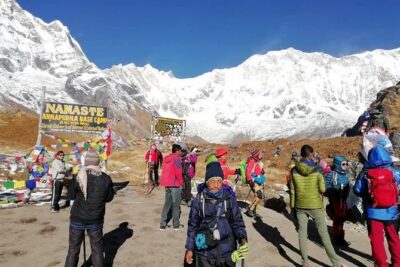
Kathmandu to Annapurna Base Camp (ABC) 5-Day Trek
Read our review →Browse the lists this tour appears in